Clear Sky Science · en
Bi-level graph attention paradigm with differential strategy integration for heterogeneous multi-agent reinforcement learning
Why many AIs need to learn to cooperate
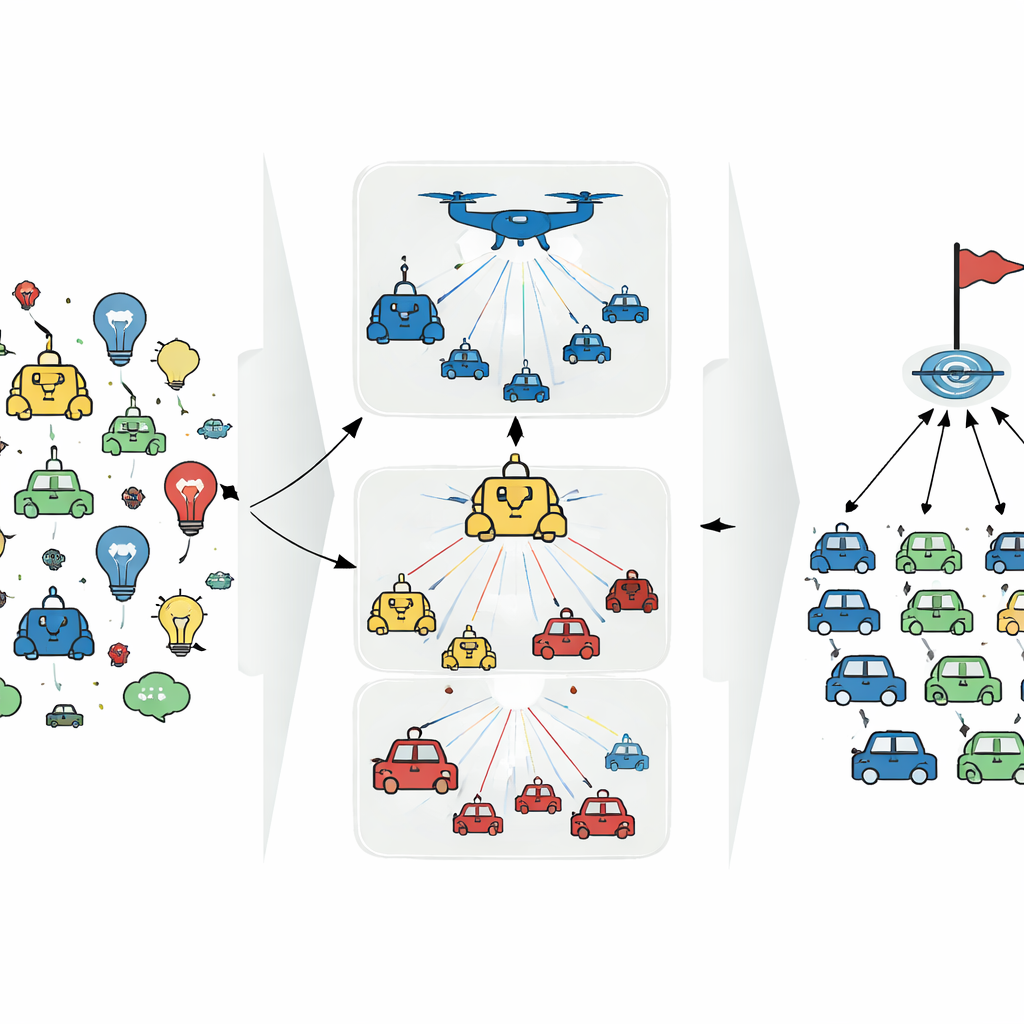
From robot teams and self-driving cars to swarms of drones and virtual players in strategy games, many modern systems rely on large numbers of artificial agents working together. But getting these digital teammates to coordinate is harder than it sounds, especially when each has different abilities and only a partial view of what is going on. This paper introduces a new way to organize such teams so they can share just the right information, make better group decisions, and scale to much larger and more varied problems than before.
Groups, guides, and everyday teamwork
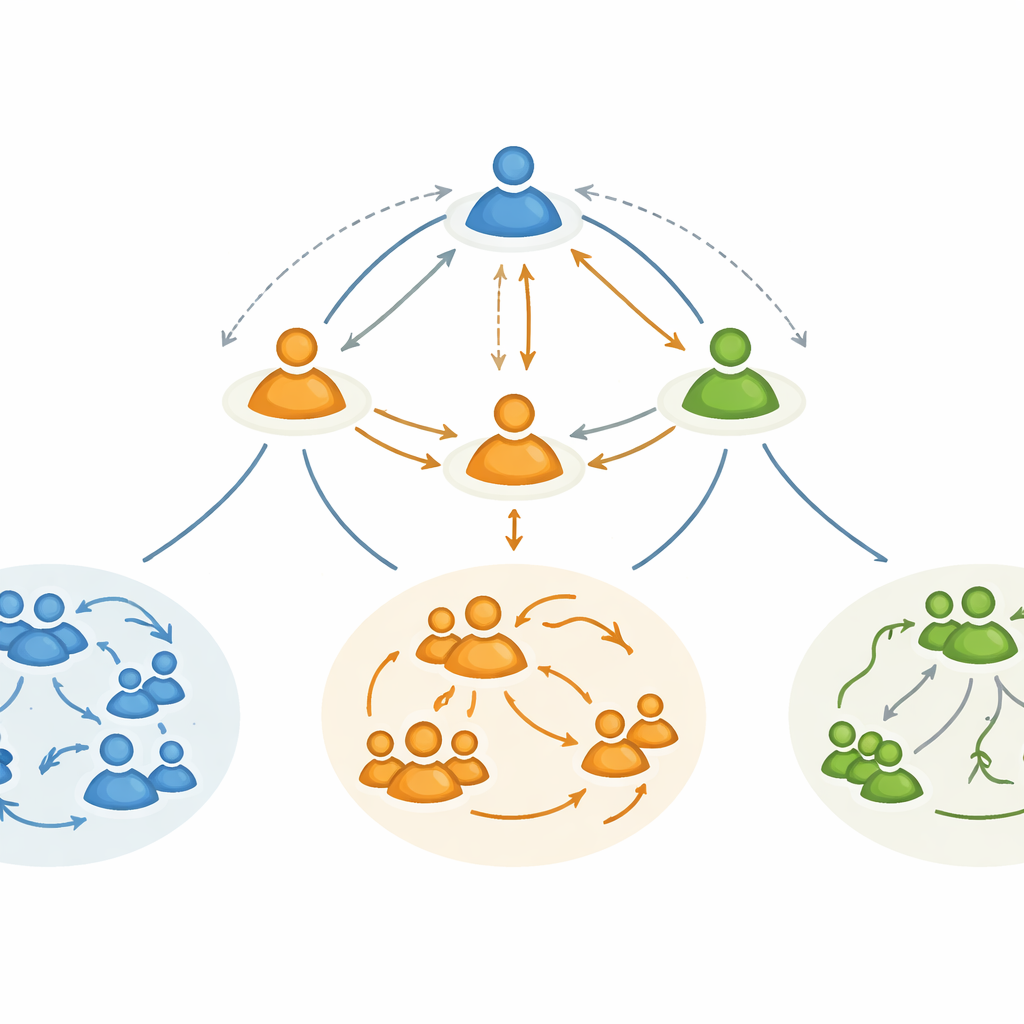
The authors start from a simple idea that mirrors how people and animals cooperate: divide the team into roles and groups. In an office project, members from marketing, engineering, and finance each bring their own skills, and a manager in each group coordinates local choices while talking with other managers. Inspired by this, the proposed method, called the Bi-level Graph Attention Paradigm (Bi-GAP), clusters artificial agents by type. Within each group, several "member" agents actually act in the environment, while a virtual "guide" agent gathers a broader view and offers strategic direction without directly taking actions itself.
Smart conversations inside and across groups
Bi-GAP’s core innovation lies in how these agents communicate. Rather than letting every agent talk to every other—which quickly becomes overwhelming as team size grows—the method uses a two-layer attention mechanism, implemented on a graph. At the first layer, member agents of the same type share information selectively, focusing on the teammates most relevant to their current situation. The guide agent for that group listens to all its members, weighing their inputs to form an informed summary. At the second layer, only the guide agents from different groups talk to one another, again using attention to focus on the most important partners. This two-step structure reduces message overload, filters out noise, and makes the overall system more robust to missing or misleading information.
Blending big-picture advice with local instincts
Good coordination needs more than communication; it also needs a way to fuse different viewpoints into a single decision. Bi-GAP tackles this by giving each acting agent two sources of guidance: its own local reasoning and the advice generated by its guide agent. Instead of treating these equally all the time, the method compares the two suggested strategies. When they mostly agree, the member agent relies more on its own detailed view, preserving fine-grained reactions. When they diverge strongly, the guide’s broader perspective is given more weight, nudging the agent toward a course of action that better fits the group’s overall plan. This adaptive blending helps balance quick, local responses with stable, team-level coordination.
Testing in virtual battles and pursuit games
To see whether Bi-GAP offers real benefits, the researchers evaluated it in two demanding testbeds. The first is a combat simulator built on the real-time strategy game StarCraft II, where mixed squads of units must coordinate movement and attacks against a strong built-in opponent. The second is a predator–prey environment, where faster and slower agents with different capabilities chase or evade one another in continuous motion. Across both settings, and under both full and partial visibility, the new method was compared to several leading multi-agent reinforcement learning techniques. Bi-GAP not only achieved higher win rates and rewards, but also learned effective behaviors faster and remained stable even as the number of agents and their diversity increased.
What this means for future AI teamwork
In plain terms, the study shows that giving large, mixed teams of AI agents a light but well-structured hierarchy can make them far better collaborators. By grouping similar agents, letting guide agents coordinate across groups, and blending global advice with local judgment, Bi-GAP manages complex tasks more efficiently than earlier approaches that were either too centralized or too fragmented. As multi-agent systems become more common in robotics, traffic control, virtual games, and other real-world applications, such communication and decision schemes could help ensure that growing digital crowds act less like a confused mob and more like a well-drilled team.
Citation: Li, Y., Zhang, Z. & Wang, J. Bi-level graph attention paradigm with differential strategy integration for heterogeneous multi-agent reinforcement learning. Sci Rep 16, 12156 (2026). https://doi.org/10.1038/s41598-026-41722-w
Keywords: multi-agent reinforcement learning, heterogeneous agents, graph attention, coordination, hierarchical control