Clear Sky Science · en
The impact of land use types on soil physicochemical properties in Dandi District, Ethiopia
Why the Ground Beneath Our Feet Matters
In Ethiopia’s highland farms, the future of food and clean water is being decided just a few inches below the surface. This study looks at how turning forests into crop fields and grazing land changes the very soil that farmers depend on. By comparing neighboring forest, cultivated, and grazing areas in one district, the researchers show how everyday land use choices can quietly weaken the ground, draining it of the nutrients and structure it needs to support both people and nature.
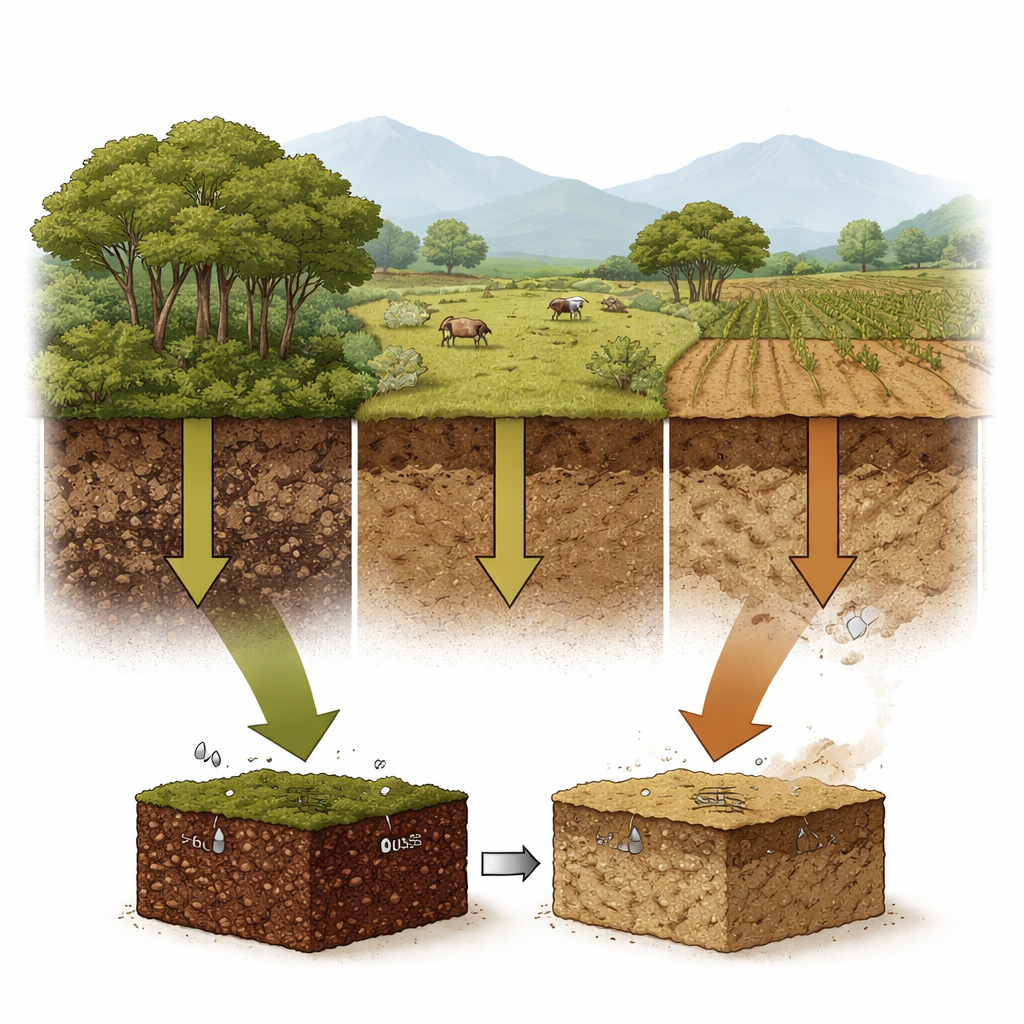
Three Neighboring Patches, Three Different Stories
The research took place in Dandi District, a mountainous area where forest once covered much more of the landscape. Today, most of the land is used for crops or livestock. The scientists focused on one local community, Boda Basaka kebele, and chose three main land types that sit side by side on upper, middle, and lower slopes: untouched forest, cultivated fields, and grazing land. From each combination of slope and land type, they collected topsoil samples from the upper 30 centimeters—the layer where roots, nutrients, and living organisms are most active. This careful design allowed them to separate the influence of land use from that of slope and elevation.
What They Measured in the Soil
Back in the laboratory, the team tested how the soil behaves physically and what it contains chemically. They examined texture (sand, silt, and clay), how tightly soil particles are packed (bulk density), and how much water the soil holds. They also measured acidity (pH), how easily water conducts electricity (a sign of dissolved salts), and key ingredients for plant growth such as organic carbon, total nitrogen, available phosphorus, and a suite of positively charged nutrients like calcium, magnesium, potassium, and sodium. Finally, they looked at the soil’s capacity to hold and exchange these nutrients, a property known as cation exchange capacity, which is strongly linked to organic matter.
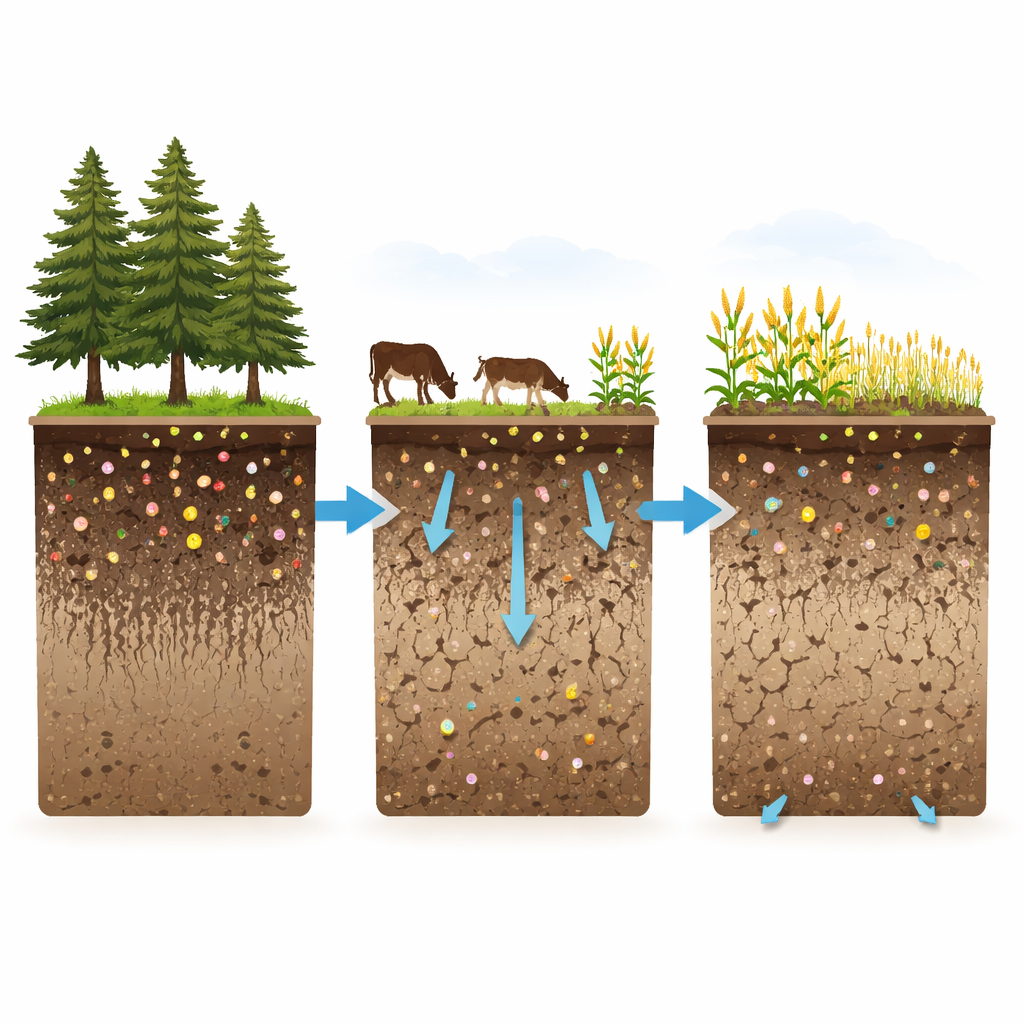
Forest Soils as Quiet Reservoirs of Fertility
The contrast between forest and farmed land was stark. Forest soil had the softest structure, with the lowest bulk density, meaning it was looser and more porous. It also held the most organic matter and carbon, and it contained more nitrogen and a higher nutrient-holding capacity than the other land types. Its pH hovered in a gentle, near-neutral range that suits many crops, and available phosphorus was relatively high. In effect, the forest floor acts as a natural sponge and pantry: falling leaves and roots feed the soil, while a protective canopy shields it from pounding rain and scorching sun, helping to build and conserve fertility over time.
Farms and Pastures on a Downward Slide
Cultivated land showed the greatest signs of stress. Here, the soil was more compacted, making it harder for roots and water to move through. Organic matter and carbon dropped sharply, total nitrogen was lowest, and the soil became more acidic. Even though farmers commonly apply fertilizers, the available phosphorus remained modest—likely because in these acidic conditions, phosphorus binds tightly to minerals instead of staying accessible to crops. Grazing land fell in between forest and cropland: it kept slightly better structure than fields but still lost significant organic matter and nutrients, in part due to trampling and removal of grass cover. Interestingly, differences in slope mattered less than how the land was used, suggesting that human management now outweighs natural topographic effects in shaping soil quality.
Turning Findings into Practical Action
By combining all of the measurements, the researchers showed that soil health in Dandi District is driven mainly by organic matter and related nutrients, which in turn are strongly controlled by land use. Their results point toward practical responses: protecting remaining forests, weaving trees into crop fields through agroforestry, rotating livestock to avoid constant trampling, adding manure and compost to rebuild organic matter, and using soil tests to guide smarter fertilizer use, especially for hard-to-manage phosphorus. For non-specialists, the message is simple but powerful: when forests are cleared and land is pushed too hard without giving anything back, the soil gradually becomes thinner, harder, and poorer. If communities invest in practices that feed the soil—rather than just take from it—they can slow or reverse this decline, safeguarding food production and ecosystem resilience in Ethiopia’s highlands.
Citation: Tesema, D., Fituma, K. & Mammo, S. The impact of land use types on soil physicochemical properties in Dandi District, Ethiopia. Sci Rep 16, 13204 (2026). https://doi.org/10.1038/s41598-026-41618-9
Keywords: soil health, land use change, Ethiopian highlands, forest conservation, sustainable farming