Clear Sky Science · en
Comparative greenness assessment for the simultaneous estimation of diclofenac and methocarbamol in their tablets applying synchronous fluorimetry
Why this pain pill study matters
Many people with back pain or muscle spasms are prescribed combination tablets that pair a painkiller with a muscle relaxant. This study looks at a smarter, cleaner way to check the quality of one such tablet containing diclofenac, a common anti-inflammatory drug, and methocarbamol, a muscle relaxant. The researchers developed a laboratory test that is fast, very sensitive, and more environmentally friendly than many current methods used by quality-control labs.

Two medicines in one tablet
Diclofenac is widely used to ease pain and inflammation in conditions such as arthritis. Methocarbamol helps relax muscles and is prescribed for painful spasms, for example after spine problems. When combined in a single tablet, these drugs need to be present in the right amounts to be both safe and effective. Drug companies and regulators therefore rely on precise tests to measure how much of each compound is actually inside finished tablets. Existing techniques such as high-performance liquid chromatography (HPLC) can do this reliably, but they require expensive equipment, skilled operators, and large volumes of organic solvents that create chemical waste.
A new way to read drug “glow”
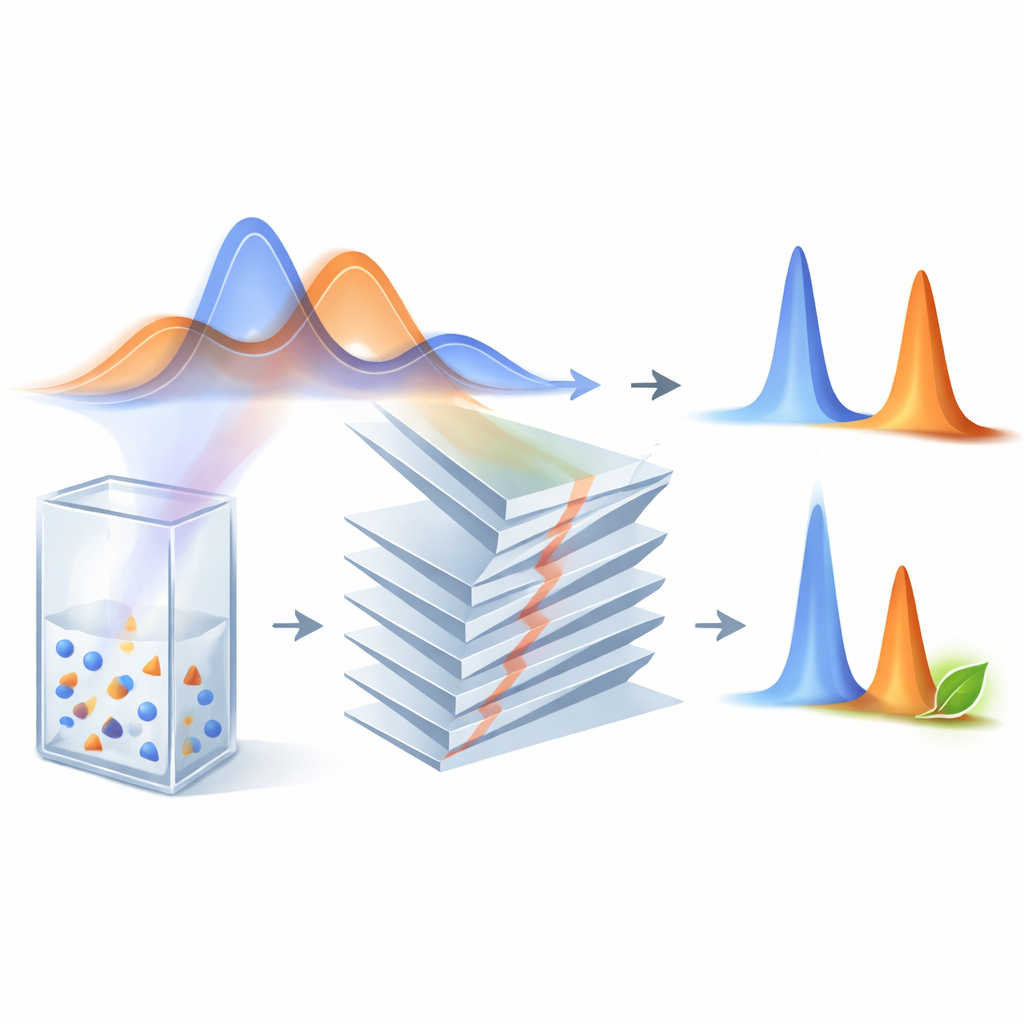
The authors turned to fluorescence, the faint light that some molecules emit after absorbing energy. Measuring this glow can be extremely sensitive and usually needs little sample preparation. However, diclofenac and methocarbamol emit light in similar regions of the spectrum, so their signals overlap and are hard to separate with simple fluorescence measurements. To solve this, the team used a more advanced approach called synchronous fluorimetry combined with mathematical processing of the signal. In practice, they scan the light going in and coming out of the sample together with a fixed spacing between them, then take the first derivative of the resulting curve. This sharpening step turns broad, overlapping signals into narrower peaks that can be distinguished from each other.
Tuning the test for clarity and sensitivity
The researchers carefully adjusted several experimental conditions to get the clearest separation between the two drugs. They tested different spacing values between the scanned wavelengths and found that a particular setting gave the best balance of peak sharpness and intensity. They also compared several solvents and discovered that using pure water as the main diluting liquid produced the strongest, cleanest signals—an added bonus for safety and sustainability. A mild phosphate buffer at neutral pH further improved the brightness of the glow. Under these optimized conditions, the test could detect diclofenac and methocarbamol at extremely low levels, well below the typical amounts found in tablets, and the measured signal rose in a straight-line fashion with increasing concentration.
Testing real tablets and checking reliability
To show that their method works outside the ideal conditions of pure solutions, the team analyzed mixtures that mimicked real tablet compositions with different ratios of diclofenac to methocarbamol. They also tested a marketed product, Methoquick tablets. In all cases, the measured contents closely matched the expected values. The results agreed statistically with those from a published HPLC method, meaning the new test is just as accurate and precise. Repeated measurements on different days showed only small variations, and minor deliberate tweaks to the buffer volume did not disturb the outcome, demonstrating that the procedure is robust and practical for routine use.
A greener path for medicine testing
Beyond performance, the authors evaluated how environmentally friendly their method is using several modern rating tools that score factors such as solvent use, energy demand, and waste generation. Because the new test relies mainly on water, small sample volumes, and a light-based instrument that consumes modest energy, it earned higher “green” scores than the comparison chromatographic method. In simple terms, the study shows that quality control laboratories can monitor combination pain-and-spasm tablets with a technique that is not only fast and highly sensitive but also kinder to workers and the environment.
Citation: Attia, M., Hadad, G.M., Salam, R.A.A. et al. Comparative greenness assessment for the simultaneous estimation of diclofenac and methocarbamol in their tablets applying synchronous fluorimetry. Sci Rep 16, 9666 (2026). https://doi.org/10.1038/s41598-026-41615-y
Keywords: diclofenac, methocarbamol, fluorescence analysis, green analytical chemistry, tablet quality control