Clear Sky Science · en
Lack of group-to-individual generalizability in pseudocontingencies
Why our food beliefs can be misleading
Many people feel that the tastiest foods are the least healthy ones, even though plenty of dishes are both nutritious and delicious. This article explores why such stubborn beliefs arise and, crucially, why different people may rely on these shortcuts to very different degrees. By looking under the hood of how we learn from everyday experiences with food, the authors show that a simple mental rule can shape our views of the world—and that averaging across people can hide how diverse our thinking really is.
How we guess links without seeing them directly
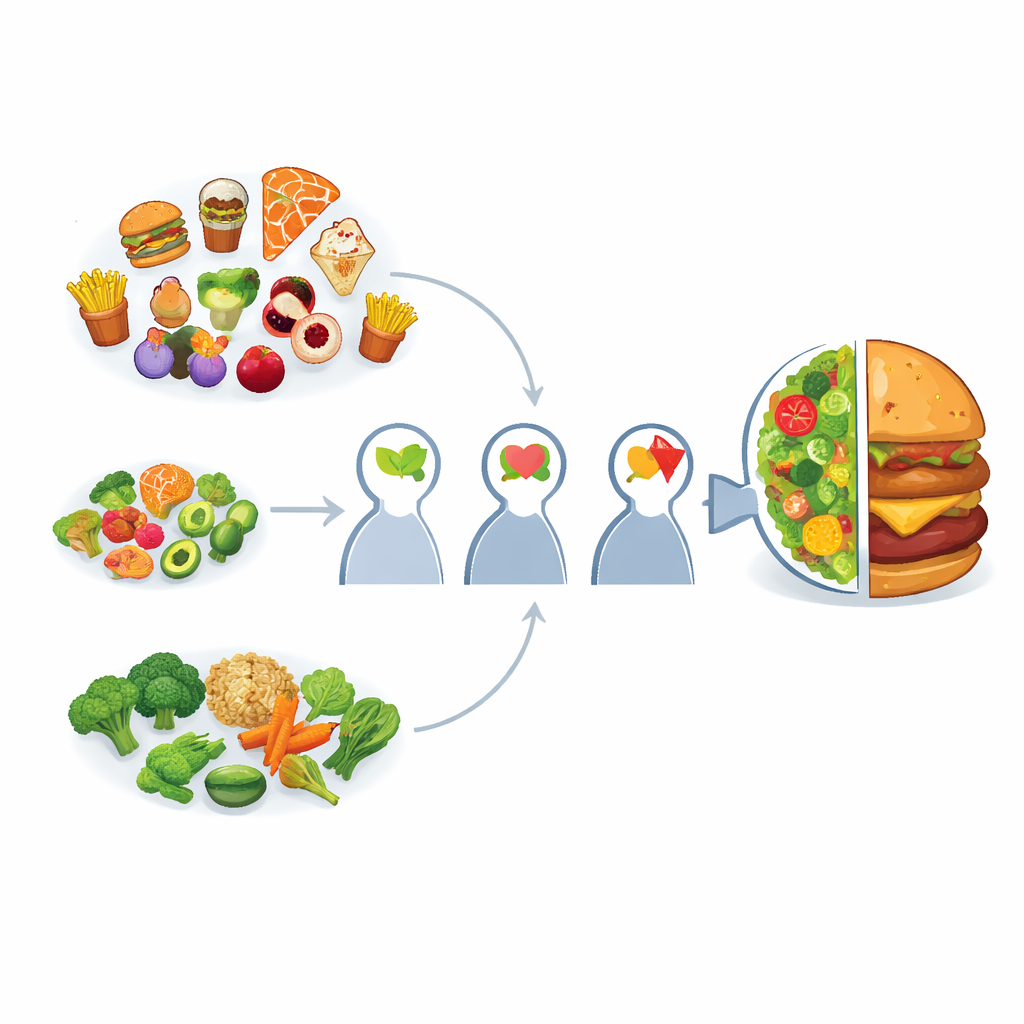
Humans constantly infer relationships: dark clouds mean rain, high publication counts mean academic success, and, for many, unhealthy foods mean better taste. Often, we do not track how often things truly occur together; instead, we rely on how common each thing is on its own. The authors focus on this shortcut, called pseudocontingency inference: people look at the separate frequencies of “healthy” and “tasty” foods in their surroundings and treat those base rates as if they directly revealed a link between health and taste. This strategy can be efficient when information is scarce but can easily produce illusions when the environment is skewed—for example, when there are many unhealthy yet tempting foods on offer.
A computer model of learning from food environments
To study this process, the researchers built an agent-based computer model in which simulated individuals encounter foods one by one in different environments. For each food, an agent notes whether it is healthy and whether it is tasty. From these experiences, the agent can calculate two kinds of information: the true pairing between health and taste (how often they co-occur) and the base rates (how often each appears overall). The model assumes that each agent blends these two sources into a single belief, controlled by a bias strength parameter. At one extreme, beliefs follow only the true pairings; at the other, they follow only the base rates. As the agents see more foods, they steadily update their beliefs, mimicking how people might gradually form impressions about the health–taste link.
People rely on shortcuts—but not equally
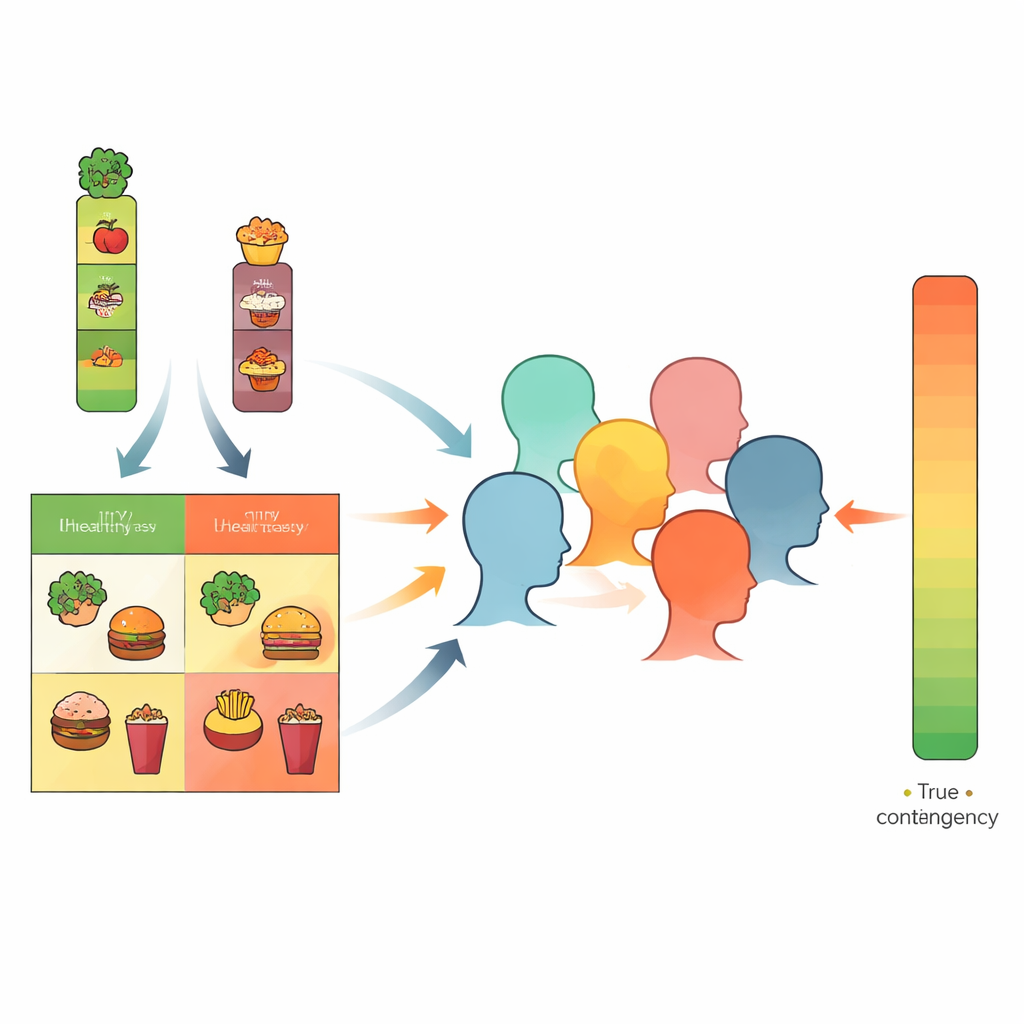
The authors then fitted this model to existing data from lab experiments in which participants viewed many meals that varied in health and taste. The environments were cleverly arranged so that base rates and true pairings sometimes pointed in opposite directions. When the model used a single shared bias strength for everyone, it reproduced the average shift in beliefs toward the idea that unhealthy food tastes better in environments with skewed base rates. However, this group-level setting failed to match the wide spread of individual responses that the experiments revealed. When the researchers instead allowed each person to have their own bias strength, they found strong evidence that most people lean toward using base rates, but to very different degrees. On average, individuals relied on pseudocontingencies less than the group-level model suggested, and individual values spanned from low to very high reliance.
When simple models generalize better than detailed ones
The team went a step further by testing whether these fitted parameters could predict results in a second, independent experiment with a slightly different food environment. Interestingly, the one-size-fits-all group parameter did a better job predicting average beliefs across this new study than the more finely tuned individual parameters. The richer, person-specific model captured variation within the original dataset but seemed to overfit noise that did not carry over to new contexts. This reveals a tension familiar in many fields: models that closely track individuals can explain more detail in one study but may generalize less well than simpler, more parsimonious descriptions.
What this means for understanding and changing beliefs
The findings show that many of our everyday beliefs about how things go together—such as “unhealthy equals tasty”—can arise from the simple way we read structure into our environments, rather than from the true underlying relationships. Yet people differ substantially in how much they lean on this shortcut, and models that average across individuals can overestimate that reliance. For those designing health messages, consumer policies, or social interventions, the study suggests two lessons: altering what is most common in our surroundings can systematically shift beliefs, and paying attention to individual differences may be crucial when targeting behavior change or explaining health inequalities.
Citation: Kaan, J., Kunz, S., Moore, S. et al. Lack of group-to-individual generalizability in pseudocontingencies. Sci Rep 16, 10459 (2026). https://doi.org/10.1038/s41598-026-41585-1
Keywords: belief formation, eating habits, cognitive bias, computational modeling, health perception