Clear Sky Science · en
Societal and climatic controls on swidden cultivation in the Eastern European Plain
Farming with Fire in an Ever-Changing Land
Across northern Europe’s forests, generations of farmers relied on a simple but powerful trick: cutting and burning trees to fertilize the soil with ash. This practice, known as slash-and-burn or swidden farming, shaped both landscapes and societies for thousands of years. The paper summarized here traces when and where this fiery form of agriculture appeared on the Eastern European Plain, and how its rise and fall followed shifts in climate and waves of human migration.
How Fire-Based Farming Works
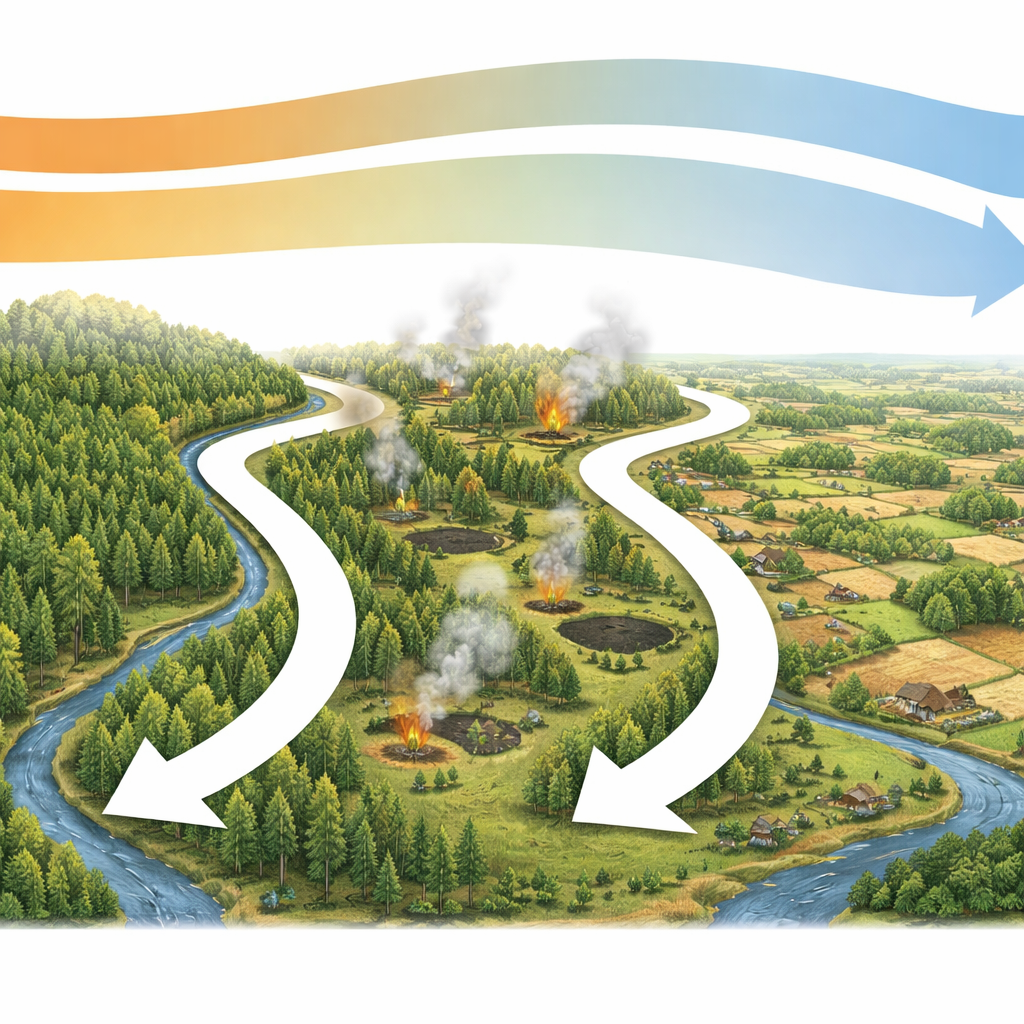
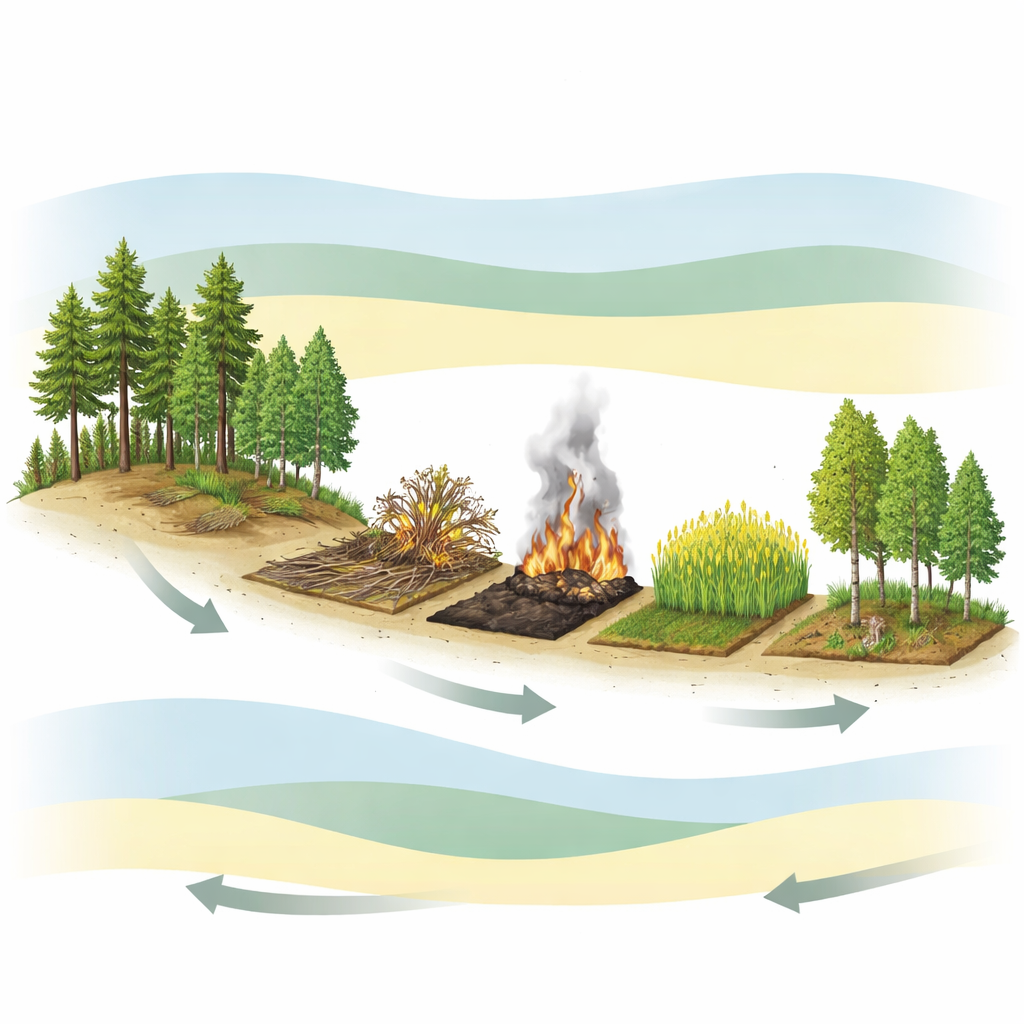
Slash-and-burn farming clears small patches of forest, leaves the felled wood to dry, and then burns it in place. The ash briefly turns poor, sandy soils into rich ground that can yield good harvests for a few years. After that, the field is abandoned to long forest regrowth, sometimes for decades, while farmers move on to new patches. Because it needs no heavy plows or draft animals, this system lets people shift quickly across a landscape, following suitable soils and seasons. It is especially common on well-drained sandy terraces along rivers, where fires are easier to control and the growing season is slightly longer.
Reading Ancient Fires in the Soil
To rebuild the history of this farming system, the authors did not rely on old texts, which are scarce for much of Eastern Europe’s past. Instead, they used the soil itself as the archive. Swidden fields leave behind a distinct, grayish layer packed with tiny, rounded charcoal fragments spread evenly through the upper sand. These layers differ sharply from traces of natural forest fires. By locating such horizons at 75 sites across the Dnieper, Don, Oka, and Volga river basins and in the northeastern Baltic region, and then radiocarbon dating 120 charcoal samples, the team built the first large-scale timeline of swidden use in this region.
Waves of Expansion and Periods of Quiet
The dates reveal that slash-and-burn farming first appeared about 4,000 years ago, in the Bronze Age, but remained rare at first. It became widespread only with the Early Iron Age and later historical periods. The researchers identify several distinct waves of expansion: early fields around 1900–1700 BCE, a broader spread between about 1200 and 200 BCE, and then a long, uneven boom from roughly 100 CE to 1800 CE. Between these waves lay centuries when swidden fields nearly vanished, either because populations declined or because farmers favored permanent fields. Within each wave, clusters of dates in different river basins line up with known archaeological cultures and political changes, suggesting that new groups arriving along the big rivers often brought or revived fire-based farming.
Forests, Crops, and Climate Shifts
The charcoal fragments also record which trees were burned. Early fields often targeted young oak stands, while later ones cleared pine, spruce, and, over time, more secondary birch and other fast-growing trees that colonized old fields. When the timing of swidden peaks is compared with independent climate reconstructions from pollen, cave deposits, and tree rings, a pattern emerges: the biggest bursts of activity coincide with cooler, often drier phases, such as the cold centuries after the Roman Empire and the Little Ice Age. In contrast, warmer, wetter periods saw fewer swidden sites. On sandy soils, cooling shortens the season less severely than on heavy, waterlogged clays, making fire-cleared sandy plots a safer bet for harvests when the climate turns harsher.
What This Means for People and the Past
For non-specialists, the key message is that a seemingly simple farming method acted as a flexible survival strategy during times of climate stress and social upheaval. Because slash-and-burn requires light tools and mobile households, it fit well with migrating peoples and expanding states moving through forested frontiers. The study shows that the spread and decline of this practice on the Eastern European Plain cannot be explained by culture or climate alone; instead, it reflects their constant interaction. Understanding this long history helps explain how past societies coped with changing environments—and why forests and farmlands across the region still carry hidden traces of those ancient fires.
Citation: Ponomarenko, E., Ershova, E., Viazov, L. et al. Societal and climatic controls on swidden cultivation in the Eastern European Plain. Sci Rep 16, 10293 (2026). https://doi.org/10.1038/s41598-026-41211-0
Keywords: slash-and-burn farming, Eastern European forests, ancient agriculture, climate change history, human migration