Clear Sky Science · en
Association between screening duration and treatment outcomes in the clinical trials of ranibizumab and aflibercept for neovascular age-related macular degeneration
Why waiting for eye treatment matters
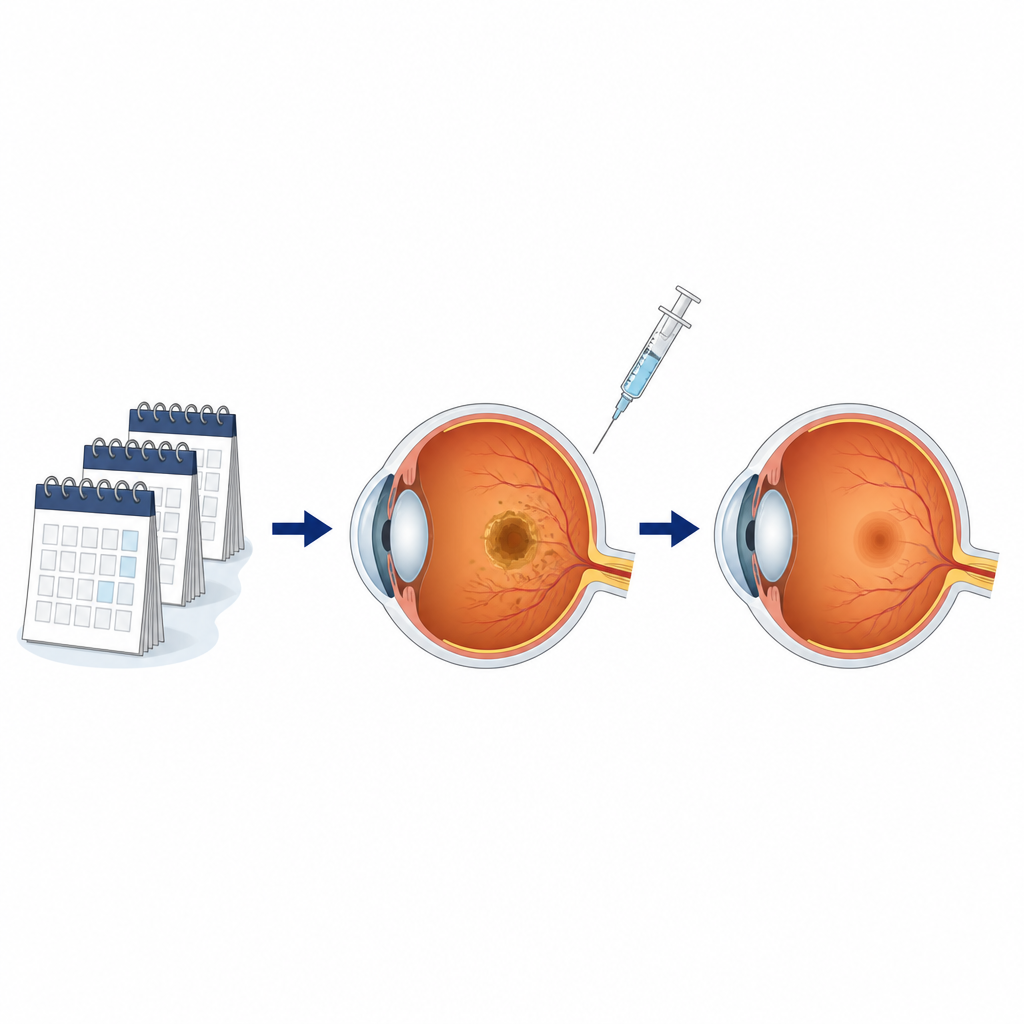
People with age-related macular degeneration worry that every day of delay before treatment could cost them precious vision. Clinical trials for new eye drugs often include a short waiting period for screening tests before the first injection, raising a practical question: does this pause harm patients sight or the health of the retina? This study looked closely at data from two large international trials to find out whether a screening period of up to three weeks changes how well modern injections work for a common blinding eye disease.
Understanding the eye disease in question
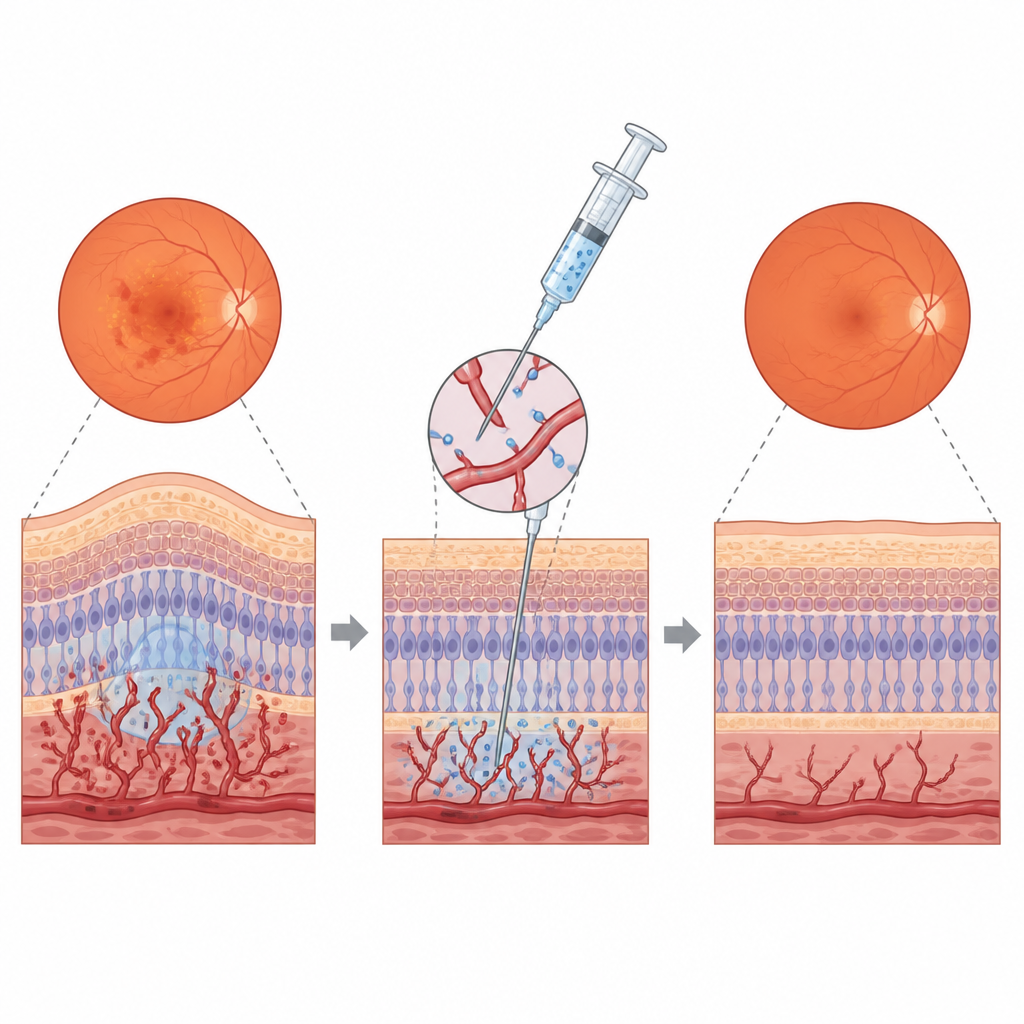
Neovascular age-related macular degeneration, often called wet AMD, is a leading cause of severe vision loss in older adults. In this condition, fragile new blood vessels grow under the center of the retina, the macula, and leak fluid or blood. This can blur or distort straight-ahead vision that people use for reading, driving, and recognizing faces. Drugs that block a signal called VEGF are injected into the eye to dry up these leaky vessels and protect sight. Ranibizumab and aflibercept are two widely used anti-VEGF medicines, and closely matched copies known as biosimilars are now being tested and approved to expand treatment options and lower costs.
How the researchers used existing trial data
The authors performed a post hoc analysis, meaning they revisited data from two already completed phase 3 trials of biosimilar versions of ranibizumab and aflibercept, including 1,152 participants with newly diagnosed wet AMD. In both trials, volunteers first went through a screening period, during which doctors confirmed the diagnosis and checked whether each person met strict inclusion rules. The time from signing the consent form to receiving the first injection ranged from 1 to 21 days. The team examined whether longer screening was linked to changes in two key measures: best corrected visual acuity, essentially how well people could see letters on a chart with proper glasses, and central subfield thickness, a scan-based measure of swelling in the central retina.
What the numbers revealed
Participants were mostly in their seventies, with a mix of European, American, and Asian sites. On average, vision and retinal thickness improved over time after anti-VEGF therapy, both in the early phase at week 8 and at week 48, which represented roughly one year of treatment. When the researchers plotted these changes against the length of the screening period, they saw no clear pattern suggesting that waiting a few extra days worsened outcomes. More formal statistical models, which took into account age and starting vision or thickness, also showed no meaningful link between screening duration and later vision or anatomy. Whether they looked at each extra day of delay, success rates defined by modest vision gains and thinning of the retina, or grouped people into four waiting-time bands, there was still no significant impact.
Placing the findings in real-world context
These results stand out because other research has warned that missed or widely spaced injections in everyday practice can lead to worse vision for people with wet AMD, especially when delays stretch over many weeks or months. Here, however, the delay was limited to the carefully managed 1 to 21 day screening window at the very start of therapy. Within this narrow range, outcomes were similar whether screening was very quick or took closer to three weeks. There was a hint that people who started treatment soon after screening might have slightly greater improvement in retinal thickness, but the differences were small and not strong enough to rule out chance, especially given the sample size and focus on only two anti-VEGF medicines.
What this means for patients and trials
For patients worried about a short scheduling delay between diagnosis and the first anti-VEGF injection in a clinical trial setting, this study offers cautious reassurance. Within a three week window, and under the close monitoring typical of trials, the timing of screening did not clearly change how much vision improved or how much retinal swelling went down during the first year of treatment. The authors note that much longer delays, or delays in routine clinics where disease may be less tightly monitored, could still be harmful. Even so, their findings support the idea that brief, well controlled pre-treatment pauses can be built into study designs without noticeably weakening the benefits of modern wet AMD injections.
Citation: Kim, H.M., Woo, S.J. Association between screening duration and treatment outcomes in the clinical trials of ranibizumab and aflibercept for neovascular age-related macular degeneration. Sci Rep 16, 15680 (2026). https://doi.org/10.1038/s41598-026-41200-3
Keywords: wet age-related macular degeneration, anti-VEGF injections, screening delay, clinical trials, visual acuity