Clear Sky Science · en
A cross-sectional analysis of male versus female flourishing among 202,898 participants across 22 countries on 73 variables in the global flourishing study
Why this global wellbeing check matters
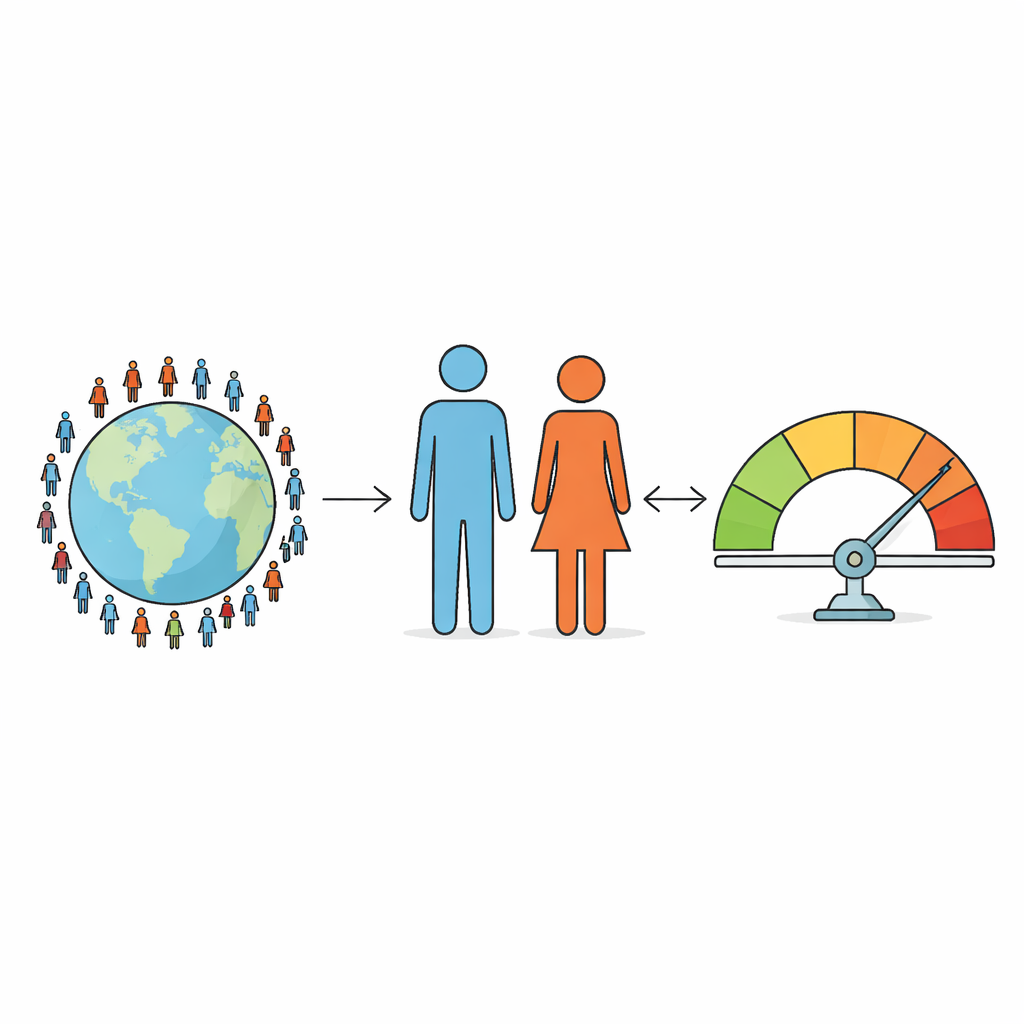
Arguments about whether life is going better for men or for women are common, but they often rely on narrow measures such as income or depression rates in a few wealthy countries. This study takes a far broader and more global look. Using survey answers from more than 200,000 adults in 22 countries, the researchers asked how men and women compare across 73 different aspects of “flourishing” — from happiness and health to friendships, purpose, money and spirituality. The results reveal a surprisingly mixed picture in which neither sex wins outright, and where local culture strongly shapes who seems to be doing better.
Taking the pulse of life around the world
The project draws on the Global Flourishing Study, an ongoing international survey designed to track how people are doing in many areas of life. Participants answered a long questionnaire that covers six main domains of flourishing: happiness and life satisfaction; health; meaning and purpose; character and virtue; close social relationships; and financial and material security. Additional questions probed spirituality, religion and family life. The authors treated the survey’s “gender” question as a stand-in for biological sex (male or female), while noting that this is an imperfect and debated distinction and that nonbinary people are not well represented in the data.
A close race with different strengths
When all items are combined into overall indices of flourishing, men report doing only slightly better than women. On a 0–10 scale, men’s average score is higher by just 0.02 points on a 10-item index and by 0.07 points when financial security is added. Looking within the six headline domains reveals a more nuanced story. Women report marginally higher levels of happiness and satisfaction, stronger close relationships, and a greater sense that what they do is meaningful. Men, in contrast, rate their health and their financial and material security noticeably higher, while scores related to moral character and virtues are essentially the same for both sexes. Because the gaps in health and money are larger than those in happiness, relationships and meaning, the combined index tilts slightly in men’s favor.
How feelings, bodies and bank accounts differ
Digging into specific questions uncovers familiar patterns alongside surprises. Women more often say they are happy, optimistic and satisfied with life, yet they also report more anxiety, depression and suffering. Men tend to say their mental and physical health is better, and they report less pain and fewer health limits, but they are more likely to smoke, drink heavily and exercise more, suggesting different ways of coping with stress. In social life, women report slightly richer close relationships, more social support and stronger feelings of belonging, while men are a bit more engaged in civic activities such as community participation and political involvement. On money matters, men describe more stable jobs, higher financial comfort and better housing situations. Women, however, are more deeply involved in religion and spirituality almost everywhere, and they are somewhat more likely to have married and to have children.
Culture reshapes the gender gap
Although these overall trends may sound familiar, the study shows that they are far from universal. When the researchers repeated their analyses within each of the 22 countries, patterns shifted. In nine nations, including Australia, India, Nigeria and Japan, women actually report higher overall flourishing than men. In health, men lead in most places, but women do better in the Philippines, Indonesia, Japan and Nigeria. Financial advantages for men are large in many countries, yet Japan and Nigeria buck this trend for overall financial and material security, and some countries show women pulling ahead in education or housing. These cross-national differences suggest that biology alone cannot explain the results; instead, social norms, economic opportunities, religion, laws and local histories all interact to shape how men and women fare.

What the findings mean for everyday life
For a lay reader, the main message is that asking “Are men or women better off?” has no simple answer. On some fronts, such as happiness, close relationships and spirituality, women have a slight edge. On others, especially health ratings and financial stability, men report clearer advantages. When everything is tallied, men appear to be flourishing a bit more overall, but the difference is small and varies widely from country to country. The study also highlights groups that are often overlooked: participants who did not identify as male or female reported much lower flourishing on nearly every measure, underscoring the extra challenges they face. Ultimately, the authors argue that understanding and improving wellbeing requires looking beyond single scores or stereotypes to the many intertwined parts of life and the cultural settings in which people live.
Citation: Lomas, T., Padgett, R.N., Warren, M.A. et al. A cross-sectional analysis of male versus female flourishing among 202,898 participants across 22 countries on 73 variables in the global flourishing study. Sci Rep 16, 10166 (2026). https://doi.org/10.1038/s41598-026-40963-z
Keywords: flourishing, wellbeing, gender differences, global survey, mental health