Clear Sky Science · en
Enhanced adaptive zebra optimization algorithm optimized kernel extreme learning machine for bankruptcy prediction problems
Why predicting corporate failure matters
When a company collapses, the damage rarely stops at its own doors: jobs vanish, loans go unpaid, supply chains fray and local economies wobble. Being able to spot warning signs of bankruptcy years in advance is therefore valuable not only for business leaders, but also for banks, investors and regulators. This study presents a new computer-based approach that sifts through financial data to flag troubled firms earlier and more reliably than many existing tools.
A smarter way to read financial signals
Traditional methods for forecasting bankruptcy usually rely on straight-line relationships among a few financial ratios, such as debt levels or cash on hand. These methods are easy to understand but struggle with the messy, nonlinear patterns found in real corporate accounts, especially when markets are volatile. In recent years, machine learning models have improved accuracy by uncovering subtle patterns in historical data. One such method, called Kernel Extreme Learning Machine, can quickly learn complex relationships, but its success hinges on choosing a pair of internal settings just right. Poor choices can make its predictions unreliable, and common search methods for tuning these settings are slow and easily misled.
Zebras inspire a better search strategy
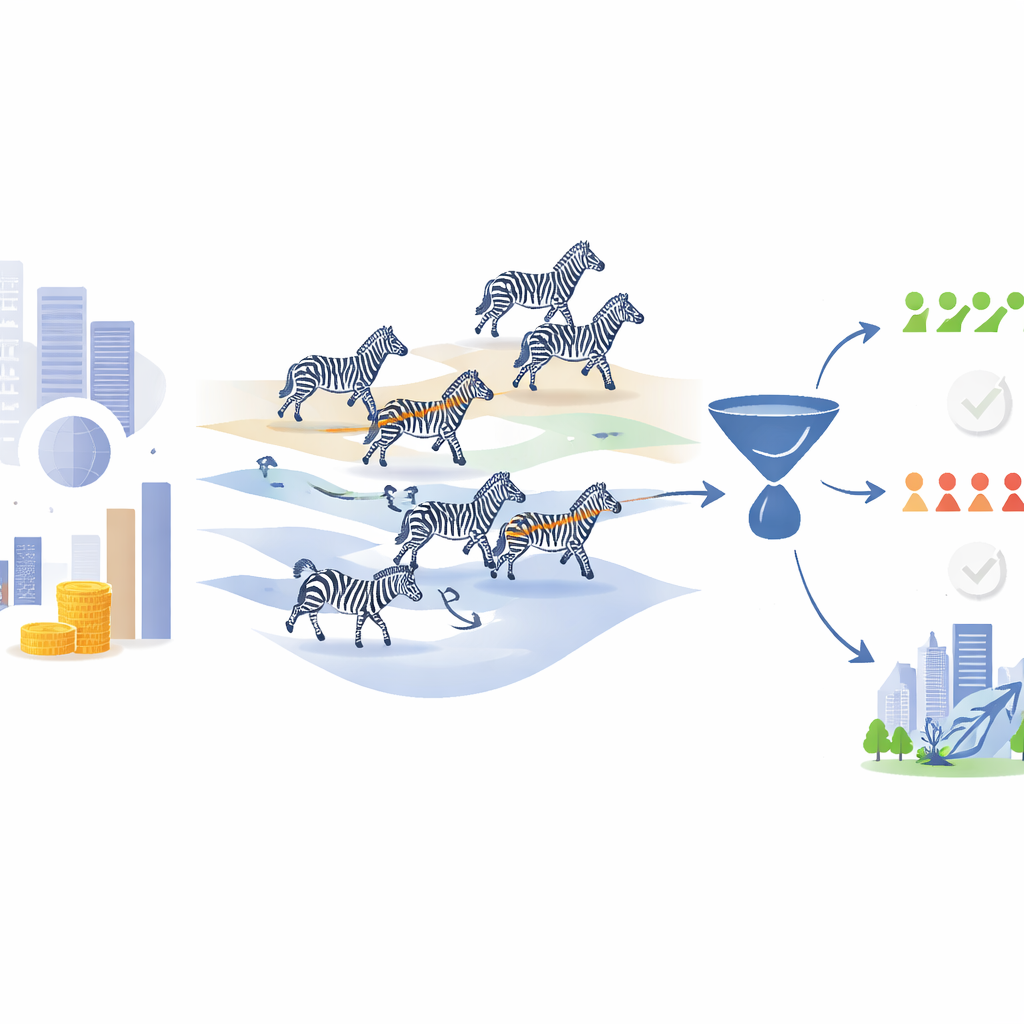
The authors turn to nature for help, drawing inspiration from how zebra herds forage and defend themselves. In their computer model, each zebra stands for a possible solution to an optimization problem—here, a particular setting of the machine learning model. Earlier versions of this so‑called Zebra Optimization Algorithm moved the herd through the search space, but they tended to lose diversity too quickly and get stuck in mediocre solutions. To fix this, the researchers designed an enhanced version, called EAZOA, that keeps track of the best "zebras," allows some to make occasional long exploratory jumps, and treats the edges of the search space with extra care so good solutions near the boundaries are not discarded.
Testing the new herd on tough problems
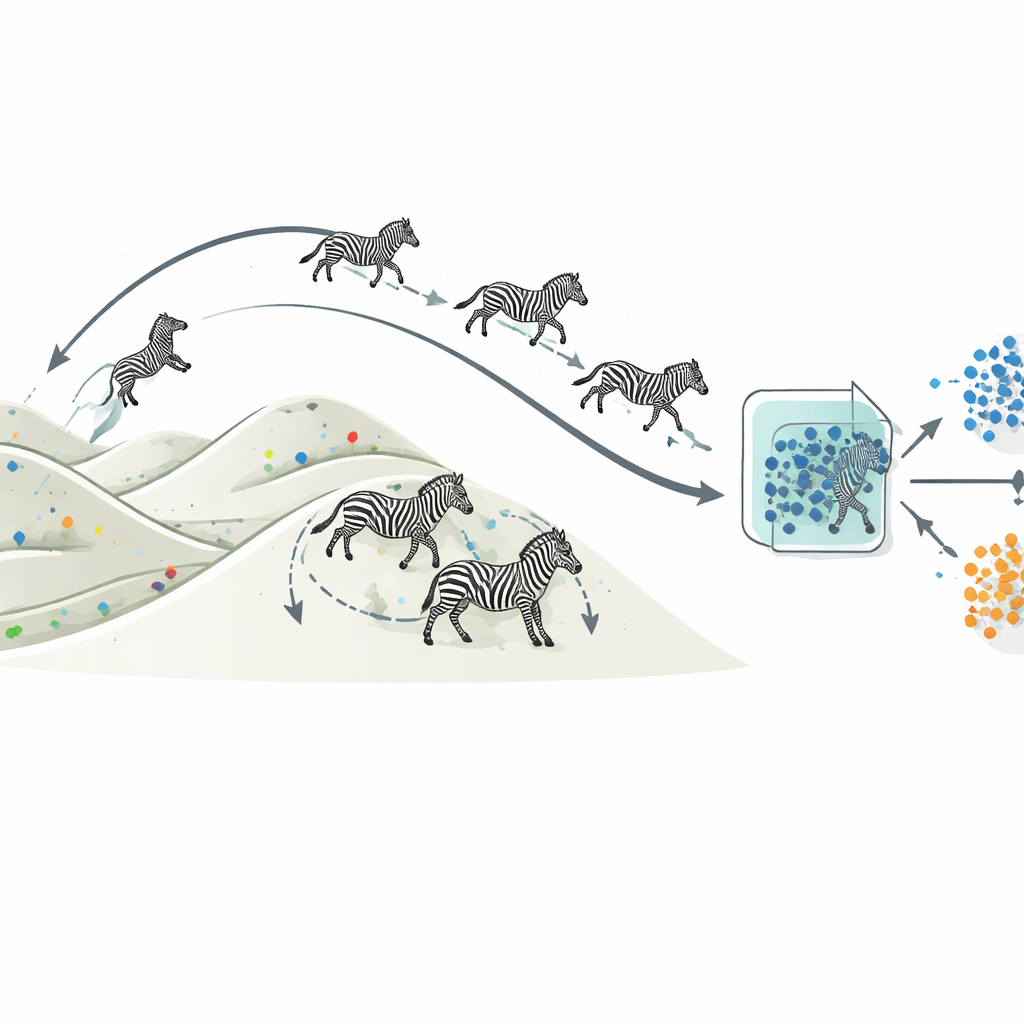
Before applying EAZOA to real financial data, the team tested it on demanding mathematical puzzles that are widely used to benchmark search algorithms. Across many of these challenges, and at both modest and high levels of complexity, EAZOA consistently found better answers, with less variability, than several well-known competitors, including particle swarm, grey wolf and whale-inspired methods, as well as the original zebra approach. It converged more quickly toward high-quality solutions while still exploring broadly enough to avoid being trapped in local dead ends, demonstrating a good balance between wide-ranging search and fine-tuning.
Turning better search into better bankruptcy calls
To see whether these gains matter in practice, the authors combined EAZOA with the Kernel Extreme Learning Machine and trained the resulting model on a well-known Polish dataset containing 30 financial ratios for 240 firms, roughly half of which later went bankrupt. They used careful cross-validation, repeatedly shuffling and splitting the data while preserving the proportion of failing and healthy companies, to check how well the system would generalize to unseen cases. Compared with versions of the same learning machine tuned by other optimization schemes, the EAZOA-enhanced model achieved the highest scores on standard measures such as accuracy, precision, recall and the F1-score, and did so with relatively stable performance across repeated trials.
What this means for real-world risk watchers
For non-specialists, the main message is that how we tune a predictive model can be just as important as the model itself. By guiding a virtual herd of zebras more intelligently through the space of possible settings, the authors obtain a faster and more reliable early-warning tool for corporate distress. While the current results are based on a single, medium-sized dataset from one country, they suggest that such bio-inspired search strategies, when paired with modern learning techniques, could become useful components in systems that monitor financial health, helping managers, lenders and regulators act before a struggling company reaches the point of no return.
Citation: Liu, W., Zhang, Y. & Du, M. Enhanced adaptive zebra optimization algorithm optimized kernel extreme learning machine for bankruptcy prediction problems. Sci Rep 16, 10268 (2026). https://doi.org/10.1038/s41598-026-40651-y
Keywords: bankruptcy prediction, financial risk, machine learning, optimization algorithm, zebra optimization