Clear Sky Science · en
Intentional versus passive technology use patterns differentially predict attentional control and psychological well-being
Why Our Screen Habits Matter
Most of us spend hours every day with phones, computers, and tablets, and we often hear warnings that “too much screen time” is bad for our minds. This study suggests the real issue is not how long we are online, but how we use our devices. The researchers introduce the idea of “digital balance” – using technology with clear goals and limits – and show that this kind of intentional use is linked to sharper attention and better overall well-being, while passive, automatic scrolling is linked to the opposite.
Two Different Ways We Go Online
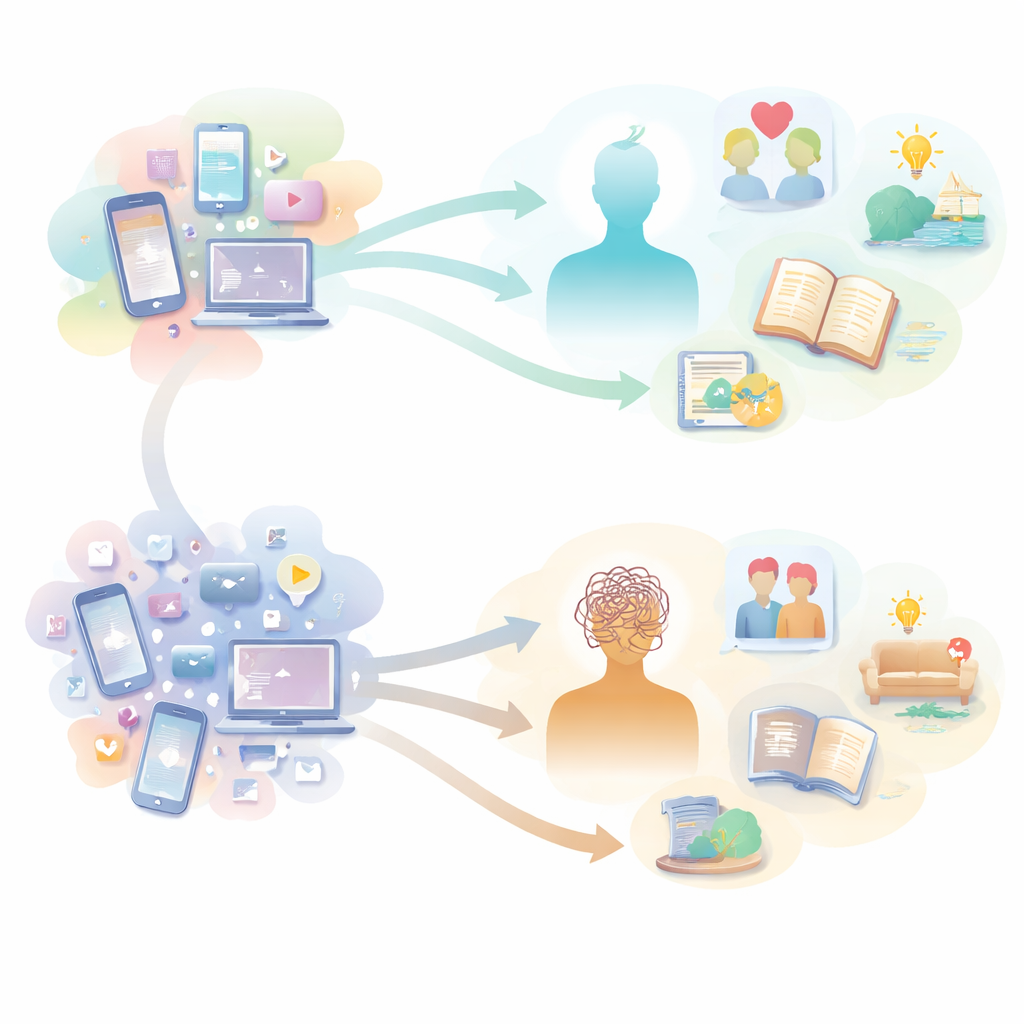
To make sense of modern screen use, the authors distinguish between intentional and passive patterns. Intentional use means going online with a purpose, deciding in advance what you want to do and how long you will do it, and checking afterward whether that use really served your priorities. Passive use, in contrast, looks like endless scrolling, opening apps out of habit, and reacting to notifications without thinking. Digital balance is the broader pattern in which intentional use dominates, and our online time fits around, rather than fights with, what we care about in life.
How Balanced Use Supports the Mind
The team connects digital balance to two major psychological ideas. One, known as self-determination, holds that people feel better when they experience choice, a sense of skill, and real connection with others. Purposeful technology use can support these needs: planned communication can deepen relationships, focused information searches can build competence, and carefully chosen entertainment can truly refresh us. A second idea, about attention as a limited resource, suggests that constant reacting to alerts and feeds drains our ability to focus. When we set clear start and stop points and know why we are online, we are less likely to be pulled into that kind of mental drain.
What the Researchers Did
The study involved 842 adults who regularly used smartphones and multiple digital platforms. Participants completed a new questionnaire that measured how intentionally or passively they used technology in four areas: social media, entertainment, information seeking, and communication. They also answered standard surveys about how well they could focus and shift their attention, as well as how satisfied, emotionally positive, and generally “flourishing” they felt in life. For a subset, the researchers gathered actual screen time records from phones, allowing them to see whether patterns of use mattered beyond simple hours spent online.
Attention as the Missing Link
When the researchers analyzed the data, clear patterns emerged. People who reported more intentional use tended to have better attentional control and higher psychological well-being. Those with more passive patterns tended to report poorer attention and lower well-being. Importantly, attention appeared to sit in the middle of this relationship: intentional use was linked to stronger attention, which in turn was linked to feeling better overall, and passive use showed the opposite chain. These patterns held even after accounting for total screen time, age, gender, education, and personality, suggesting that the quality of engagement is more important than the quantity.

Who Is Most Affected
The study also hints that not everyone is affected in quite the same way. Younger adults showed stronger negative links between passive use and attention than older adults. This may be because younger people face denser streams of notifications, are still developing their self-management skills, and have grown up with devices constantly within reach. For them, slipping into passive patterns may be especially disruptive, but they may also benefit most from learning to shape their digital habits more deliberately.
What This Means for Everyday Life
In plain terms, this research suggests that trying to simply “cut down” on screen time may miss the point. Instead, what matters most is whether we are in charge of our technology, or it is in charge of us. Using devices with clear goals, firm boundaries, and alignment with our values appears to support both our ability to concentrate and our emotional health. By contrast, letting apps and alerts steer our attention is linked with scattered focus and lower well-being. The authors argue that future efforts to promote digital health—in homes, schools, workplaces, and app design—should focus less on banning screens and more on teaching and enabling intentional, balanced use.
Citation: Wang, H., Xu, L. & He, R. Intentional versus passive technology use patterns differentially predict attentional control and psychological well-being. Sci Rep 16, 12077 (2026). https://doi.org/10.1038/s41598-026-40374-0
Keywords: digital balance, intentional technology use, screen time, attention and focus, mental well-being