Clear Sky Science · en
Deformation control equations for engineering piles subjected to vertical and nonlinear lateral loads
Why digging deep holes can put nearby buildings at risk
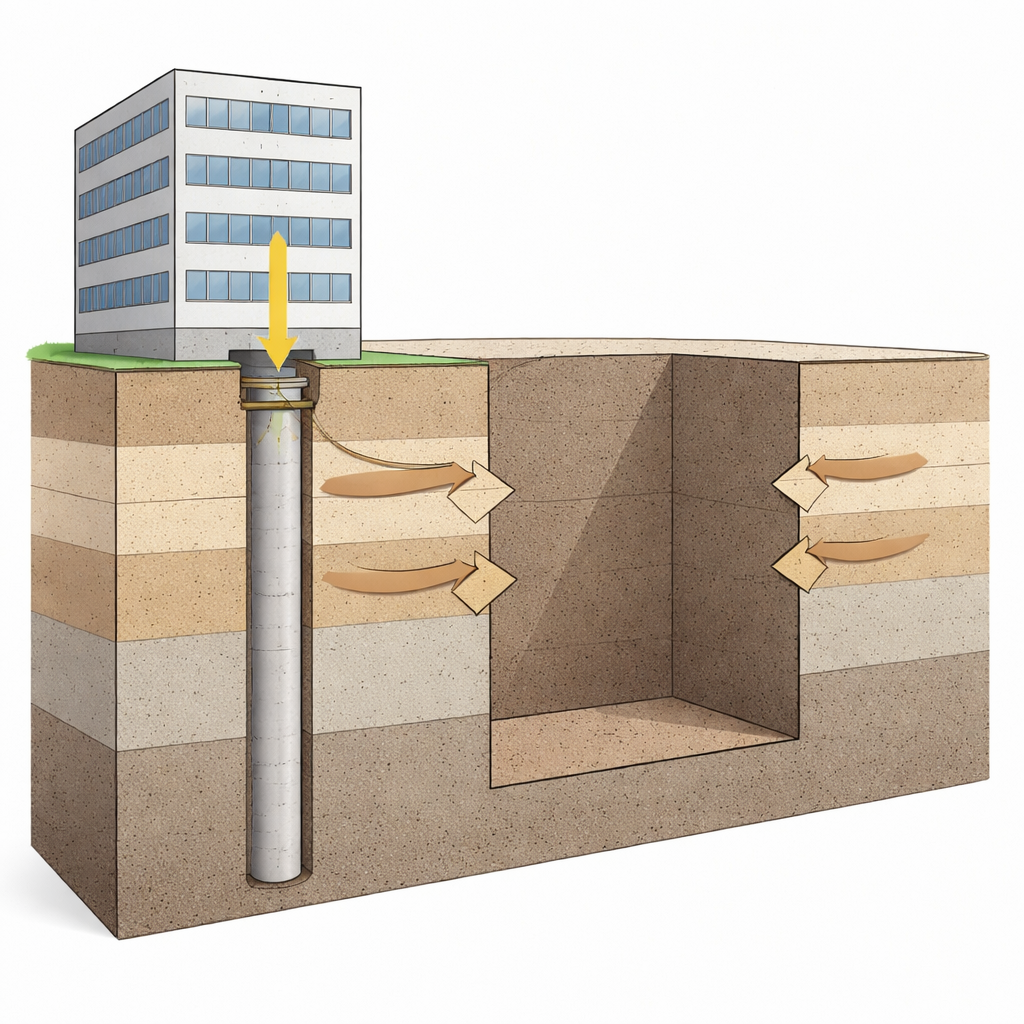
In crowded cities, new subway lines, basements, or underground malls often require deep excavations right next to existing buildings. These buildings are commonly supported by long concrete or steel columns called piles that extend into the ground. When soil is removed nearby, the ground can shift sideways and change how these piles carry the weight of the building. This study asks a practical question: can we predict how much those piles will bend and move so engineers can keep nearby structures safe?
How nearby digging disturbs the underground support
When a deep pit is excavated, the soil that once pushed against the excavation wall is suddenly unloaded. The remaining ground tends to move toward the pit, and the stress field in the soil changes with depth. A pile standing just outside the excavation feels these changes as sideways pressure along its shaft, on top of the vertical weight from the building above. Earlier methods often treated the soil as a series of independent springs, which made it hard to capture how soil deformation varies continuously with depth and how it couples with the pile’s bending. The authors highlight that this simplification can miss important features of pile behavior, especially where soil properties vary from one layer to another.
A new way to describe pile and soil moving together
The researchers developed a unified mathematical model that treats the pile and surrounding soil as a single interacting system. Instead of focusing separately on forces at a few points, they used an energy-based approach: they wrote expressions for how much elastic energy is stored in the bending pile and in the deformed soil, as well as the work done by vertical loads and by the sideways earth pressure created by excavation. Using a technique called the variational method, they derived governing equations that describe how sideways displacement of the pile changes with depth while automatically honoring how the soil reacts around it. The model allows the stiffness of the soil to increase or decrease with depth, a key feature in layered ground, and accounts for the way the soil grips the pile along its surface.
Capturing depth-dependent soil behavior
To make the soil response realistic, the authors idealized the ground as several horizontal layers, each with its own stiffness but smoothly blended from one to the next. They described how the sideways resistance along the pile shaft depends on soil strength, friction at the pile–soil contact, and the stress changes caused by excavation. The resulting equations link the pile’s bending, the distribution of sideways soil pressure, and the decay of soil movement outward from the pile. Solving these equations leads to an analytical expression for how much the pile deflects at each depth, including how the curvature and shear forces vary from the pile head down to the toe.
Putting the theory to the test in the lab
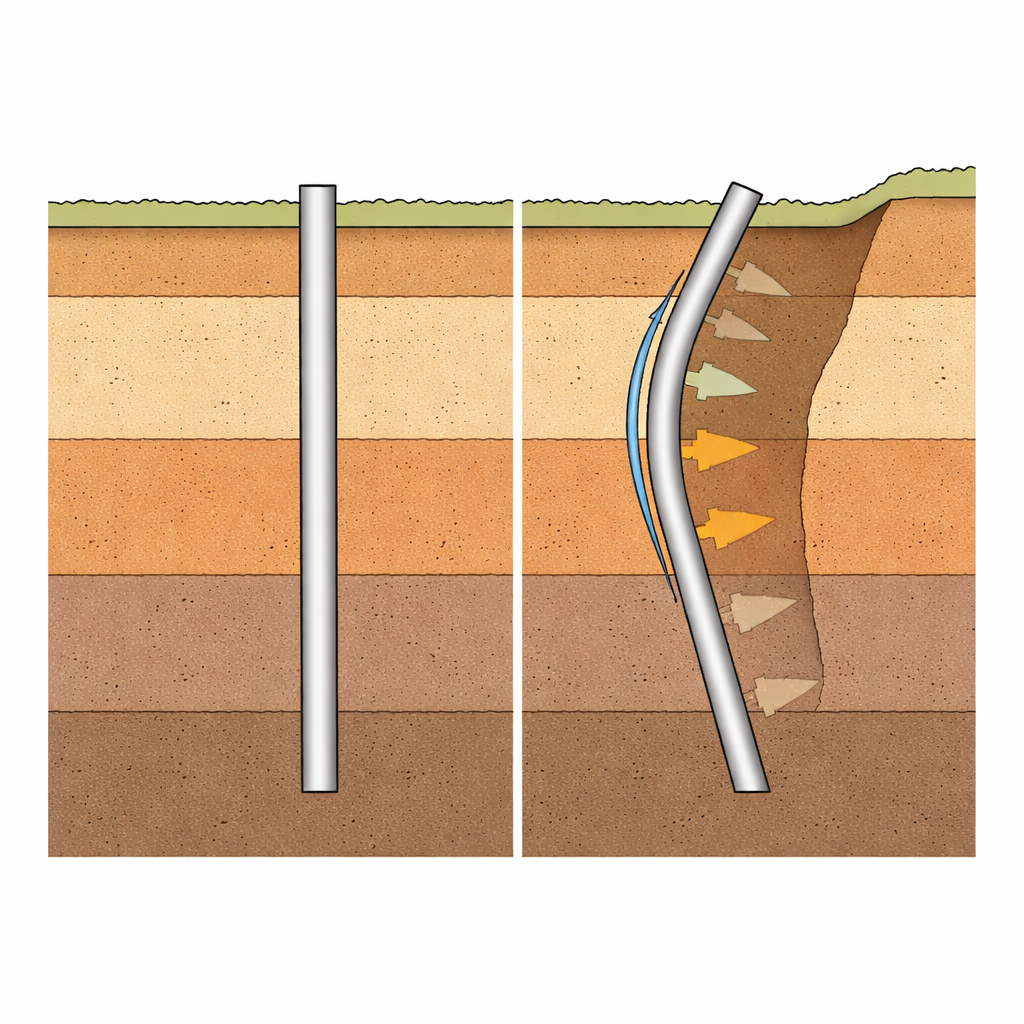
To check whether the theory matches reality, the team performed a laboratory excavation using a small-scale soil box, a model retaining wall, and a single instrumented pile located just outside the pit. They deepened the excavation in four stages, carefully measuring how the pile’s sideways displacement profile evolved with depth each time. The measurements showed the classic pattern seen in real sites: the pile head moved the most, and the displacement gradually faded toward the base. When they compared their theoretical predictions with the experimental data, the agreement was strong. In the upper and middle parts of the pile, differences were typically only a few hundredths of a millimeter, with relative errors mostly below ten percent.
Understanding where the model struggles
Near the pile toe, the differences between prediction and measurement grew somewhat larger, up to about twenty percent. The authors explain that this zone is affected by stiffer boundary conditions at the base and by more complex shear deformation in the deeper soil layers—effects that are harder to reproduce exactly in a simplified analytical framework. The experimental setup itself can also introduce edge effects that do not perfectly mirror field conditions. Even so, the overall shape and magnitude of the displacement curves from the model closely followed the observed behavior across all excavation stages.
What this means for building safety
For non-specialists, the main message is that the study offers engineers a more reliable way to forecast how piles next to deep excavations will bend and move. By treating the pile and soil as an energy-sharing system and allowing soil stiffness and pressures to vary with depth, the model reproduces the depth-dependent deformation seen in controlled experiments. This improves confidence that designers can estimate pile movements before digging begins, evaluate whether nearby structures will remain within safe limits, and adjust support or excavation plans as needed. In short, the work strengthens the scientific basis for protecting buildings and infrastructure as cities continue to grow downward as well as upward.
Citation: Chen, B., Lian, N., Dai, P. et al. Deformation control equations for engineering piles subjected to vertical and nonlinear lateral loads. Sci Rep 16, 11081 (2026). https://doi.org/10.1038/s41598-026-39516-1
Keywords: deep excavation, pile foundations, soil-structure interaction, lateral displacement, urban underground construction