Clear Sky Science · en
Residue dissipation and dietary risk assessment of premix formulation of fluopyram, trifloxystrobin, and their metabolite in cucumber (Cucumis sativus L.) under field conditions
Why cucumber lovers should care
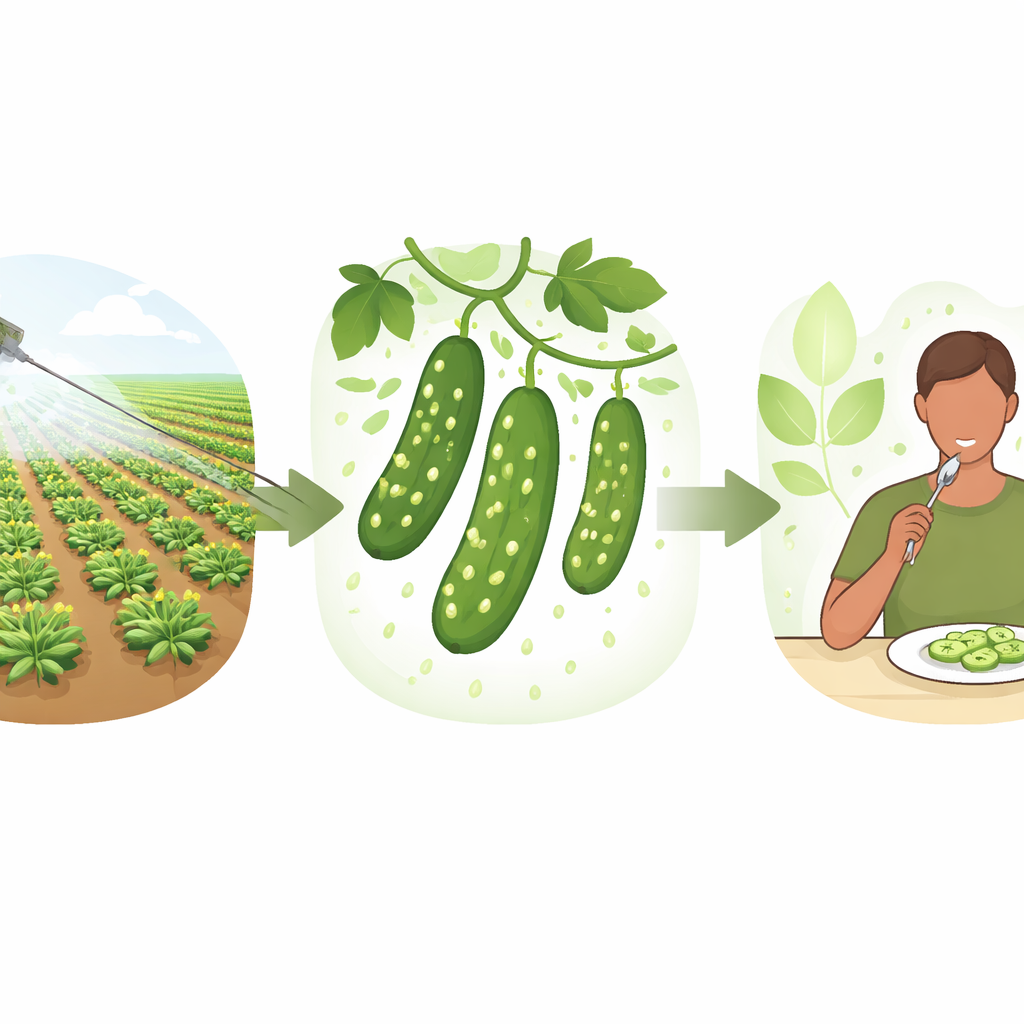
Cucumbers are a favorite in salads and street snacks, and they are often eaten raw. To protect these tender plants from destructive fungal diseases, farmers turn to modern fungicides. This study asks a question that matters to anyone who eats fresh produce: when a popular two-in-one fungicide is sprayed on cucumbers, how long do the traces stay on the fruit, and are the remaining amounts safe to eat?
Keeping cucumber crops healthy
Across the world, cucumber production has surged, but so have the fungal diseases that attack the roots and leaves, threatening big losses for farmers. To keep plants healthy, many growers use a premixed spray containing two fungicides, fluopyram and trifloxystrobin. These chemicals work in different ways to stop fungal growth and give broad protection to the crop. At the same time, their different chemical properties mean they may linger on the fruit and in the soil in different ways, raising concerns about what ends up on our plates.
How the field experiment was done
To track what really happens in farmers’ fields, researchers ran a controlled field trial in semi-arid northern India using a common cucumber variety. They sprayed the premix three times at the label-recommended rate and at a slightly higher rate, mimicking real-world use. At set times after the final spray—from a few hours up to 20 days—they collected market-ready cucumbers and soil samples. In the lab, they used a streamlined extraction technique and gas chromatography instruments to measure tiny amounts of the two fungicides and a breakdown product of trifloxystrobin, known as a metabolite. They carefully validated their method to be sure that the measurements were accurate, sensitive, and free of confusing background signals.
How fast the spray residues fade
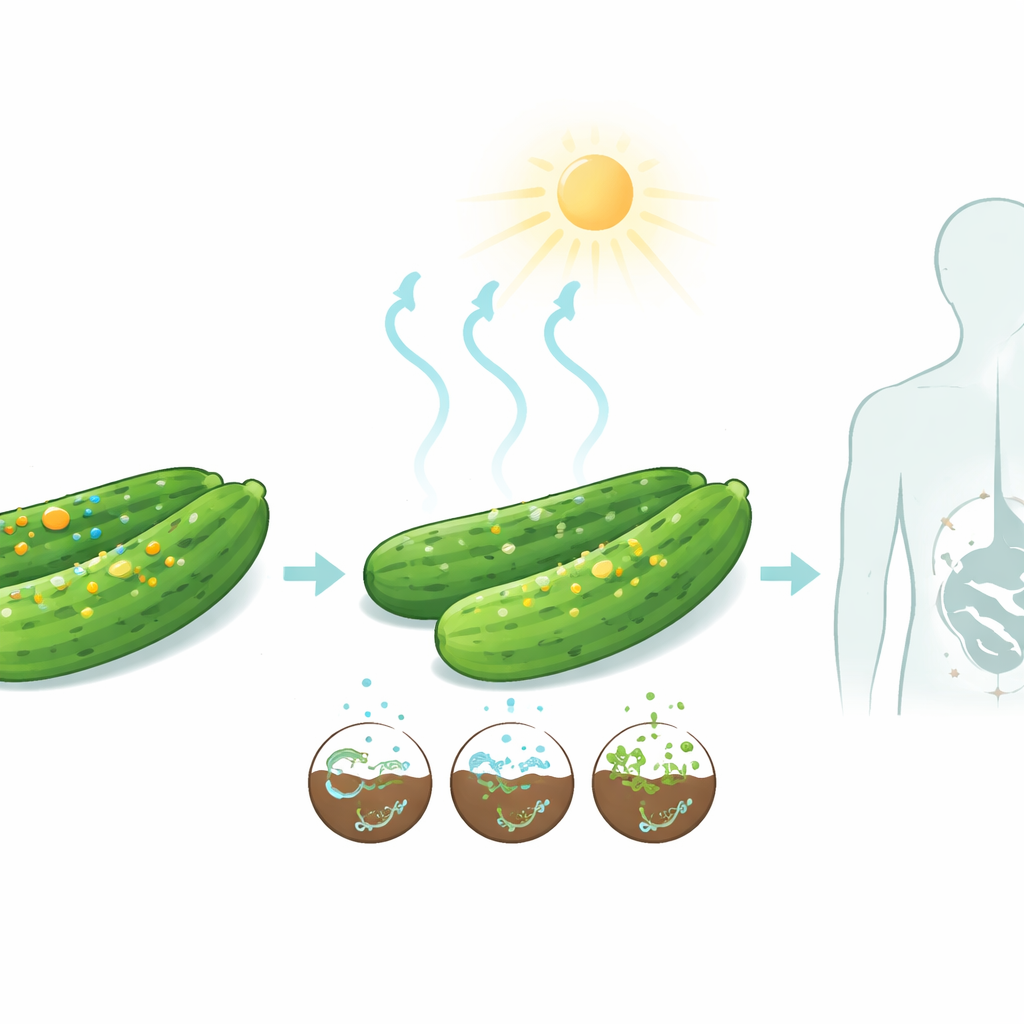
The measurements showed that both fungicides and the metabolite appear on cucumbers right after spraying but then decline quickly. Fluopyram started at about half a milligram per kilogram of fruit and lost around two-thirds of its residue within five days. Depending on the dose, it dropped below the level the instruments could reliably measure within 10 to 15 days. Trifloxystrobin began at similar levels but broke down even faster, with more than 90 percent gone within a week and no measurable traces after 7 to 10 days. Its metabolite appeared briefly at lower levels and then disappeared within three to seven days. When the scientists analyzed the pattern mathematically, the decline followed a simple “first-order” decay curve—each day, a fixed fraction of what remained broke down or washed away. By harvest time, soil samples also showed no measurable residues, suggesting little long-term buildup in the field.
What this means for people who eat cucumbers
Finding that residues fade is only half the story; the critical question is whether the amounts present during normal eating are harmful. To answer this, the team combined their highest measured residue levels with national data on how much cucumber people typically eat in rural and urban India. They then compared the resulting daily intake with internationally accepted safety thresholds. The resulting hazard quotients—a way of expressing risk as a fraction of a safe dose—were far below one for both fungicides, even at the higher spray rate. This held true for both long-term (chronic) and short-term (acute) exposure, meaning that the expected intake from cucumbers is only a tiny fraction of doses considered harmful in toxicology studies.
Take-home message for consumers and farmers
For everyday cucumber eaters, the study offers reassuring news: when this common two-part fungicide is used as directed, its traces on cucumbers decline quickly and remain well within international food safety limits. Under the hot, sunny conditions of the study site, the chemicals and their key breakdown product did not persist long enough to pose a significant dietary risk. For farmers, the work underscores the importance of following recommended doses and waiting periods between the last spray and harvest. For regulators, it provides locally grounded data that support maximum residue limits tailored to regional climates. Together, these findings suggest that, with good agricultural practice, farmers can control serious fungal diseases in cucumbers while still delivering a crop that is safe for the table.
Citation: Ahlawat, S., Chauhan, R., Yadav, S.S. et al. Residue dissipation and dietary risk assessment of premix formulation of fluopyram, trifloxystrobin, and their metabolite in cucumber (Cucumis sativus L.) under field conditions. Sci Rep 16, 13553 (2026). https://doi.org/10.1038/s41598-026-39095-1
Keywords: cucumber, fungicide residues, food safety, pesticide dissipation, dietary risk