Clear Sky Science · en
Improved modelling for vibrational energies of diatomic molecules using the generalized fractional derivative
Why the tiny vibrations of molecules matter
Every breath you take, every flame that burns, and every cloud in space is full of simple two-atom molecules that are constantly vibrating. These microscopic vibrations determine how molecules absorb light, store energy, and take part in chemical reactions. To understand and predict such behavior, scientists build mathematical models of how molecules move. This article presents a new way to model those vibrations more accurately, using a modern twist on calculus applied to an old but powerful molecule model.
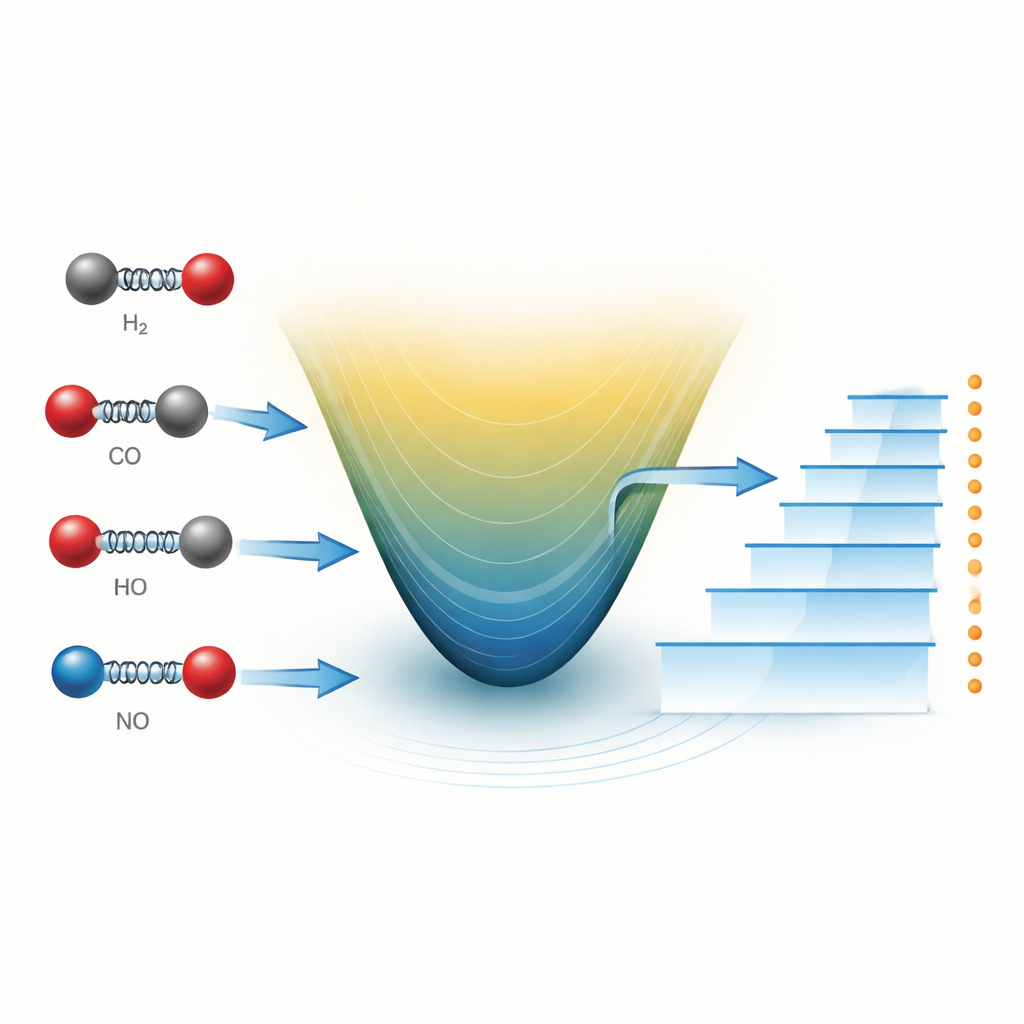
How scientists usually picture a shaking molecule
A diatomic molecule—made of just two atoms—can be imagined as two balls joined by a spring. When the atoms move closer or farther apart, they climb up or down an energy landscape. For nearly a century, a simple formula known as the Morse potential has been a workhorse for describing this landscape. It captures how the bond stretches, stiffens, and eventually breaks. Combined with the Schrödinger equation from quantum mechanics, the Morse potential lets researchers calculate the allowed vibration energies, which show up as sharp lines in molecular spectra measured in the lab or from distant stars.
Where the classic picture falls short
The standard Morse model works best for molecules that are not spinning and not too highly excited. Real molecules, however, rotate as they vibrate, and their behavior becomes more intricate at higher energy levels. To handle rotation, an extra energy barrier—called the centrifugal term—is added, but this makes the equations hard to solve exactly. Over the years, many clever approximations and numerical tricks have been developed, yet small mismatches remain between theory and precise experimental data, especially for higher vibrational levels and for molecules with different electronic states.
A new fractional twist on molecular motion
The authors adopt a recent idea from "fractional" calculus, which generalizes ordinary derivatives so that their order can be a non-integer. In this framework, the way a system responds can carry a memory of its past, or effectively encode subtle, nonlocal interactions. Building on a generalized fractional derivative that preserves key rules of standard calculus, the team extends a well-known solution technique (the Nikiforov–Uvarov method) to what they call the generalized fractional NU method. They use this approach to obtain analytical formulas for the vibrational energy levels of molecules in any number of spatial dimensions, starting from the Morse potential and treating the rotational barrier with a refined approximation.
Putting the new model to the test
To see whether the fractional approach really helps, the authors apply it to twenty-two different diatomic molecules, including species important in chemistry, materials science, and astrophysics such as CO, Na2, AlH, SiO+, TaO, and TaS. For each case they build potential energy curves from known molecular constants and compare the predicted vibrational levels with high-quality benchmark data obtained from Rydberg–Klein–Rees (RKR) analyses. They treat the fractional order as a small adjustable parameter that effectively summarizes complex interactions not captured by the simpler model. By systematically minimizing the average percentage error for each molecule, they show that the fractional formulas reproduce the observed vibrational energies with remarkable accuracy, often improving the agreement by a factor of two or more over the classical limit and competing successfully with state-of-the-art alternative potentials and numerical methods.

Why smaller errors tell a bigger story
Beyond average error measures, the study examines how the mismatch between theory and experiment changes level by level. For many molecules, the traditional model drifts further from the data as the vibrational quantum number grows. In contrast, the fractional model keeps those deviations smaller and more uniform, especially in the upper part of the spectrum where accurate predictions are most demanding. The authors also test their analytical solution for rotating states of the CO molecule and find excellent agreement with highly precise numerical benchmarks, showing that their approximations remain reliable even for substantial rotational motion.
What this means for understanding molecules
In everyday terms, the work shows that gently "bending" the usual rules of calculus—by allowing derivatives of non-integer order—leads to a more flexible and faithful description of how simple molecules vibrate and rotate. By tuning a single fractional parameter, the model captures subtle effects that previously required more complicated potentials or heavy numerical calculations. This makes it a powerful and efficient tool for interpreting molecular spectra in the lab, designing new materials, and probing the composition of astronomical environments where diatomic molecules abound.
Citation: Khokha, E.M., Abu-Shady, M., Omugbe, E. et al. Improved modelling for vibrational energies of diatomic molecules using the generalized fractional derivative. Sci Rep 16, 12037 (2026). https://doi.org/10.1038/s41598-026-39091-5
Keywords: diatomic molecules, vibrational spectra, Morse potential, fractional calculus, molecular spectroscopy