Clear Sky Science · en
Adding a weight to constrain the trunk increases knee joint kinetics during sidestep cutting in female athletes
Why this matters for athletes’ knees
Sidestep moves are everywhere in field sports—from dodging an opponent to changing direction at speed. But these sharp cuts also coincide with many serious knee injuries, especially tears of the anterior cruciate ligament (ACL) in women’s sports. This study asked a practical question for coaches and trainers: can simple on-field tweaks, like holding a small weight at the chest or ducking under a rope before cutting, safely increase or redirect the stress on the legs to better prepare athletes for real game demands?
How a quick sidestep can strain the knee
When an athlete plants her foot to cut sideways, the knee experiences a rapid mix of bending, twisting, and side-to-side forces in just a few hundredths of a second. If the load and the speed at which it is applied outrun the tissue’s capacity, the ACL can fail. Traditionally, scientists have focused on the size of these forces in single planes, but that approach misses how fast energy is taken up or produced by the joints. Here, the researchers focused on joint power—the rate at which energy is absorbed or generated at the hip, knee, and ankle—because it captures both how big the load is and how quickly it hits.
Simple tweaks to how players move
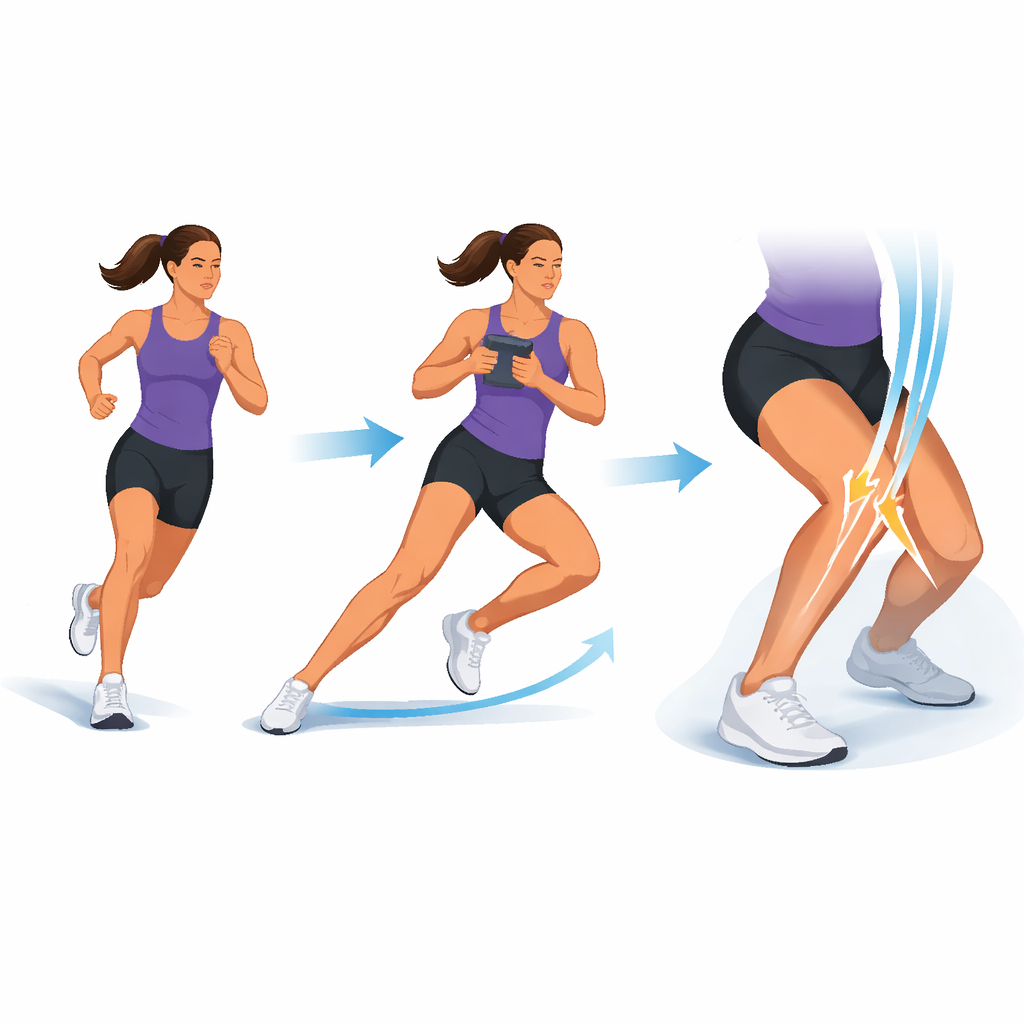
Twenty-one trained female Australian Rules Football players performed sidestep cuts under six conditions that combined two types of drills (pre-planned versus reacting to a last-second visual cue) with two practical constraints. In the trunk constraint, athletes held a small weight at chest height, roughly 5–7.5% of body mass. In the preparatory-step constraint, they ducked under a rope set at eye level just before the plant step, encouraging a lower body position. Motion-capture cameras and force plates tracked how these constraints changed joint power at the hip, knee, and ankle during the stance phase of the cut.
What changed when athletes held a weight
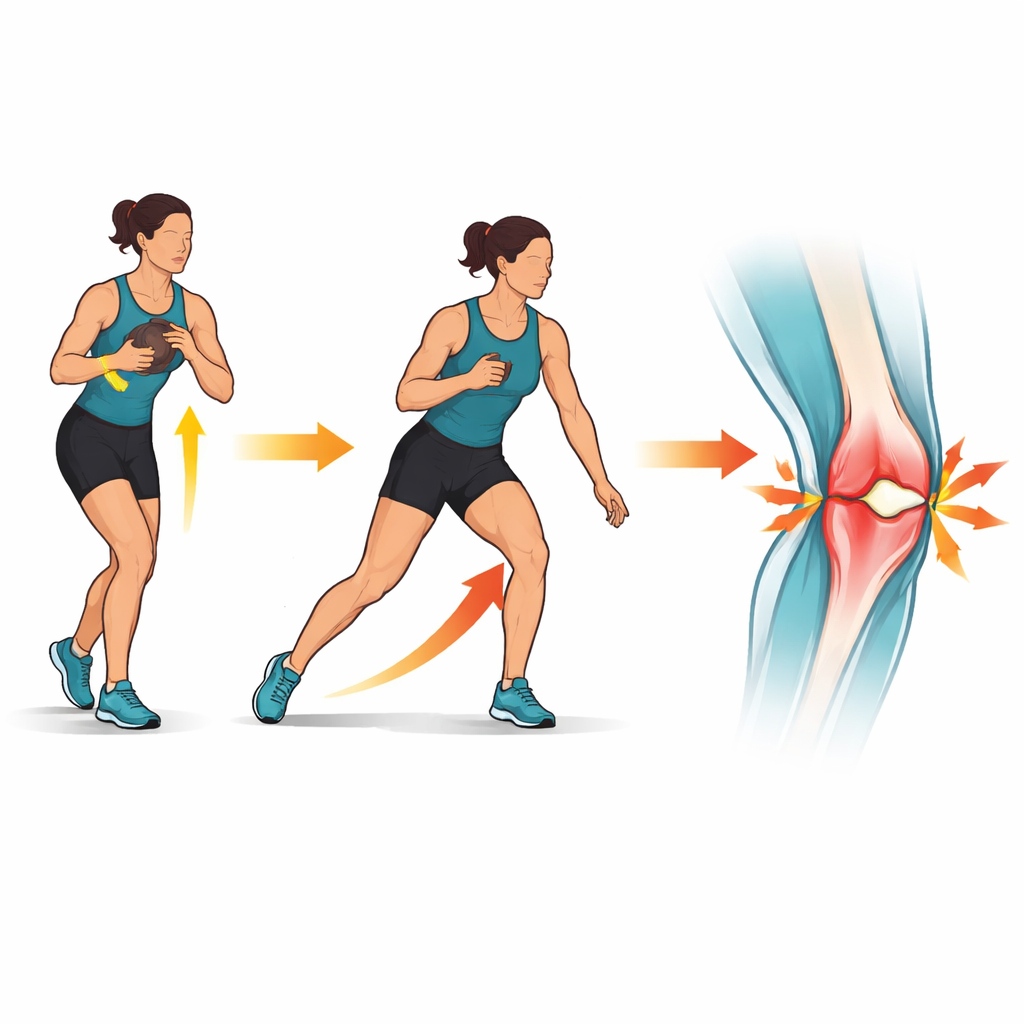
During pre-planned sidesteps—when athletes knew the cutting direction in advance—holding a chest-level weight measurably increased the energy absorbed at the knee early in stance, a time window closely linked to ACL injury. The added load likely shifted the body’s center of mass forward and upward, changing how ground forces lined up with the knee and raising the mechanical demand on the joint. In contrast, ducking under the rope did not reduce knee loading as expected. Instead, it led to greater energy generation at the hip, suggesting the hips were doing more of the work to drive the change of direction while the knee demand remained similar.
Why surprise cuts looked different
When the sidestep direction was revealed at the last moment, none of the constraints meaningfully changed joint power at the knee, hip, or ankle. The key difference was speed: athletes naturally approached unplanned cuts more cautiously, with lower entry velocities. That slower arrival reduced the overall mechanical demands, effectively blunting the impact of added trunk load or altered posture. This behavior fits with the idea that players subconsciously match how aggressively they move to what they believe their bodies can safely tolerate.
What this means for training the female knee
The study shows that a simple on-field constraint—holding a modest weight at the chest during planned sidesteps—can reliably increase how much mechanical energy the knee must absorb, while another constraint shifts effort toward the hip. Used thoughtfully and progressed over time, such drills could help build the strength and resilience of tissues that protect the ACL, better preparing athletes for the high-stress, less-than-perfect positions they inevitably encounter in games. Rather than trying only to avoid risky movements, coaches may be able to safely dose those very stresses in controlled practice, helping female athletes develop more robust knees for real-world play.
Citation: Kadlec, D., Jordan, M.J., Alderson, J. et al. Adding a weight to constrain the trunk increases knee joint kinetics during sidestep cutting in female athletes. Sci Rep 16, 12248 (2026). https://doi.org/10.1038/s41598-026-38368-z
Keywords: ACL injury, sidestep cutting, female athletes, knee loading, constraint-led training