Clear Sky Science · en
Unique phenotypic and T cell receptor characteristics of CD8+ T cells accumulated in the brains of Alzheimer’s disease mice
Why Immune Cells in the Brain Matter for Alzheimer’s
Alzheimer’s disease is usually described in terms of sticky protein clumps and dying nerve cells, but the brain’s immune system is increasingly taking center stage. This study looks at one particular group of immune cells, called CD8 T cells, that settle long term in the brain. By reexamining detailed single-cell data from mouse models of Alzheimer’s and normal aging, the researchers uncovered two major types of these brain-resident T cells that may pull the disease in opposite directions—one potentially protective, the other possibly fueling ongoing damage.
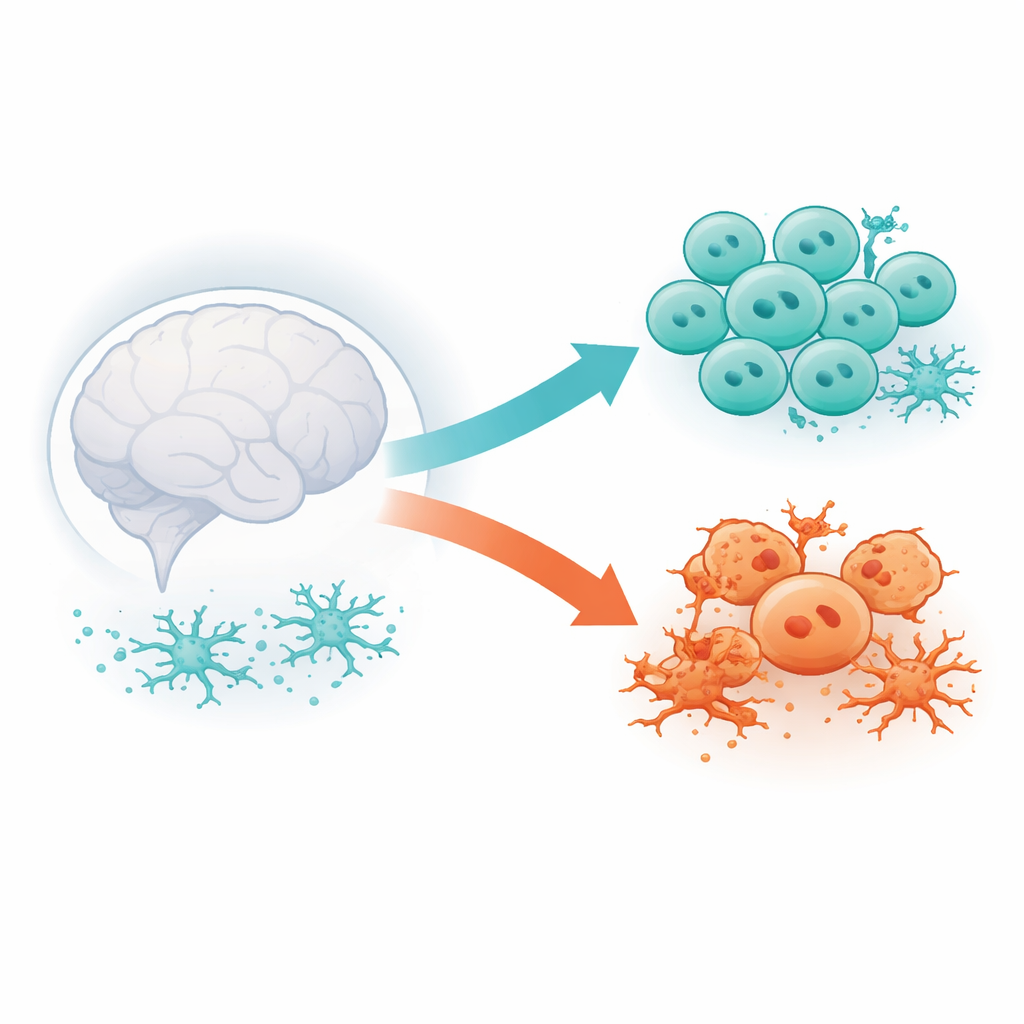
Two Faces of Brain-Resident T Cells
The team focused on CD8 T cells that live in the brain tissue rather than just passing through the blood. Using publicly available single-cell RNA sequencing data from Alzheimer’s-prone mice, their genetically modified cousins, and normally aged mice, they grouped thousands of these cells into clusters based on which genes were switched on. Two large clusters stood out. One depended strongly on a molecule called CXCR6 to enter or stay in the brain and showed hallmarks of an immune “brake” state. The other cluster appeared only when Alzheimer’s-like pathology was present and showed a more alert, stem-like profile, hinting that these cells can persist and generate new waves of active T cells over time.
Aging-Linked Cells That May Protect the Brain
The CXCR6-related cluster dominated in normally aged brains and also appeared in Alzheimer’s mice, but was nearly absent when CXCR6 was knocked out. These cells carried a combination of markers associated with long-term residence in tissues and with dampening immune responses, without showing signs of being fully exhausted or worn out. Earlier experiments by others had suggested that CXCR6-guided CD8 T cells can help reduce amyloid-beta deposits, the protein clumps that define Alzheimer’s. Putting this together, the authors argue that some age-induced T cells are not purely harmful; instead, they may help keep microglia—the brain’s resident immune cells—under control and indirectly limit amyloid buildup, acting as a built-in protective layer in the aging brain.
Disease-Linked Cells With Lasting Impact
The Alzheimer’s-associated cluster told a different story. These T cells showed high levels of genes linked to survival and “stemness,” along with immediate-early response genes that light up when cells are recently activated. They also made inflammatory signals such as interferon-gamma. By tracking the unique T cell receptor (TCR) codes each clone carries, the researchers found that these disease-linked cells shared many clones with other activated clusters, suggesting a continuum from stem-like cells to more aggressive effectors. In contrast, they shared no TCRs at all with the CXCR6-related cluster, implying that they are driven by different triggers. Communication analysis between T cells and microglia pointed to a specific pathway involving galectin-9 and an enzyme called P4HB, which can alter the redox state of the T cell surface and dampen receptor signaling—conditions that may favor the maintenance of long-lived, stem-like T cells.

Do These T Cells Recognize Alzheimer’s Proteins?
To probe what might be driving the disease-linked cells, the team examined the biophysical and structural features of their most expanded TCRs. Using computational tools, they grouped TCRs by the chemical properties of their key contact regions and found that the top two receptors in the Alzheimer’s-associated cluster had unusually distinct profiles, unlike most others in the dataset. They then modeled how these receptors might physically dock onto mouse immune molecules presenting short fragments of amyloid-beta, the core Alzheimer’s protein. For one highly expanded receptor, several amyloid-beta fragments produced stable, plausible binding models with many close contacts between the receptor and the peptide, suggesting that at least some of these T cells could be specifically recognizing amyloid-beta in the diseased brain.
What This Means for Alzheimer’s and Aging
To a non-specialist, the key message is that not all brain-invading T cells are equal. This study shows that aging alone can generate a large pool of resident CD8 T cells that seem tuned to restrain inflammation and may help curb Alzheimer’s-like changes, while Alzheimer’s pathology sparks a separate, long-lived T cell population that may recognize disease proteins and feed ongoing immune activity. Understanding how to boost the protective CXCR6-related cells and temper or redirect the Alzheimer’s-associated stem-like cells could open new avenues for therapies that work with, rather than against, the brain’s own immune system.
Citation: Zhihuan, W., Furusawa-Nishii, E. & Miyake, S. Unique phenotypic and T cell receptor characteristics of CD8+ T cells accumulated in the brains of Alzheimer’s disease mice. Sci Rep 16, 12518 (2026). https://doi.org/10.1038/s41598-026-38351-8
Keywords: Alzheimer’s disease, brain immune cells, CD8 T cells, microglia, amyloid-beta