Clear Sky Science · en
A novel decision analytic model for environmental sustainability challenges using interval-valued complex spherical fuzzy soft sets
Why smart choices matter for a greener planet
Governments, companies, and communities all say they want to be more “environmentally sustainable,” but turning that goal into concrete choices is hard. Should a city invest first in cleaner air, in protecting wildlife, in better farming practices, or in renewable energy? Experts often disagree, and their opinions are uncertain or incomplete. This paper presents a new mathematical way to combine those messy views into clearer rankings of sustainability options, helping decision‑makers choose actions that do the most good for the environment.
A new lens for fuzzy, uncertain opinions
Real‑world sustainability decisions rarely come with precise numbers. Experts might say a project is “quite helpful for air quality” or “somewhat risky for biodiversity,” but not exactly how much. Traditional tools such as standard fuzzy sets or soft sets can handle some vagueness, yet they struggle when opinions include not only support and opposition, but also neutrality and ranges of possible values. The authors build on recent advances in “spherical” and “complex” fuzzy mathematics to create a richer description of expert views, one that can record how strongly someone supports an option, how strongly they oppose it, how neutral they feel, and how uncertain all of those statements are.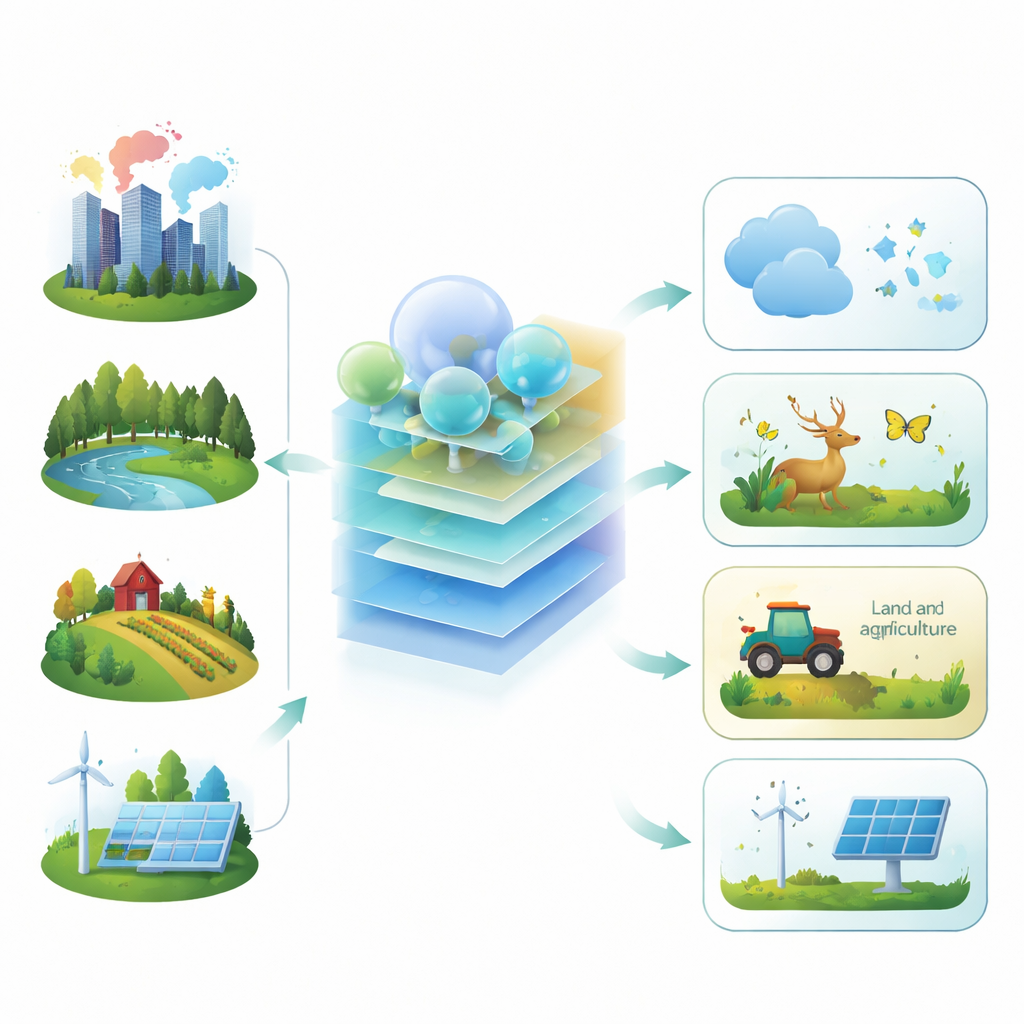
Capturing shades of agreement, doubt, and disagreement
The core of the paper is a structure with an intimidating name: interval‑valued complex spherical fuzzy soft sets. In plain terms, this structure lets each expert rate an option using three ingredients—support, neutrality, and opposition—each expressed not as a single number but as a range, and with an additional “phase” component that captures subtle patterns in the data. The authors then show how to perform basic operations with these rich ratings, such as combining them, scaling their influence, or reversing them. These rules make it possible to plug the new structure into practical decision models without losing mathematical consistency.
Blending many voices into a single ranking
To turn a table of expert scores into a decision, the study introduces two key aggregation tools: a weighted average operator and a weighted geometric operator tailored to the new fuzzy structure. Both operators take into account how important each expert is, how important each sustainability criterion is, and how uncertain each judgment may be. The weighted average is better at reflecting typical or consensus views, while the weighted geometric version emphasizes consistent strength across criteria. The authors define score and accuracy functions that convert each blended fuzzy assessment into a single index, which can then be used to rank competing environmental options from most to least desirable.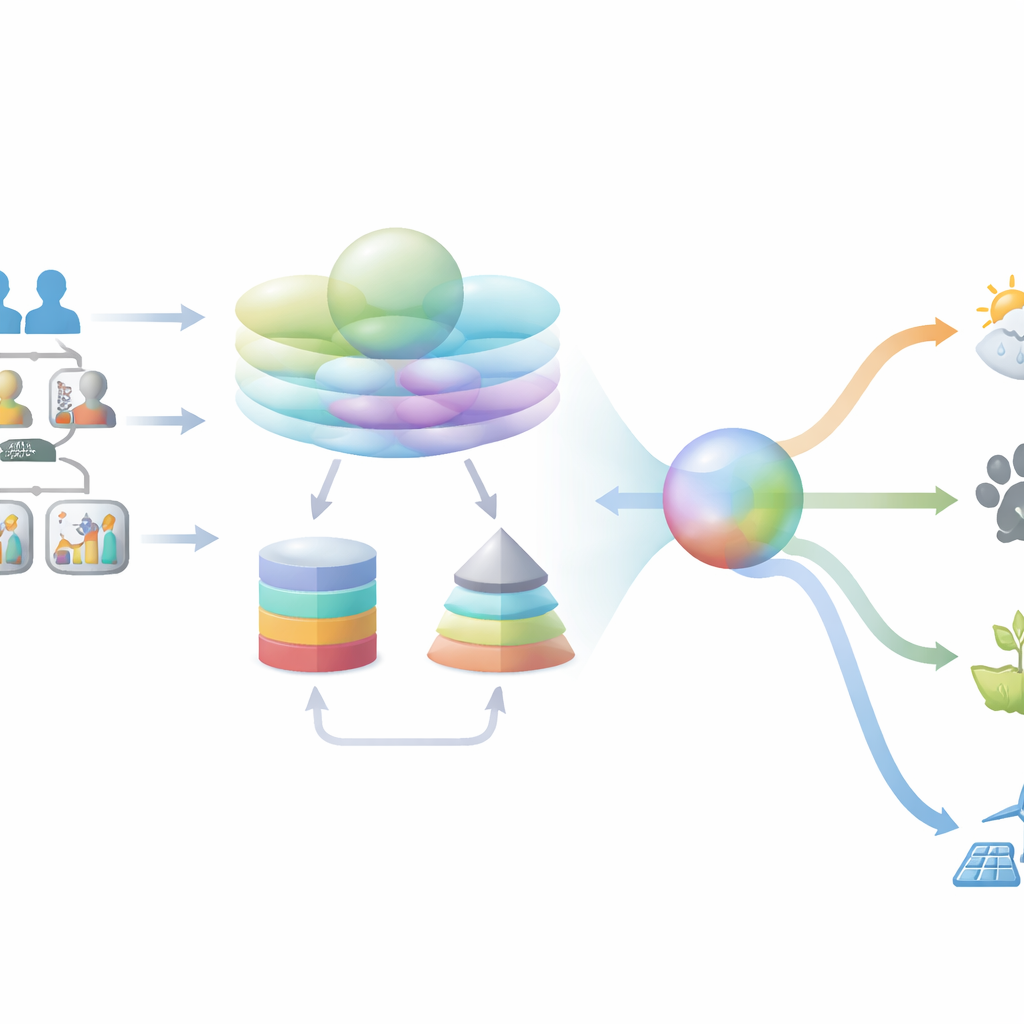
Testing the model on real sustainability choices
To illustrate how the method works, the authors design a case study with four broad environmental options: improving air and pollution control, protecting biodiversity and ecosystems, enhancing land and agriculture, and expanding renewable energy resources. Four experts evaluate each option under four criteria: cleaner air, public awareness and acceptance, contribution to the green economy, and technological feasibility. Using the new aggregation tools, the model processes all these interval‑based, three‑part opinions and produces scores for each option. In both the average‑based and geometric‑based calculations, renewable energy emerges as the top choice, followed by land and agriculture, biodiversity protection, and finally air and pollution control.
Standing out among existing decision tools
The study also compares its approach with earlier fuzzy models that lack either interval‑based uncertainty, explicit neutrality, or the flexible “soft” parameter structure. Those older methods can still rank options, but they have trouble representing the full spectrum of expert hesitation and conflict that arises in complex environmental systems. By contrast, the new method can simultaneously model support, doubt, and opposition, while also allowing each rating to be a range rather than a single point. This makes it better suited to real decision settings where data are incomplete, experts disagree, and trade‑offs between social, economic, and ecological goals are intricate.
What this means for real‑world green decisions
In accessible terms, the paper offers a smarter calculator for sustainability. It does not tell policymakers what their priorities should be, but it gives them a transparent way to merge many uncertain and sometimes conflicting expert views into a clear ordering of options. In the example explored here, that process consistently highlights renewable energy projects as the most promising path, given the chosen criteria and expert inputs. More broadly, the framework can be adapted to other domains—from water management to urban planning—helping leaders reason more carefully about environmental trade‑offs instead of relying on rough guesses or loudest voices.
Citation: Ali, S., Kumam, P., Naveed, H. et al. A novel decision analytic model for environmental sustainability challenges using interval-valued complex spherical fuzzy soft sets. Sci Rep 16, 13052 (2026). https://doi.org/10.1038/s41598-026-35366-z
Keywords: environmental sustainability, multi-criteria decision-making, fuzzy logic, renewable energy, expert aggregation