Clear Sky Science · en
A chromosome-scale genome assembly of Wu’s rock agama (Laudakia wui) from low-altitude habitats
A Lizard in a Steamy River Valley
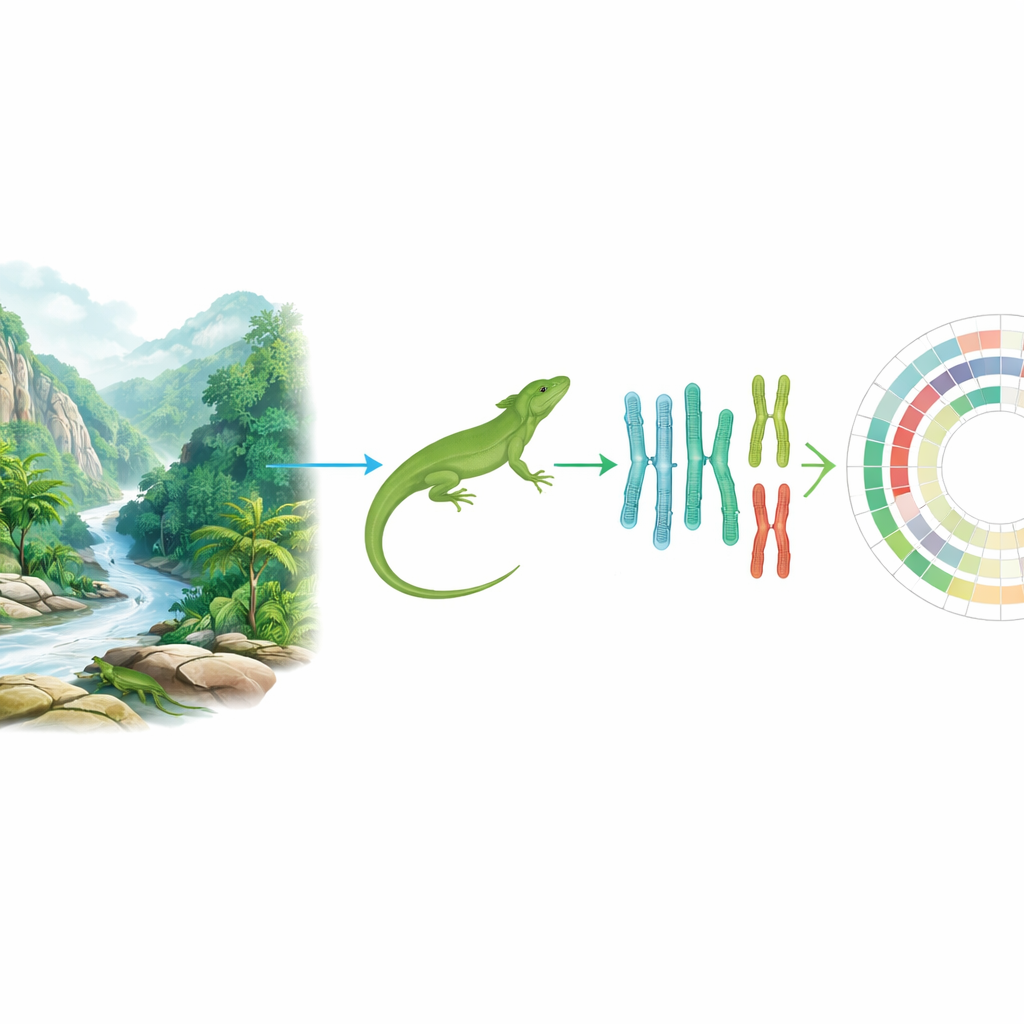
Along the deep valleys of the Yarlung Zangbo River in southeastern Xizang, China, a rock-dwelling lizard known as Wu’s rock agama makes its home on sunlit cliffs in a hot, humid rainforest climate. This study builds a detailed genetic blueprint of a population living at unusually low altitude, where temperatures and moisture resemble tropical jungles more than high mountain slopes. By decoding this lizard’s DNA at the level of whole chromosomes, the researchers open a window into how reptiles adjust to very different environments along a steep mountain valley, and provide a powerful new tool for conserving a species found nowhere else on Earth.
Life on Hot Rocks
Wu’s rock agama is a medium-sized lizard with a flat, rock-hugging body and a long, sturdy tail. It lives only in the Yarlung Zangbo River basin and nearby valleys, spreading from around 550 meters to more than 2,300 meters above sea level. At lower sites such as Mêdog County, the climate is shaped by warm, moist air from the Indian Ocean: temperatures stay high, rainfall is abundant, and dense monsoon forest covers the valley walls. At higher sites, conditions are cooler and drier. These sharp shifts over short distances make Wu’s rock agama an excellent natural example for studying how animals adjust to different combinations of heat and humidity, and how those adjustments are written into their DNA.
Reading the Genome Like a Map
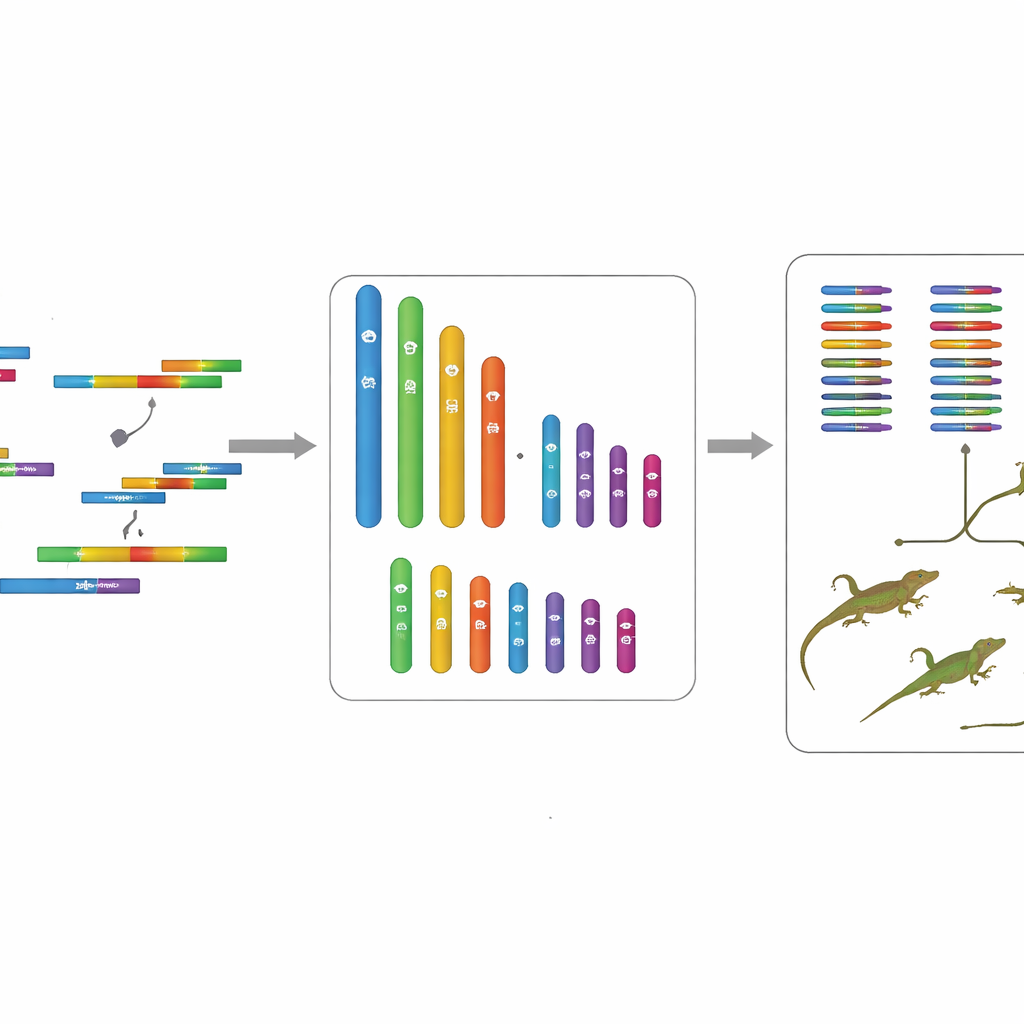
To build a precise picture of the low-altitude population’s genetic makeup, the team collected a healthy adult female from Mêdog and extracted DNA from several tissues. They then used a combination of state-of-the-art sequencing methods. One technology produced many long, highly accurate DNA stretches, which are especially useful for stitching together big pieces of the genome. Another produced huge numbers of shorter fragments, handy for checking accuracy and estimating overall genome size. A third technique, called Hi-C, captured how pieces of DNA sit next to one another inside the cell nucleus, helping the scientists arrange long DNA stretches into complete chromosomes—much like using the folds of a crumpled map to restore its original layout.
From Fragments to Full Chromosomes
By carefully assembling and cross-checking all of these data, the researchers produced a genome about 1.77 billion DNA “letters” long, organized into 18 chromosomes. Six of these are large, so-called macrochromosomes, and twelve are smaller microchromosomes. Automated computer tools then scanned this DNA landscape to identify stretches that act as genes, predicting 19,725 protein-coding genes in total. Most of these genes could be linked to known functions by matching them to large public databases, and standard quality checks showed that the assembly captures the vast majority of important vertebrate genes with very few gaps or errors. Repeated DNA segments such as jumping genetic elements were also cataloged, revealing that they make up roughly two-fifths of the genome.
Mountain Neighbors, Genetic Cousins
Because a previous study had already decoded the genome of a high-altitude population of Wu’s rock agama, the team could compare the two. The largest chromosomes lined up cleanly between the low- and high-altitude genomes, suggesting that the overall structure of the species’ genetic “bookshelves” is quite stable. In contrast, the smaller chromosomes showed more differences, hinting that they may be hotspots for change as the species adapts to different elevations. By also comparing both populations to several related lizard species, the researchers estimated that the high- and low-altitude lineages split roughly 4.8 million years ago, leaving plenty of time for subtle genetic differences to build up in response to their distinct climates.
Why This Genome Matters
The new chromosome-scale genome for the low-altitude Wu’s rock agama is not a medical breakthrough or a new gadget, but a carefully crafted reference work. It gives scientists a detailed, reliable framework for uncovering which genes and DNA changes help reptiles cope with intense heat and moisture in tropical valleys, as opposed to cooler, drier slopes higher up. Just as importantly, it provides conservation planners with a molecular record of a unique population living in an ecologically critical river basin, supporting more informed efforts to guard both the lizard and the rich web of life that shares its steep, steamy habitat.
Citation: Tan, S., Wang, Y., Chen, Y. et al. A chromosome-scale genome assembly of Wu’s rock agama (Laudakia wui) from low-altitude habitats. Sci Data 13, 501 (2026). https://doi.org/10.1038/s41597-026-06845-9
Keywords: genome assembly, lizard adaptation, tropical montane valleys, chromosome evolution, biodiversity conservation