Clear Sky Science · en
A telomere-to-telomere genome assembly of Castanopsis orthacantha (Fagaceae)
A Tree That Holds a Forest Together
High in the evergreen mountains of southwestern China grows a sturdy tree whose wood builds homes, whose nuts feed people, and whose roots help hold whole hillsides in place. This tree, Castanopsis orthacantha, is a quiet pillar of local life and of the forests that soften floods, store carbon, and shelter countless other species. The study described here delivers something invisible but powerful for this keystone tree: a nearly complete, end‑to‑end readout of its genetic blueprint, opening new ways to understand and protect these forests in a warming world.
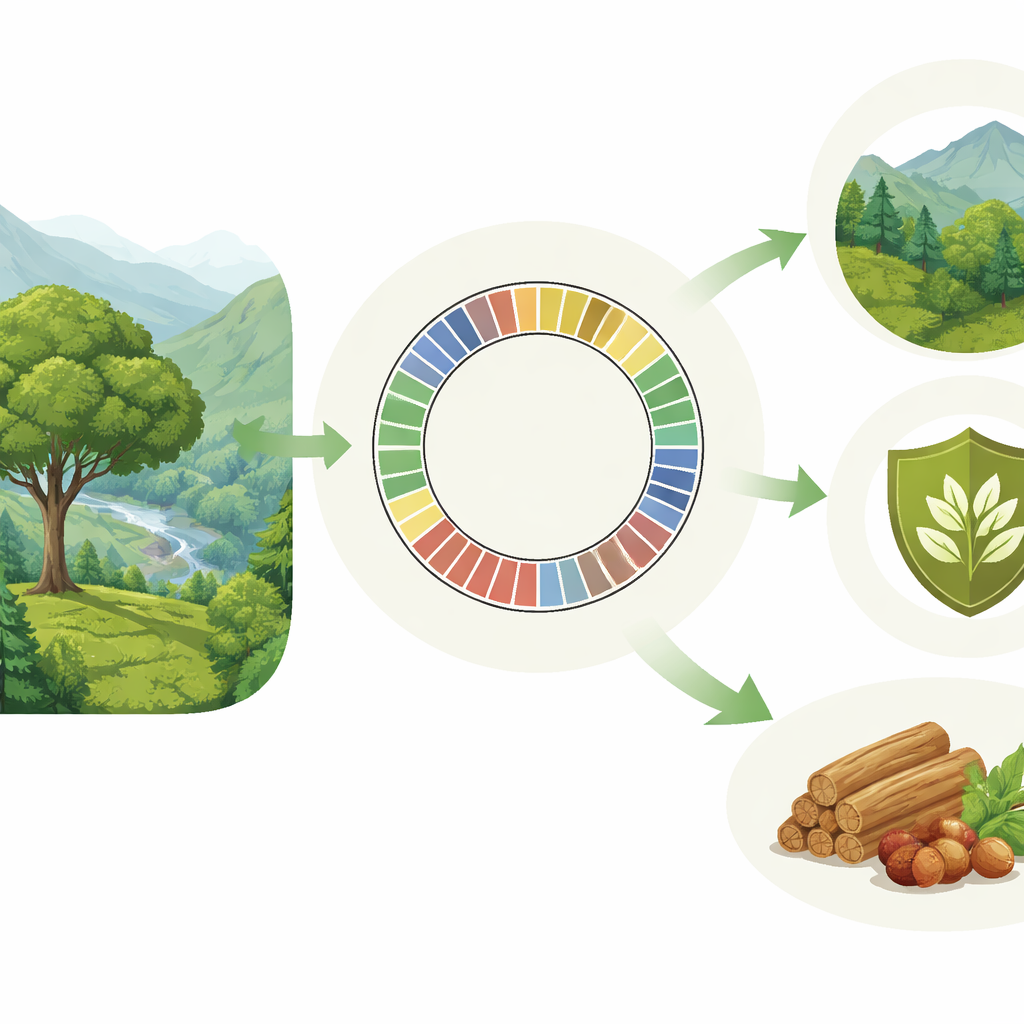
Why This Mountain Tree Matters
Castanopsis orthacantha is part of the beech and oak family and is especially abundant in the subtropical evergreen forests of the Yunnan plateau. It thrives between 1,700 and 2,500 meters above sea level, where steep slopes and changing weather make stable forests crucial. Its dense, rot‑resistant wood is prized for construction and furniture, and its nuts have long helped local communities get through lean years. Ecologically, it is a “foundation” species: where it grows well, soils stay in place, water flows more gently, and many other plants and animals can flourish around it.
Reading the Tree’s Entire Genetic Blueprint
The research team set out to assemble the tree’s genome from one end of each chromosome to the other—a level of completeness that until recently was possible only for a handful of species. They collected fresh leaves, flowers, and young stems from a mature tree on Maxiong Mountain in Yunnan. From these tissues they extracted both DNA, which carries the long‑term genetic instructions, and RNA, which captures which genes are active in different parts of the plant. These molecules became the raw material for a series of advanced sequencing and mapping techniques.
Many Lenses on the Same Genome
Instead of relying on a single technology, the scientists combined several, each with its own strengths. Short, highly accurate DNA snippets were generated with one platform to provide a clean, detailed view. Another platform produced long, high‑fidelity reads that could bridge stretches of repeated or tricky DNA. A third provided ultra‑long fragments that ran across especially tangled regions. Finally, a technique that measures how pieces of DNA sit next to each other inside real chromosomes helped the team order and orient the assembled fragments along 12 chromosome‑length “pseudomolecules.” This layered strategy produced a genome about 893 million DNA letters long, with nearly all of it neatly assigned to chromosomes and only a single small gap remaining.
What Lives Inside This Genome
Once the genetic scaffold was in place, the researchers went on to label its contents. They found that almost three‑fifths of the genome is made of repeated elements, the jumping or duplicated sequences that fill much of plant DNA and often confound older sequencing methods. On top of this backdrop they identified 35,978 protein‑coding genes, each a potential instruction for building some part of the tree’s body or response system. By comparing these genes with those from related species and with large public databases, they could assign likely roles to nearly all of them and map out where they sit along the chromosomes. They also cataloged thousands of smaller RNA molecules that help fine‑tune how and when genes are switched on.

A New Toolkit for Forest Futures
To ensure that this genome can be trusted as a reference, the team checked how well the original DNA reads re‑aligned to it and how many widely conserved plant genes it contained; the assembly passed these tests with flying colors. For scientists, this means a reliable foundation for studying everything from the tree’s evolutionary history to how it copes with cold, drought, or pests. For conservation planners and forest managers, it creates a powerful toolkit for tracking genetic diversity, guiding restoration plantings, and selecting trees better suited to future climates. In essence, the study turns a once‑mysterious mountain tree into a genetically well‑mapped ally in efforts to keep China’s subtropical forests healthy and resilient.
Citation: Yin, S., Wang, H., Chu, H. et al. A telomere-to-telomere genome assembly of Castanopsis orthacantha (Fagaceae). Sci Data 13, 450 (2026). https://doi.org/10.1038/s41597-026-06787-2
Keywords: forest genomics, subtropical trees, genome assembly, ecosystem resilience, conservation genetics