Clear Sky Science · en
Phosphorylation of Runx protein controls helper CD4+ T cell versus cytotoxic CD8+ T cell lineage choice
How immune cells decide their jobs
Our immune system relies on T cells that either coordinate defenses (helper CD4+ cells) or directly kill infected and cancerous cells (cytotoxic CD8+ cells. This paper asks a deceptively simple question: when young T cells are maturing in the thymus, how do they decide which of these two very different careers to pursue? The authors uncover a tiny chemical tag on a single amino acid of a protein called Runx that acts as a molecular switch, connecting outside cues to this life‑defining choice.
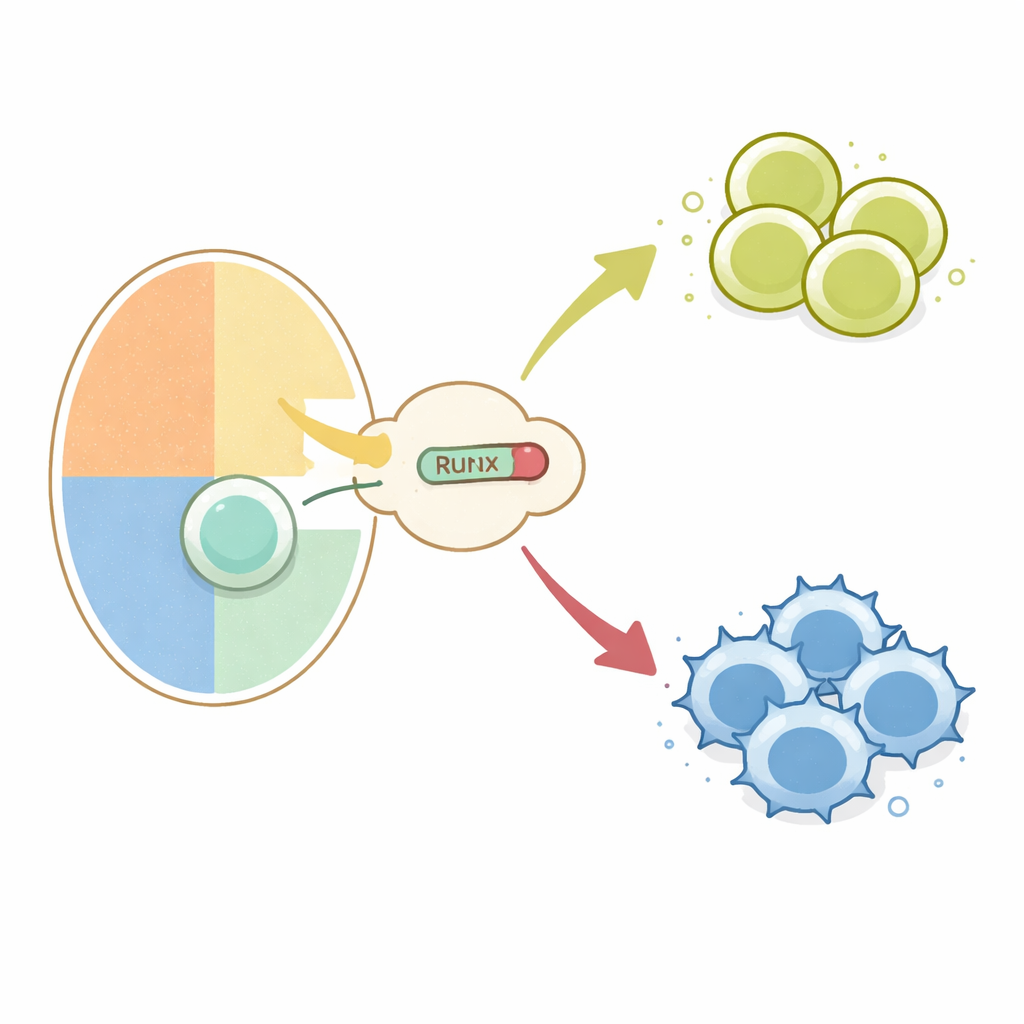
A crossroads inside the thymus
All conventional T cells start as immature precursors in the thymus that display both CD4 and CD8 surface molecules. As they test their receptors against self molecules, they are instructed to become either helper (CD4) or killer (CD8) T cells. Earlier work showed that turning off two genes, Cd4 and Thpok, is essential for the killer fate. This shutdown is driven by Runx family transcription factors working with TLE corepressor proteins on special DNA regions called silencers. What was unknown is how signals from the T cell receptor, which distinguish interactions with major histocompatibility complex class I (leading to killers) versus class II (leading to helpers), are wired into this Runx–TLE silencing machinery.
A single-letter change turns Runx into a brake
The Runx proteins end in a short motif, WRPY, that docks onto TLE proteins. The team engineered mice in which the final amino acid, tyrosine (Y), was replaced by tryptophan (W) or phenylalanine (F), creating versions dubbed RunxWRPW or RunxWRPF. These subtle changes converted Runx1 and Runx3 into powerful, almost always‑on repressors. Mice expressing these mutant forms showed severe defects in many Runx‑dependent cell types: CD8 T cells were nearly absent, natural killer cells and certain innate lymphoid cells failed to develop, and in the case of Runx1, embryos died with a loss of blood‑forming stem cells. This revealed that the normal terminal Y residue is required to keep Runx balanced between activating and repressing genes.
Rewiring helper cells into killers
To focus on T cell fate choice, the authors used a genetic switch to turn on either normal Runx or RunxWRPW/RunxWRPF specifically in developing thymocytes. When the mutant Runx was expressed from the double‑positive stage onward, cells that normally recognize class II molecules—and would become CD4 helper cells—were instead redirected into the CD8 lineage and lost CD4 expression. Even T cells carrying a transgenic receptor known to enforce the helper fate were converted into killer‑like cells. This redirection depended on the same silencers in the Cd4 and Thpok genes, and on TLE proteins, showing that overly strong Runx–TLE repression overrides the usual link between receptor specificity and lineage.
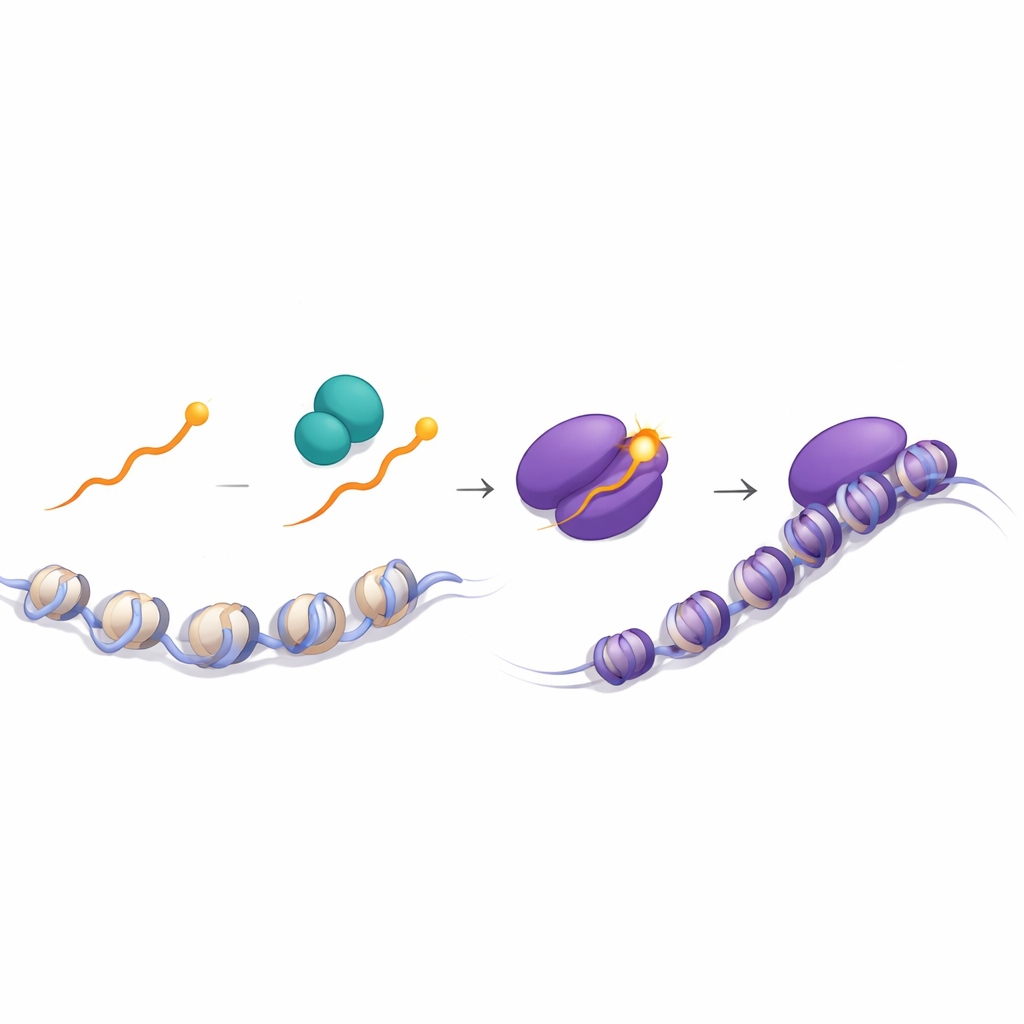
A phosphorylation switch that senses external cues
The key insight came from examining the normal Runx1 tail. Using mass spectrometry, the authors found that the terminal Y is phosphorylated—decorated with a phosphate group—far more in CD8 thymocytes than in CD4 thymocytes. This modification greatly strengthens Runx1’s interaction with TLE3. In cells lacking the tyrosine kinase Lck, this phosphorylation was nearly absent, implicating Lck and its partner Zap70, both central transmitters of T cell receptor signals. Imaging experiments showed that Runx1 encounters Lck and Zap70 mainly in the cytoplasm, and that such encounters are more frequent in cells signaled through class I molecules. Structural simulations supported the idea that a phosphorylated Y, or a Y replaced by F or W, stabilizes Runx binding to the TLE WD40 domain, promoting assembly of a potent repressor complex on silencers.
From tiny chemical tag to immune cell identity
Taken together, the study proposes that phosphorylation of the single terminal tyrosine on Runx proteins acts as a sensitive dial: in class I–signaled thymocytes, higher phosphorylation recruits TLE more efficiently to silencers in the Cd4 and Thpok genes, shutting them down and locking in the cytotoxic CD8 fate. In class II–signaled cells, low phosphorylation leaves Runx less tightly bound to TLE, those silencers stay ineffective, and the helper CD4 program proceeds. For a lay reader, the message is that the immune system can use a minute chemical tweak on one end of a protein to translate subtle receptor signals into an all‑or‑nothing choice between two central T cell types, illustrating how finely tuned molecular switches underpin robust decisions in development.
Citation: Ogawa, C., Okuyama, K., Kojo, S. et al. Phosphorylation of Runx protein controls helper CD4+ T cell versus cytotoxic CD8+ T cell lineage choice. Nat Immunol 27, 799–811 (2026). https://doi.org/10.1038/s41590-026-02441-6
Keywords: T cell differentiation, Runx phosphorylation, CD4 versus CD8 lineage, gene silencing, thymic development