Clear Sky Science · en
Warming and snow loss increase reliance on old groundwater in a Colorado River headwater
Why mountain water matters to you
Many cities and farms in the American West rely on water that begins as snow high in the Rocky Mountains. This study asks what happens to that water supply as winters warm and snowpacks shrink in the headwaters of the Colorado River, a river that supports tens of millions of people. By looking not just at snow and streams but also at hidden groundwater deep inside the mountains, the researchers reveal that our future water security may depend on very old water stored underground.
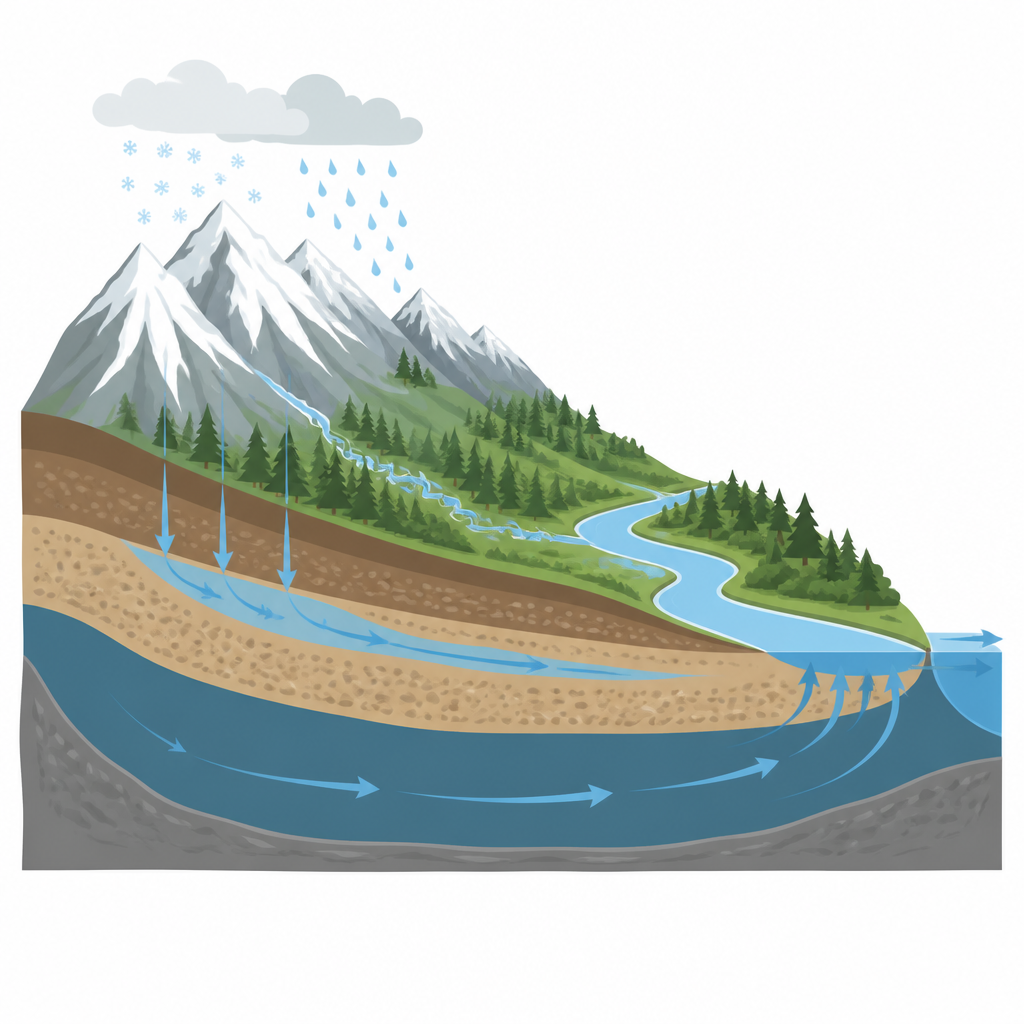
Snowy peaks as natural water towers
Mountain ranges act like natural water towers, storing winter snow and slowly releasing it as meltwater that feeds rivers through spring and summer. In the East River watershed of Colorado, a key source for the Colorado River, long term observations have shown big year to year swings in snowpack but surprisingly little was known about the groundwater beneath. New measurements from a line of wells revealed two important clues: water tables have been dropping over several years, even when snow varied a lot, and some of the groundwater is decades to thousands of years old. This raised a pressing question: is this old groundwater quietly propping up streamflow during lean snow years, and how might that change as the climate warms?
Simulating a warming future
To answer this, the team used a sophisticated computer model that links snow, soil, rock, vegetation and streams across the entire watershed. They simulated seven recent water years under observed weather, then ran two what if scenarios in which air temperatures were raised by 2.5 and 4 degrees Celsius while keeping precipitation totals the same. Warmer air meant more winter storms fell as rain instead of snow, snow melted earlier, and plants pulled more water back into the atmosphere. The model tracked not only where the water went, but also how long it had been underground by following millions of virtual water parcels as they moved from rain or snow through the subsurface to the river.
Hidden groundwater as a quiet stabilizer
The simulations showed that groundwater is far from a static reservoir. Over the seven year period, total groundwater storage steadily declined, and this decline became faster in the warmer scenarios. Yet groundwater played a stabilizing role for the river: contributions of very old groundwater to streamflow stayed nearly constant through time, while younger groundwater and surface runoff varied strongly with yearly weather. In the lowest snow year of the study, the river actually had one of its highest runoff efficiencies, because groundwater drained to the stream to make up for lost snowmelt. In other words, the river leaned more heavily on long stored water to keep flowing when fresh inputs from snow were scarce.
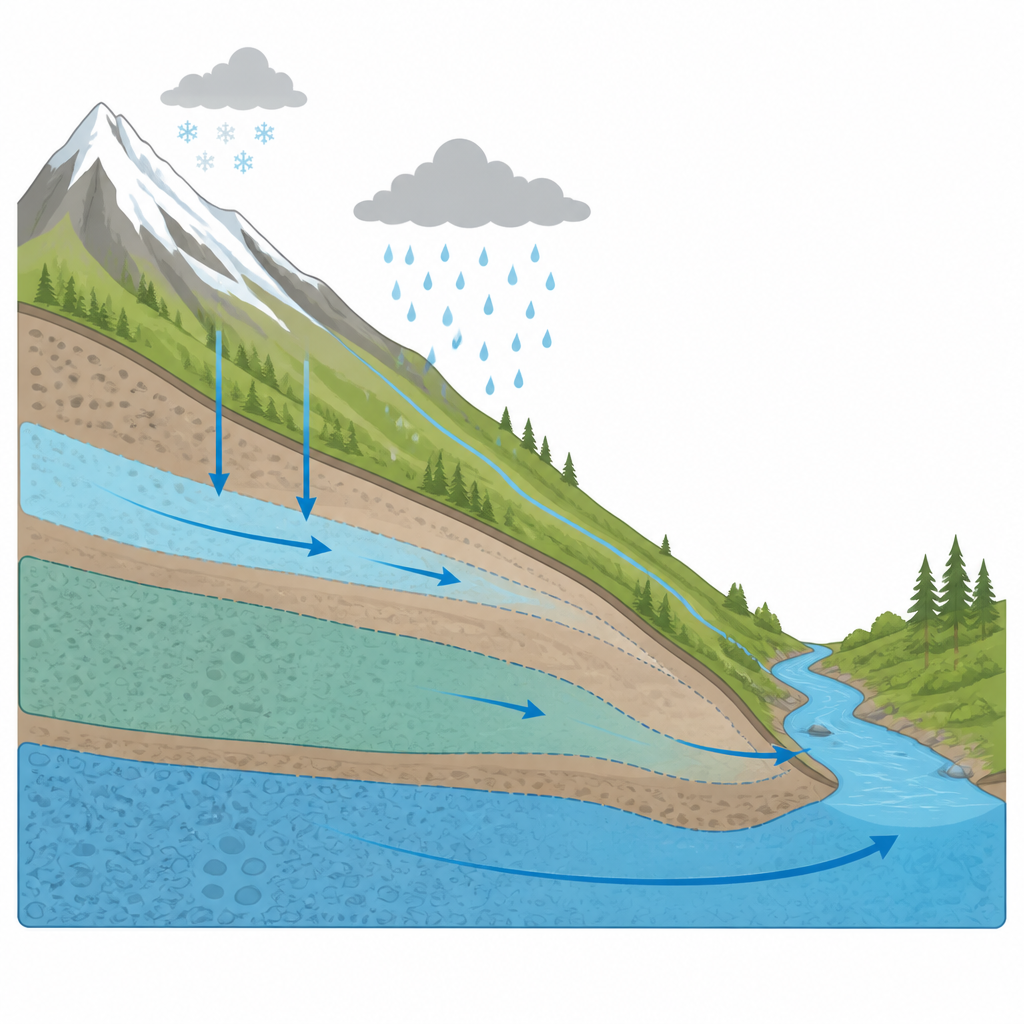
Warming shifts the source and age of river water
As temperatures rose in the model experiments, more winter rain and earlier snowmelt briefly raised groundwater levels each year, but this boost lasted only a few weeks. Over the full year, stronger evaporation and plant water use meant that groundwater levels ended lower than they began, and this net loss became most severe at the highest elevations above about 3,700 meters. The age of water feeding the river increased as well: during low flow periods, median groundwater age at the stream outlet grew from about four to six years in the baseline run and up to eight years in the warmest case. Intermediate age groundwater, about one to three years old, dwindled fastest, while the fraction of very old groundwater in streamflow crept upward to partially compensate. The result is less total water in the river, but a larger share of it coming from older, deeper stores.
What this means for future water supplies
For people and ecosystems downstream, the study suggests that today’s river flows are quietly subsidized by ancient groundwater that is being drawn down and not fully replaced. As snowpacks decline and warming continues, high elevation groundwater appears especially vulnerable, and wet years may not be able to fully refill what is lost during dry ones. In practical terms, communities that depend on mountain snowmelt are increasingly relying on old underground reserves, a strategy that cannot continue forever. Recognizing and monitoring this hidden groundwater buffer will be crucial for planning reservoirs, water rights and conservation in a future where snow is less reliable.
Citation: Siirila-Woodburn, E.R., Thiros, N., Newcomer, M. et al. Warming and snow loss increase reliance on old groundwater in a Colorado River headwater. Nat. Geosci. 19, 549–555 (2026). https://doi.org/10.1038/s41561-026-01945-y
Keywords: mountain groundwater, snowpack loss, Colorado River headwaters, streamflow change, climate warming