Clear Sky Science · en
The global geography of plant invasion risk under future climate and land-use changes
Why future plant invasions matter
Many of the plants we see in gardens, fields and along roadsides did not originally grow there. When some of these newcomers spread out of control, they can crowd out local species, alter ecosystems and affect farming and forestry. This study asks a simple but urgent question: where on Earth will these troublesome plants find the easiest foothold as climate and land use change over the rest of this century?
Mapping unwanted guests worldwide
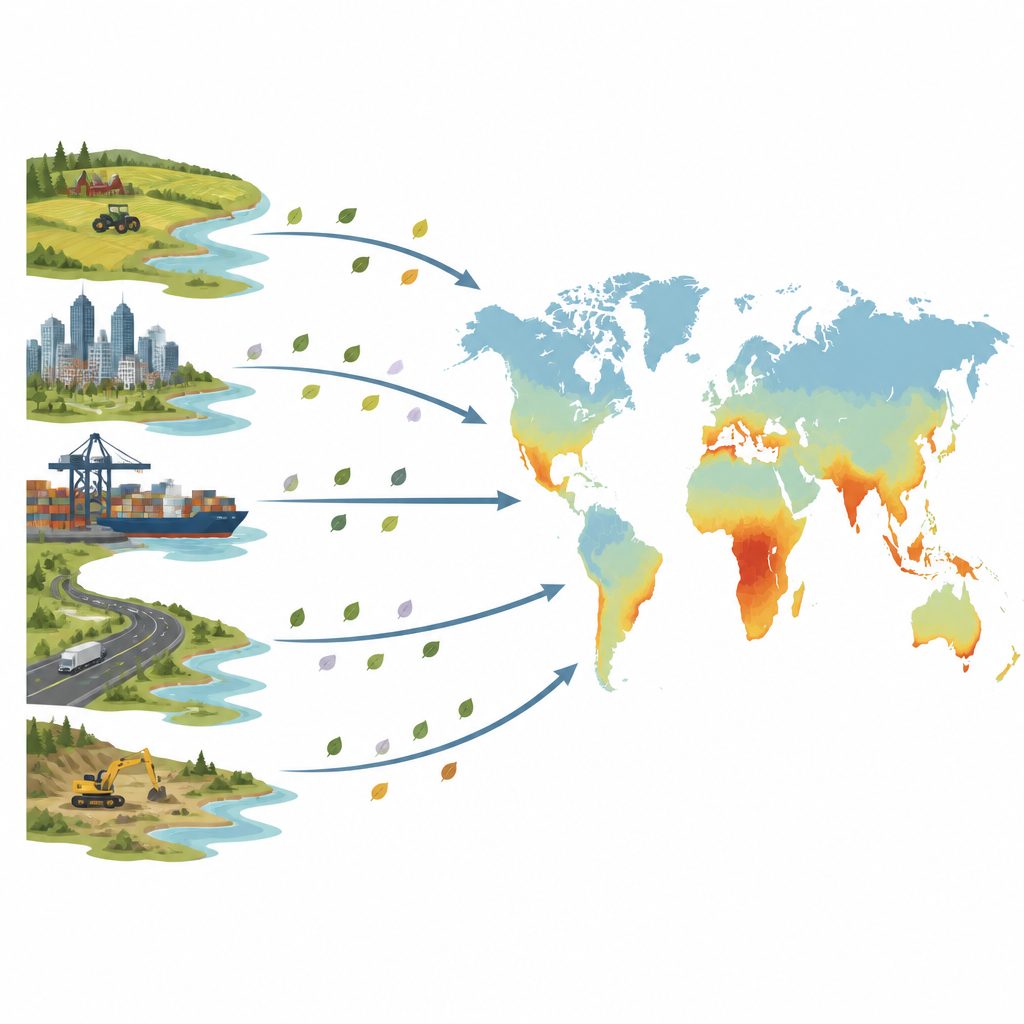
The researchers compiled records for 9,701 plant species that have already formed self-sustaining populations outside their home regions. Using global databases of climate, land use and soil conditions, they built computer models to estimate where each species could potentially grow today and in the future. They then overlaid these maps to calculate how many alien plant species could thrive in each 10 by 10 kilometer square of land across the planet.
Today’s hotspots of invasion risk
The models show that some areas of the world are suitable for thousands of naturalized alien plants, while others can host only a few dozen. At present, the highest potential richness occurs mainly in temperate regions such as Europe, North America, parts of South America, Australia and New Zealand. Overall, about one-third of the world’s land surface appears suitable for at least one in ten of the modelled species, marking these places as hotspots of invasion risk. These hotspots tend to coincide with dense human activity, where cities, farms and transport networks disturb natural vegetation and move plant material around, making it easier for alien species to take hold.
Hidden risk in the tropics
Interestingly, the models also predict high potential richness of alien plants in some tropical and subtropical regions of South America, sub-Saharan Africa and Southeast Asia. Current field records, however, show fewer established alien species there. This mismatch probably reflects gaps in sampling, limits on long-distance spread between tropical regions and strong resistance from diverse native plant communities. Because many tropical species lacked enough data to be modelled, the study suggests that invasion risks in these warm regions may be underestimated rather than low.
How climate and land use reshape the map
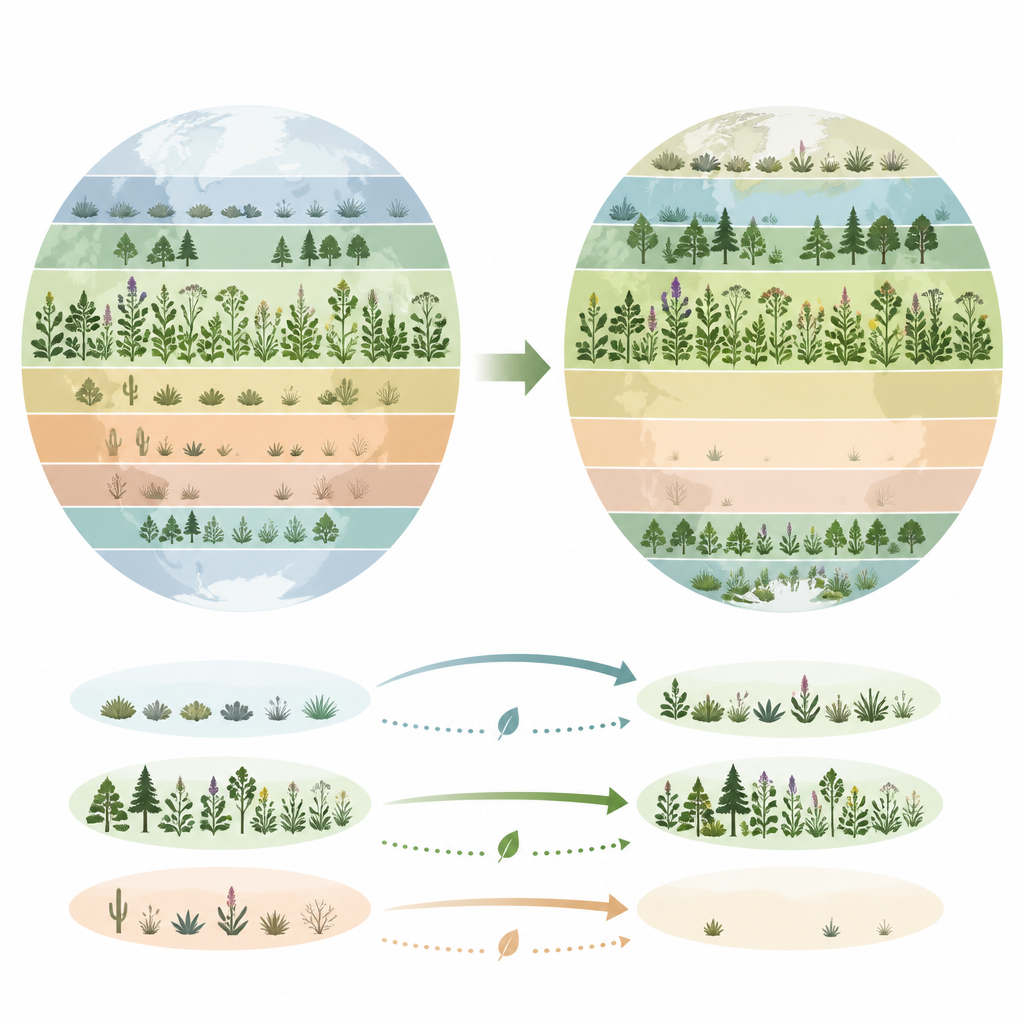
Looking ahead to 2071–2100 under both mild and severe scenarios of climate and land-use change, the total share of land classified as an invasion hotspot rises only moderately. Yet this stability in overall area hides major shifts in where those hotspots will be. As temperatures climb, regions that are now cool, such as boreal forests and tundra near the poles, become much more suitable for alien plants. At the same time, many currently temperate and subtropical semi-arid zones are projected to lose suitable conditions, especially under hotter, drier futures. Within regions, the mix of alien species is also expected to change, with some areas experiencing near-complete turnover in which species can find a home.
Limits and what they still tell us
The authors tested different climate models, future scenarios and modelling choices to estimate uncertainty. Some sources of error remain, including incomplete species records, unknown future trade patterns and the time it takes plants to spread into newly suitable areas. Even when accounting for these issues, the broad picture holds: human pressure and temperature are the main drivers of where alien plants can thrive, and their suitable zones are likely to expand toward higher latitudes.
What this means for people and nature
For non-specialists, the core message is straightforward. Many alien plants already have the potential to invade large parts of the world, and climate and land-use change will shuffle and in some places intensify this risk. Cooler regions that today seem relatively safe may become future hotspots, while some hotter and drier regions may face fewer new arrivals but still see big changes in which alien species are present. These insights can help guide biosecurity, conservation and land management so that societies focus limited resources on the places and times when they are most needed.
Citation: Omer, A., Dullinger, S., Wessely, J. et al. The global geography of plant invasion risk under future climate and land-use changes. Nat Ecol Evol 10, 952–960 (2026). https://doi.org/10.1038/s41559-026-03040-2
Keywords: invasive plants, climate change, global hotspots, biodiversity, land use