Clear Sky Science · en
Promising climate progress from net-zero ambitions to the Paris Agreement goal
Why this matters for our future
Global promises to cut climate pollution have multiplied in recent years, with many countries now pledging to reach “net-zero” emissions around mid-century. This study asks a crucial question for everyone’s future: if governments actually deliver on these promises, how much closer do we get to the temperature limits set by the Paris Agreement—and what extra effort is still needed to avoid the worst climate risks?
Following different paths for the planet
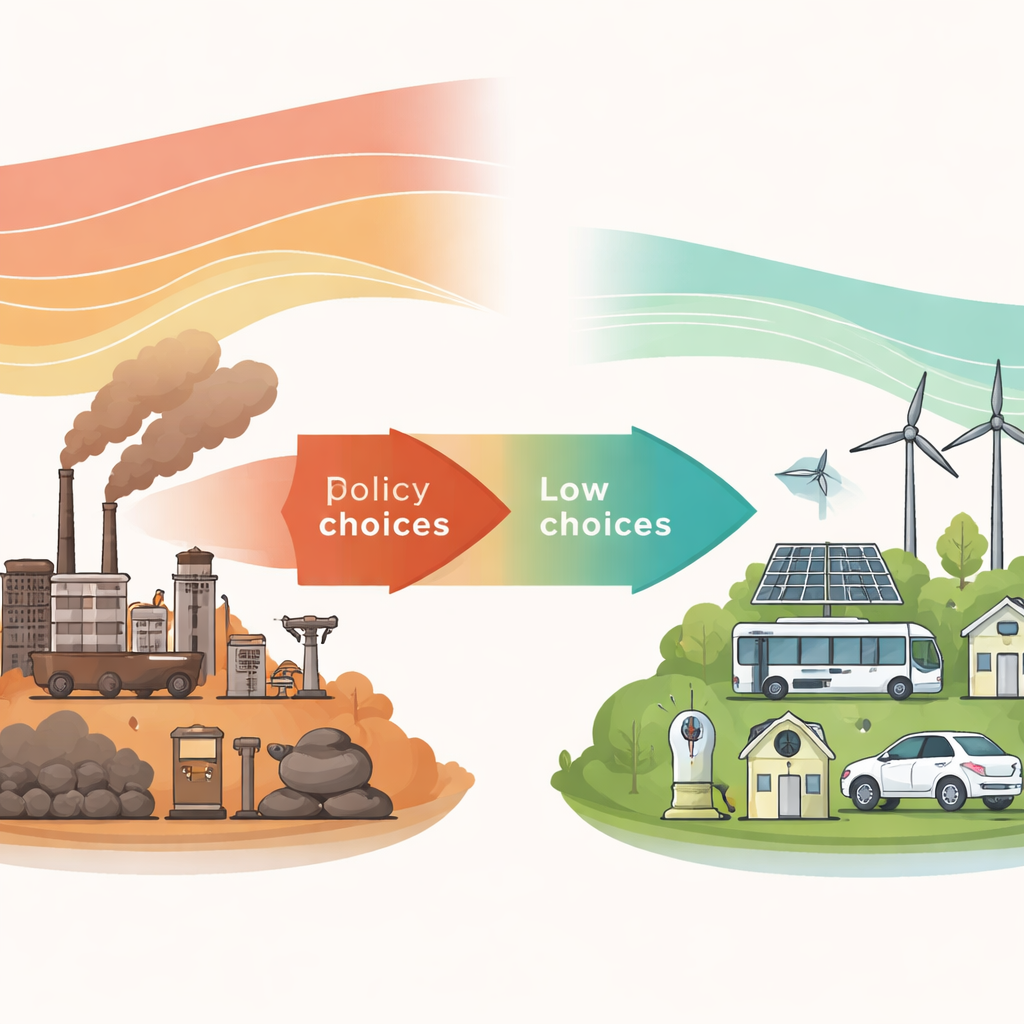
The researchers used eight independent global energy–economy models to explore five possible policy worlds. One reflects today’s actually implemented policies. A second adds countries’ near-term climate plans for 2030. Three more scenarios then stack on long-term net-zero pledges, extend such pledges to all countries, and finally imagine those net-zero dates brought forward by 5–10 years. By running all five futures through a common climate emulator, the team estimated how much warming each world would produce by 2100.
How far current promises really go
The findings show that doing only what is already on the books keeps global emissions roughly flat and sends the world toward about 2.6–3.4 °C of warming—far beyond the Paris goals. Meeting the latest 2030 pledges helps but still leaves emissions high enough for around 2.3–2.8 °C of warming. When countries also fulfill their announced net-zero strategies, end-of-century warming falls to roughly 1.8–2.1 °C. Extending net-zero coverage to all nations and speeding up the timelines moves the world into the “well below 2 °C” range, roughly 1.4–1.8 °C. Yet even in these most ambitious cases, staying below 1.5 °C without first overshooting that limit looks very unlikely.

What needs to change in the energy system
Across all the models, the routes to lower warming look surprisingly similar. Early emission cuts up to mid-century are driven mainly by using energy more efficiently, rapidly shrinking coal use, and electrifying transport and heavy industry while cleaning up power generation. Ambitious net-zero scenarios see unabated fossil fuels fall from roughly 80% of global primary energy today to under 20% by 2050, with coal largely phased out. Renewables—especially solar and wind—expand dramatically, in some models supplying more than three-quarters of global primary energy by mid-century. Electricity’s share of final energy use crosses 50% in many models by 2050 as electric vehicles, heat pumps and electric industrial processes spread. Still, even the strongest pledges generally do not triple global renewable capacity by 2030, nor do they by themselves cut methane deeply enough to fully meet the Global Methane Pledge.
Different regions, different roles
The study also highlights how responsibilities and options vary by region. Wealthier regions such as Europe, North America and parts of East Asia reach net-zero earlier, relying on sharp emission cuts before 2050. Emerging economies in South and Southeast Asia and Sub-Saharan Africa often reduce emissions more slowly and may not reach net-zero this century, in part because many have not yet set firm targets and also because they need support to develop along cleaner pathways. In coal-dependent countries such as China and India, the biggest opportunities lie in retiring coal power and electrifying heavy industry. Other regions lean more on renewable electricity, bioenergy and, in some models, carbon capture technologies. These shifts bring economic costs, especially for fossil-fuel exporters, but the models suggest these costs remain manageable relative to global economic growth.
Why stronger action and cooperation are essential
For a non-specialist, the core message is that today’s net-zero promises are moving the world in the right direction and could, if fully implemented and broadened, keep warming below 2 °C. But pledges alone are not enough. Without concrete domestic policies to boost energy efficiency, rapidly scale up renewables, cut methane, and phase down fossil fuels, the world will miss both the Paris temperature range and newer goals like tripling renewable capacity. The study concludes that stronger, earlier action by all countries, backed by international finance, technology transfer and fair burden-sharing, is needed to turn ambition into reality and keep the most dangerous levels of warming off the table.
Citation: Tagomori, I.S., Diuana, F.A., Baptista, L.B. et al. Promising climate progress from net-zero ambitions to the Paris Agreement goal. Nat. Clim. Chang. 16, 550–557 (2026). https://doi.org/10.1038/s41558-026-02615-y
Keywords: net-zero pledges, Paris Agreement, renewable energy transition, climate policy scenarios, global warming pathways