Clear Sky Science · en
Hybrid quantum-classical clustering for preparing a prior distribution of eigenspectrum
Why energy gaps matter to everyday science
From the color of a material to the stability of a medicine or battery, many properties of matter are controlled by tiny differences in quantum energy levels, known as energy gaps. Calculating these gaps for realistic molecules and materials is notoriously hard, even for supercomputers. This paper presents a new way to use early quantum computers together with classical machine learning to quickly sketch the overall pattern of energy levels in complex systems, providing a kind of "road map" that more precise methods can refine.
Seeing the pattern instead of every detail
The authors focus on a common bottleneck in physics and chemistry: before you can pinpoint individual energy levels, you first need a rough picture of where they lie. Today’s classical algorithms and quantum algorithms both work best when they already know something about the spectrum they are trying to resolve. Instead of aiming for exact answers from the start, this work targets a more modest but crucial goal: preparing a coarse-grained prior distribution of energy levels for structured quantum systems, such as local spin chains or molecules, where approximate quantum states can be prepared with reasonable resources.
Three-step teamwork between quantum and classical worlds
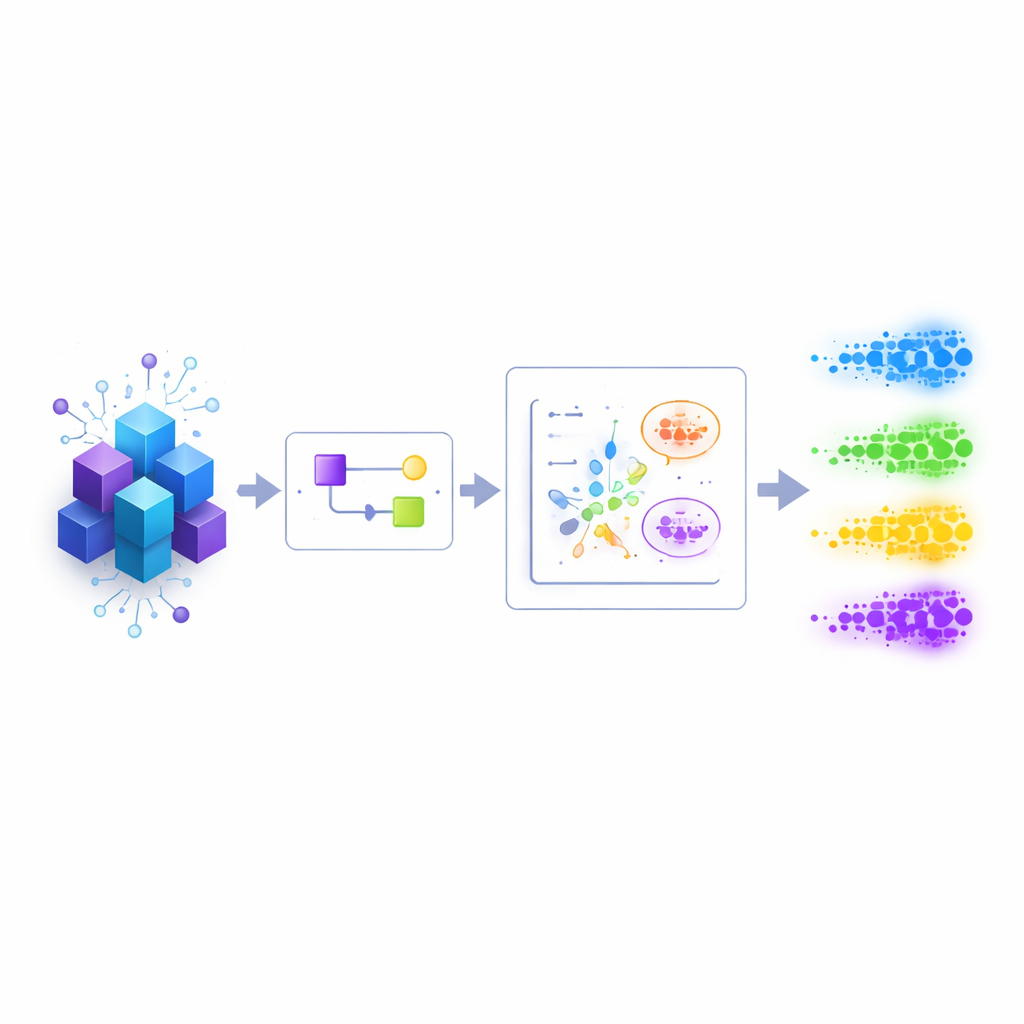
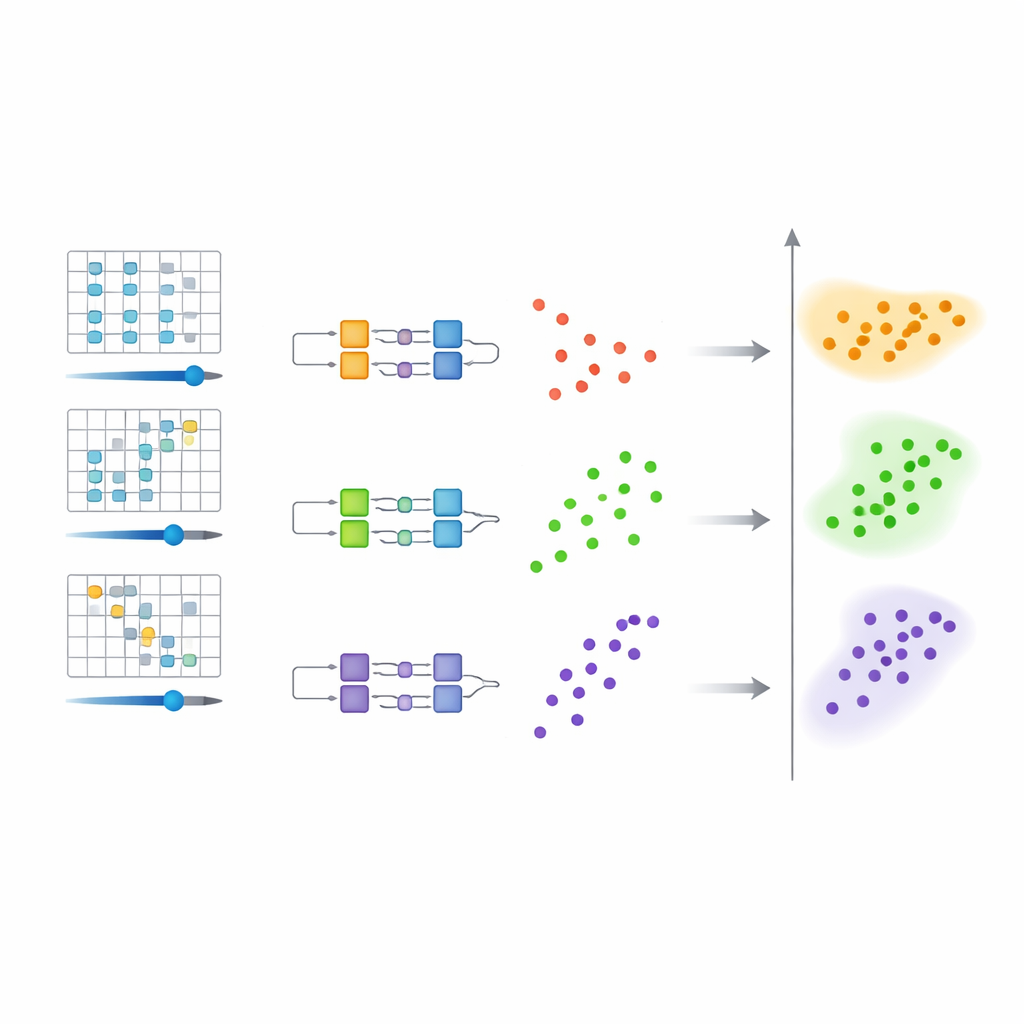
The proposed method operates in three coordinated steps. First, the original quantum system is gently modified by introducing a controllable “shift” parameter into its energy operator, or Hamiltonian. For each value of this shift, the modified system has a ground state that is closest in energy to some original level of interest. Second, a programmable quantum circuit is tuned so that, for each chosen shift, it approximates the ground state of the corresponding modified Hamiltonian. The knobs of this circuit—its numerical parameters—provide a compact, classical representation of those quantum states. Third, all of these parameter settings are fed into a standard clustering algorithm on a classical computer. Each cluster of similar parameters corresponds to one underlying energy level, and the middle of the associated shift values gives an estimate of that energy.
Why clustering quantum circuits saves effort
A key insight is that it is easier to tell states apart in parameter space than to resolve them perfectly in energy. The authors show, using mathematical theorems, that when different energy levels give rise to noticeably different circuit parameters, those parameters naturally form separate groups. Because only rough separation between clusters is required, the quantum circuits do not have to reach extremely high accuracy. This relaxed requirement shortens the time the quantum system must evolve, reduces the number of measurements needed, and makes the overall process more tolerant of noise—an important advantage for today’s error-prone devices.
Putting the method to the test
To check that this strategy works in practice, the team runs detailed simulations on two types of systems. The first is a one-dimensional chain of interacting spins, a standard model in condensed matter physics. There, the clustered circuit parameters reproduce the main structure of the low-lying energy spectrum, even when realistic noise is added. The method scales well as the number of spins grows, keeping errors roughly stable. The second test uses a simple lithium hydride molecule, where the goal is to track how the energy levels—and thus the energy gaps—change as the distance between the atoms varies. Although some closely spaced levels remain hard to separate with a coarse step size and limited circuit design, the approach still captures the overall trends and can be refined by using its output as a better starting point for more precise quantum routines.
Looking ahead to more powerful quantum machines
The framework is designed to be flexible across hardware generations. On near-term devices, it can be implemented with imaginary-time evolution techniques that mimic cooling the system into its lowest energy state. On future fault-tolerant machines, more advanced tools such as quantum linear-systems solvers and singular-value transformations could speed up convergence and extend the range of systems that can be handled. In both cases, the heavy lifting of fine-grained analysis is shifted to the classical side, which only needs to process low-dimensional parameter data rather than full quantum wavefunctions.
What this means for quantum-enhanced science
In everyday terms, the method offers a fast way to sketch the outline of a complex energy landscape before filling in the fine details. By using quantum hardware to generate informative states and classical clustering to organize them, the approach reduces depth, measurement costs, and sensitivity to noise compared with many existing hybrid algorithms. For chemists and materials scientists, this could mean quicker, more resource-efficient estimates of band gaps and reaction barriers, helping guide which systems are worth studying in greater detail as quantum technology continues to mature.
Citation: Ren, M., Chen, YC., Lai, CJ. et al. Hybrid quantum-classical clustering for preparing a prior distribution of eigenspectrum. npj Quantum Inf 12, 56 (2026). https://doi.org/10.1038/s41534-026-01194-2
Keywords: quantum eigenspectrum, hybrid quantum algorithms, energy gap estimation, quantum clustering, variational quantum circuits