Clear Sky Science · en
High-temperature surface decarburization in 8Cr4Mo4V high alloy steel by metal-carbon coupling diffusion
Why hot steel surfaces matter
Many parts in modern aircraft, such as the bearings that help engines spin smoothly, are made from advanced steels that must survive intense heat, speed, and stress. When these steels are heated during manufacturing, their surfaces can lose carbon and react with oxygen in the air, quietly weakening the very layer that does the hardest work. This study looks closely at a new high-alloy steel used for aircraft bearings and explains, from the atomic scale up, how its surface breaks down in heat and how that knowledge can guide better protection strategies. 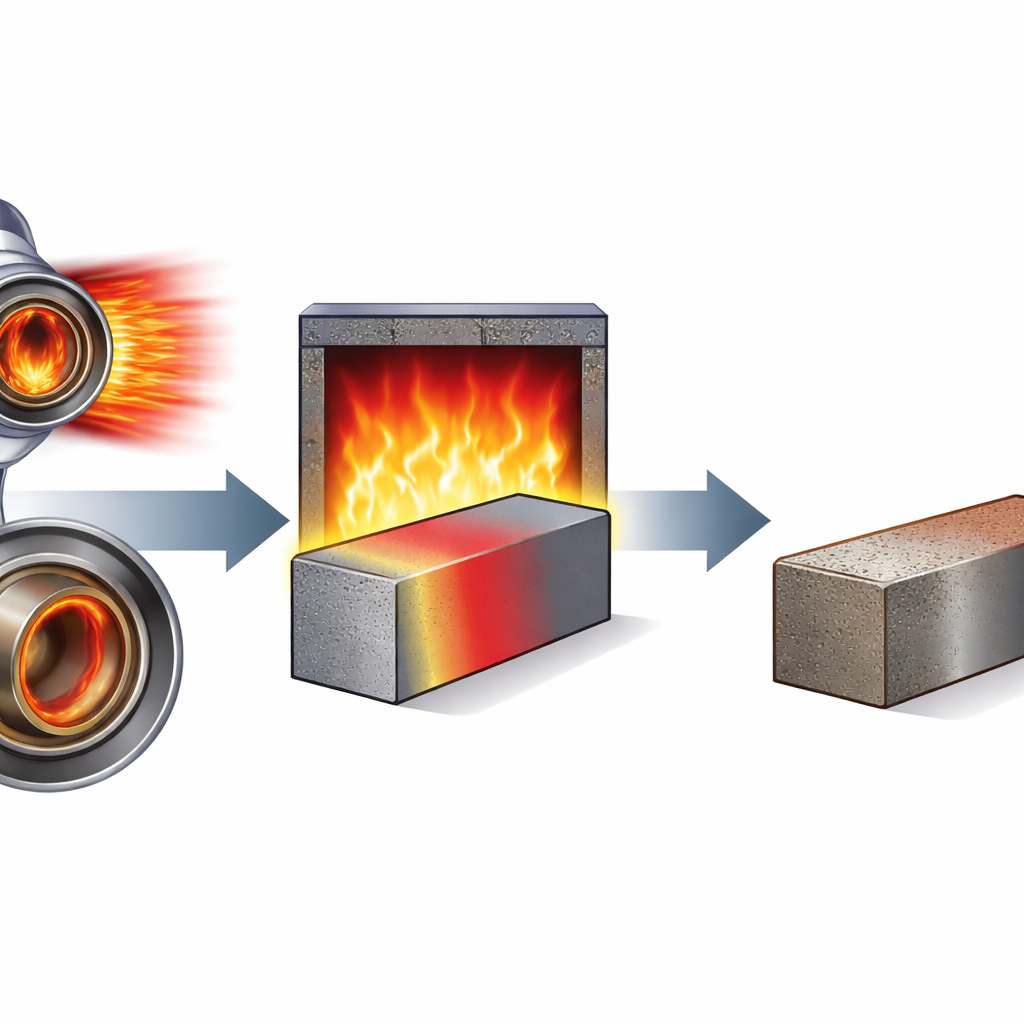
What happens to steel in extreme heat
The researchers focused on a steel called 8Cr4Mo4V, chosen for its high hardness, wear resistance, and stability, all critical for aircraft bearings. To mimic industrial heat treatment, they heated samples in air between 700 and 1100 degrees Celsius and tracked how much oxygen and carbon moved in or out. They weighed the samples over time to measure how fast an oxide layer grew on the surface and compared this to well-known steels. They found that this alloy oxidizes more quickly than common stainless steels, which means its surface is more vulnerable during high-temperature steps.
Layers of rust and a hidden soft skin
By looking at polished cross sections under microscopes, the team saw that the steel surface did not just grow a simple rust film but developed several stacked layers. At lower temperatures, a thin iron-oxide layer formed. As the temperature rose, the scale thickened dramatically and separated into outer, middle, and inner zones, each made of slightly different iron oxides and mixed oxides with chromium. Some of these inner oxides were denser and slowed further oxygen attack, while others were full of pores and cracks that sped it up. Beneath this oxide stack, the steel itself changed: a soft, carbon-poor layer appeared and grew deeper with higher temperature, matching a steep drop in hardness measured from the surface inward. 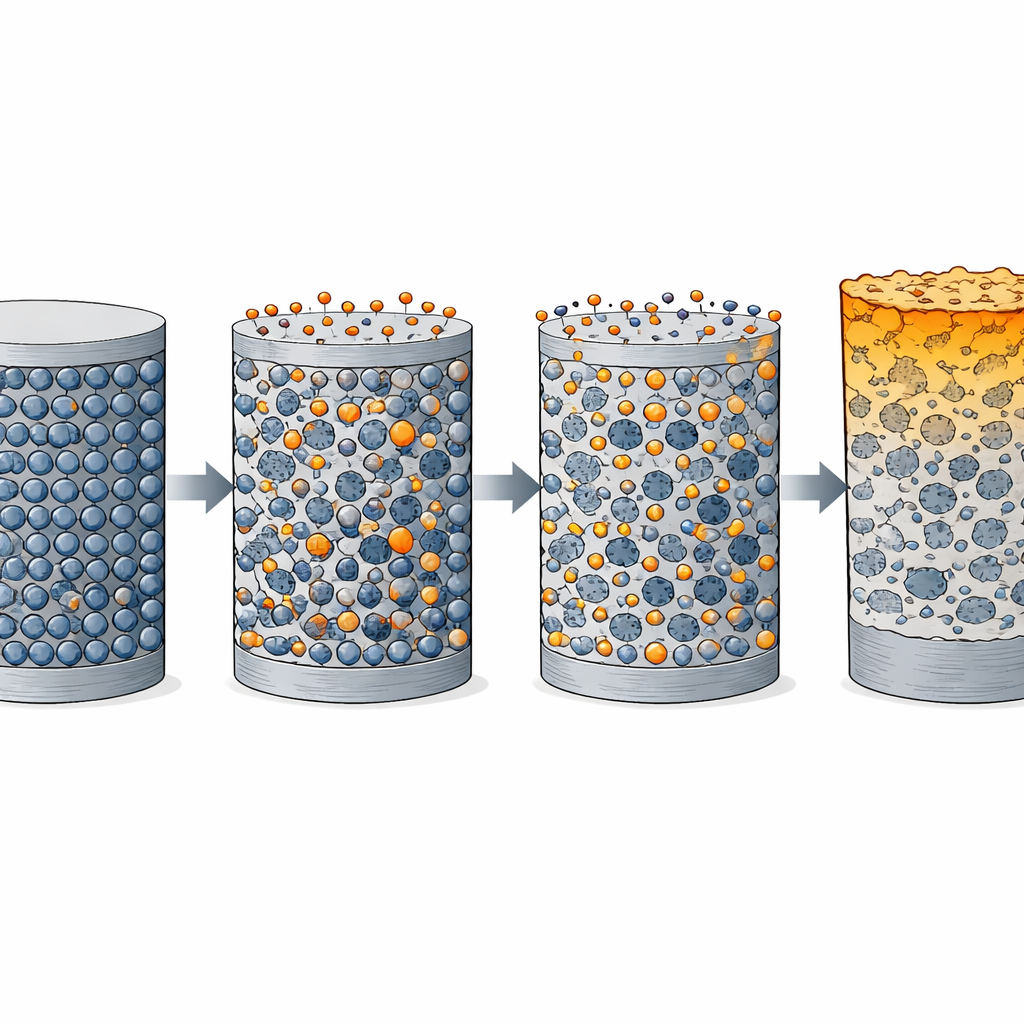
How atoms slip away from the surface
The team then zoomed in from the micrometer scale down to individual atoms using advanced electron microscopes. They compared the region just under the decarburized surface with the still-hard interior. Inside the steel, carbon was tied up in neat, needle-shaped carbides rich in chromium. Near the damaged surface, these carbides had mostly dissolved, leaving a patchy network and a more disordered iron lattice. Chemical scans showed that chromium, vanadium, and molybdenum atoms migrated outward toward the forming oxide, leaving behind tiny empty sites and distorted crystal spacing in the metal. These defects, along with the more open crystal form that appears at certain temperatures, created easier paths for carbon atoms to escape toward the surface.
A different picture of surface damage
From these observations, the authors propose a shift from the textbook view in which carbon simply diffuses outward on its own. In this steel, surface degradation is driven by a tight coupling between metal atoms and carbon. First, heating dissolves carbides and draws chromium and other alloy elements outward, where they help build complex oxide layers. Their movement stretches and distorts the underlying metal lattice, and the resulting defects act like express lanes that speed carbon out of the steel. This coupled flow of metals and carbon explains why there is a particularly sensitive temperature window, around 700 to 800 degrees Celsius, where decarburization suddenly becomes much more severe.
What this means for safer, longer-lasting parts
For engineers designing aircraft bearings and their heat treatments, the study’s message is clear: protecting these steels is not just a matter of slowing carbon loss. Because the escape of carbon is tied to the outward drift of chromium, vanadium, and molybdenum, successful protection strategies must stabilize these metals near the surface or insert barriers that block their movement and oxygen access. By revealing how oxidation, metal diffusion, and carbon loss reinforce one another from the atomic level upward, this work offers a roadmap for smarter coatings, better heat schedules, and, ultimately, more reliable high-performance steel components.
Citation: Hu, L., Gan, L., Zheng, W. et al. High-temperature surface decarburization in 8Cr4Mo4V high alloy steel by metal-carbon coupling diffusion. npj Mater Degrad 10, 54 (2026). https://doi.org/10.1038/s41529-026-00769-w
Keywords: high alloy steel, surface decarburization, oxidation kinetics, aircraft bearings, heat treatment