Clear Sky Science · en
Heterogeneous responses of soil microbial communities and functions in coastal wetlands to long-term nitrogen deposition
Why extra nitrogen in the air matters
Burning fossil fuels and using fertilizers are sending more nitrogen into the atmosphere, and much of it eventually falls back to Earth. Coastal wetlands, which store huge amounts of carbon and shelter rich wildlife, are directly in the path of this invisible fallout. This study asks a deceptively simple question with big implications: when these wetlands are showered for years with different kinds and amounts of nitrogen, how do the hidden soil microbes respond—and what does that mean for climate‑warming gases and nutrient pollution?
Testing long-term nitrogen showers
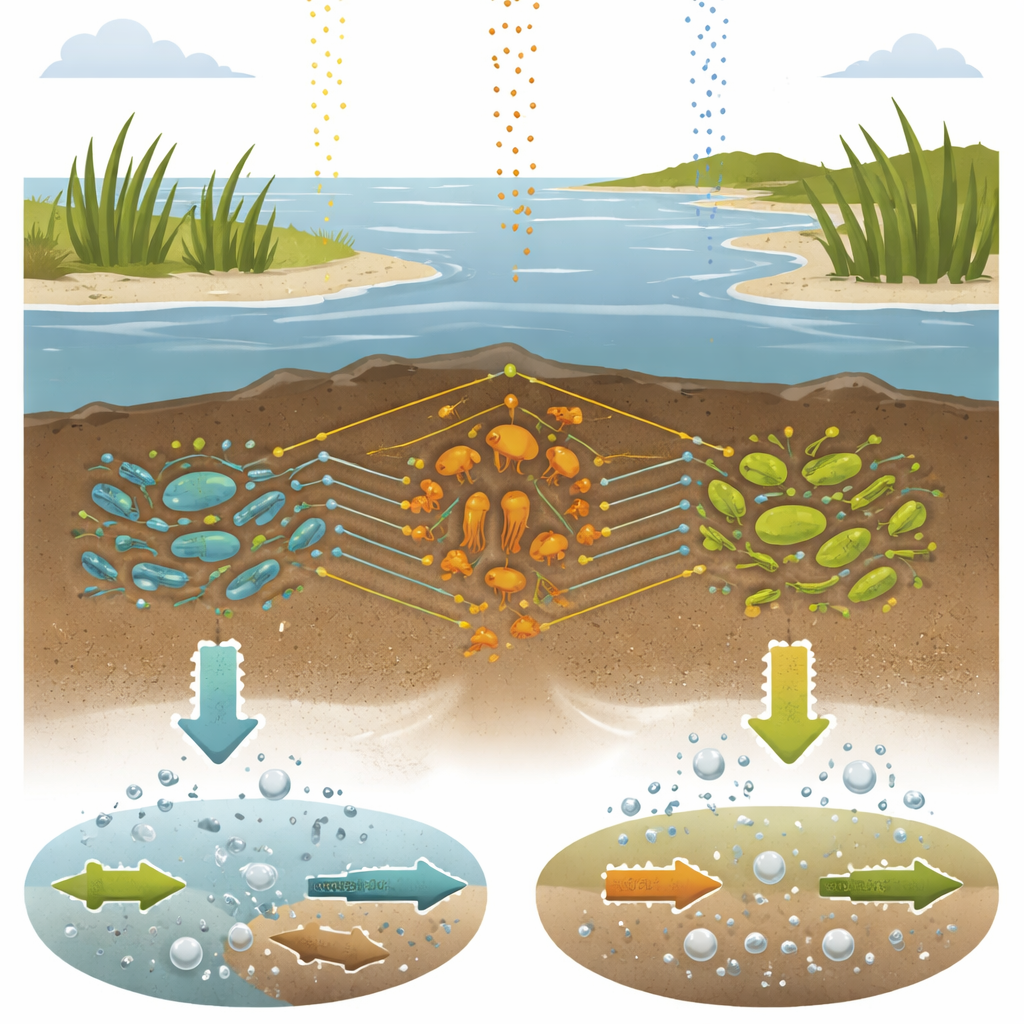
To explore this, researchers ran a seven‑year field experiment in a coastal wetland in China’s Yellow River Delta. They mimicked atmospheric nitrogen deposition by regularly adding three fertilizer types that supplied either ammonium, nitrate, or a mix of both, and they did so at low, medium, and high doses. The team then took soil samples and used DNA sequencing to profile three major groups of microscopic life: prokaryotes (bacteria and archaea), fungi, and a group of single‑celled predators called Cercozoa. They also used high‑throughput genetic chips and isotope tracing to measure the abundance of genes involved in carbon, nitrogen, phosphorus, and sulfur cycling, and to directly track nitrogen transformation rates in the soil.
Shifting underground communities
The added nitrogen clearly reshaped the underground community, but not all microbes reacted in the same way. Overall, prokaryotes and Cercozoa became more diverse, while fungi stayed surprisingly steady. The chemical form of nitrogen mattered more than how much was added: ammonium versus nitrate strongly influenced which prokaryote and Cercozoa types were present and how their communities were assembled, whereas fungal communities barely budged. Cercozoa turned out to be especially sensitive, showing pronounced changes in diversity and structure, suggesting that these small predators act as early‑warning indicators of environmental change in coastal wetlands.
Networks of cooperation and strain
Microbes in soil do not live as isolated species; they form intricate networks of cooperation, competition, and predation. By building \
Citation: Sun, M., Li, M., Xie, B. et al. Heterogeneous responses of soil microbial communities and functions in coastal wetlands to long-term nitrogen deposition. npj Biofilms Microbiomes 12, 93 (2026). https://doi.org/10.1038/s41522-026-00947-3
Keywords: nitrogen deposition, coastal wetlands, soil microbes, greenhouse gases, microbial networks