Clear Sky Science · en
Platinum oxide formation under oxygen evolution reaction conditions
Why this matters for clean energy
Platinum is a workhorse metal in devices that turn electricity into hydrogen fuel and back again, but it slowly wears out during use. This study looks closely at what happens to a smooth platinum surface when it is driven very hard under water-splitting conditions, revealing how a thin, protective but activity-limiting oxide skin grows and changes. Understanding this hidden layer helps engineers design longer-lasting fuel cells and electrolysers for a low-carbon energy system.
A closer look at platinum in action
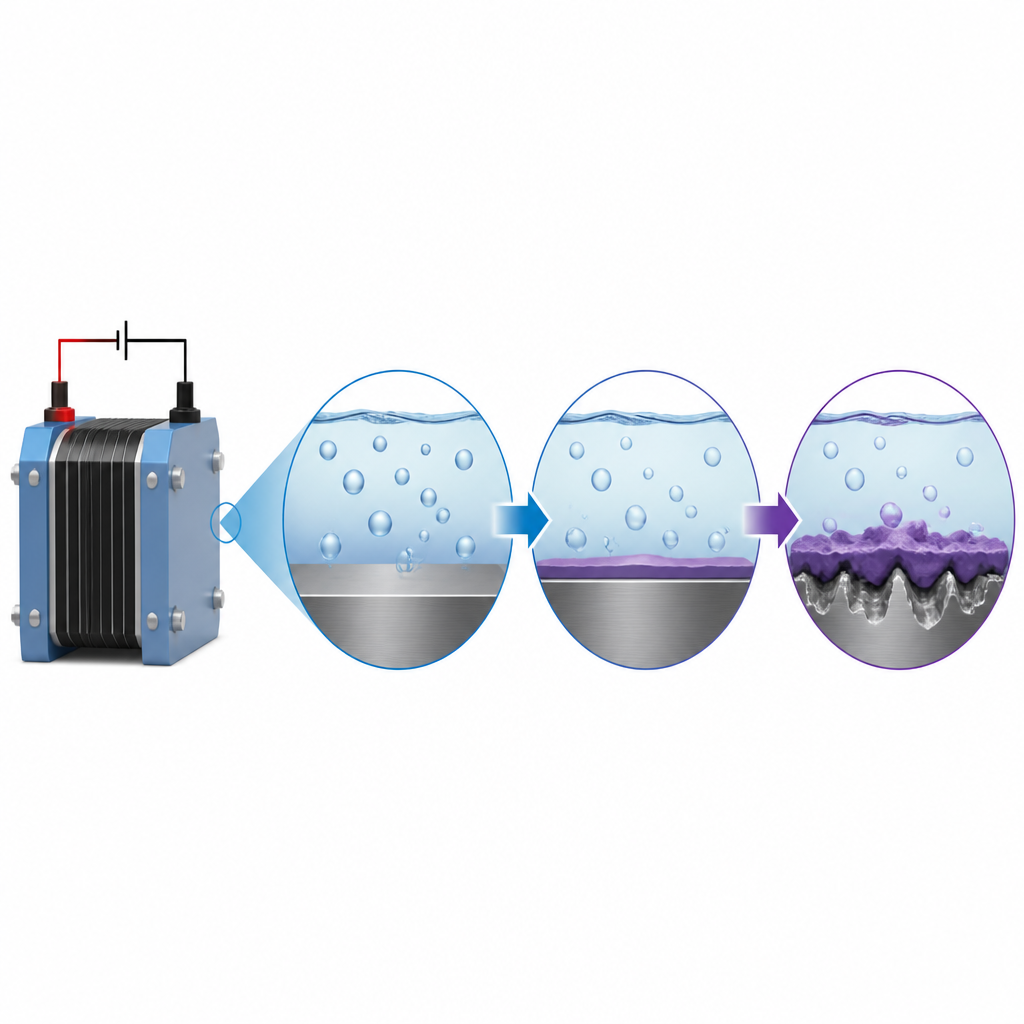
In fuel cells and electrolysers, platinum sits at the boundary between a solid metal electrode and a watery acid solution. Under gentle working conditions, this interface is well understood and quite stable. Problems arise when the voltage rises into the range where the oxygen evolution reaction, the step that releases oxygen gas from water, becomes important. In real devices this can happen during start-up and shut-down, when voltages can spike. The authors set out to see, atom by atom, how a perfectly ordered platinum surface changes in this harsh regime, and how those changes tie into loss of performance and long-term damage.
Watching the surface while it works
To follow the platinum surface in real time, the team used a custom setup that combines a rotating disk electrode, which keeps fresh liquid flowing over the metal, with high-energy surface X-ray diffraction. This allows them to probe the exact positions of atoms at the metal surface while the oxygen evolution reaction is running at realistic current levels. They gradually raised the voltage up to about 2.1 volts, much higher than previous studies, and recorded how the diffraction signal changed. They then complemented these "operando" measurements with X-ray reflectivity, to see the total thickness and density of any surface film, and with X-ray photoelectron spectroscopy, to identify the chemical state of the platinum atoms after oxidation.
From smooth metal to thin, rough oxide
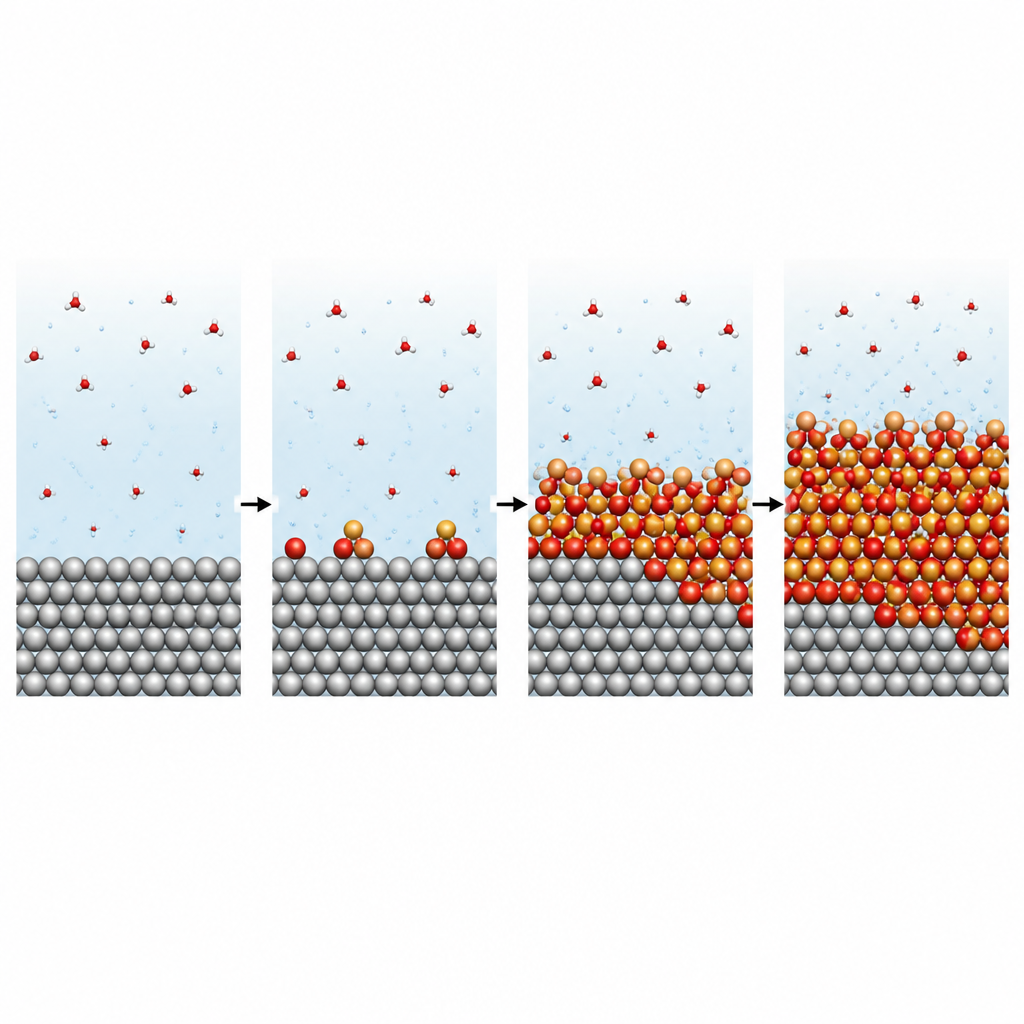
The X-ray diffraction data reveal that oxidation of the platinum surface does not happen all at once. Instead, atoms in the top layer are pulled slightly outward from the metal in a so-called place-exchange process, creating vacancies and a first, ordered stage of surface oxidation around one volt. As the voltage rises between about 1.2 and 1.6 volts, more atoms leave their regular positions and join a highly disordered oxide layer that no longer lines up with the underlying crystal. The surface becomes rougher at first, but then appears to smooth again as a more continuous oxide film forms. The analysis shows that platinum atoms are effectively removed from the metal in a layer-by-layer fashion, very much like a reverse crystal growth process controlled by the applied voltage.
Measuring the hidden oxide skin
Because the disordered oxide does not give a clear diffraction pattern, the researchers turned to X-ray reflectivity to measure the film as a whole. These measurements show that a very thin platinum oxide layer, less than a billionth of a meter thick, grows on the surface and becomes slightly thicker and rougher as the voltage increases. Its density matches that expected for a defective version of a known platinum dioxide structure. When the thickness deduced from reflectivity is compared with the number of atoms displaced in the diffraction data, and with the electrical charge needed to remove the oxide in separate experiments, all three approaches agree: the oxide thickness rises in a nearly straight line with applied voltage.
What kind of oxide is it?
The spectroscopy results confirm that most of the oxidised platinum is in a high oxidation state, consistent with platinum dioxide, with a smaller fraction in a lower oxidation state. This fits a picture where a thin, defective platinum dioxide layer covers the metal, possibly with an extra oxygen-rich layer at the boundary between oxide and metal. The oxide is stable in air but slowly breaks down in vacuum, indicating that it is only marginally stable from a thermodynamic point of view and is maintained by the electrochemical conditions. The metal beneath stays conductive, helping the electric field across the oxide drive further, self-limiting growth.
What this means for future devices
For a lay reader, the key message is that platinum in water-splitting devices grows a controllable, nanometre-scale rust layer that both protects and weakens it. This oxide forms step by step from the top atomic layer downward as the voltage rises, and its thickness is set mainly by the electric field rather than by simple chemical exposure to oxygen. The film shields the deeper metal from rapid destruction, but at the cost of reducing the surface activity for producing oxygen. By revealing this balance in atomic detail, the study provides a roadmap for improving operating protocols and for developing new catalyst materials that mimic the protective aspects of this oxide while preserving high performance.
Citation: Jacobse, L., Schuster, R., Kohantorabi, M. et al. Platinum oxide formation under oxygen evolution reaction conditions. Nat Commun 17, 4368 (2026). https://doi.org/10.1038/s41467-026-72954-z
Keywords: platinum oxidation, oxygen evolution reaction, electrocatalyst stability, fuel cells, water electrolysis