Clear Sky Science · en
Rapid adaptive increase of amylase gene copy number in Indigenous Andeans
How our spit tells a story about food and history
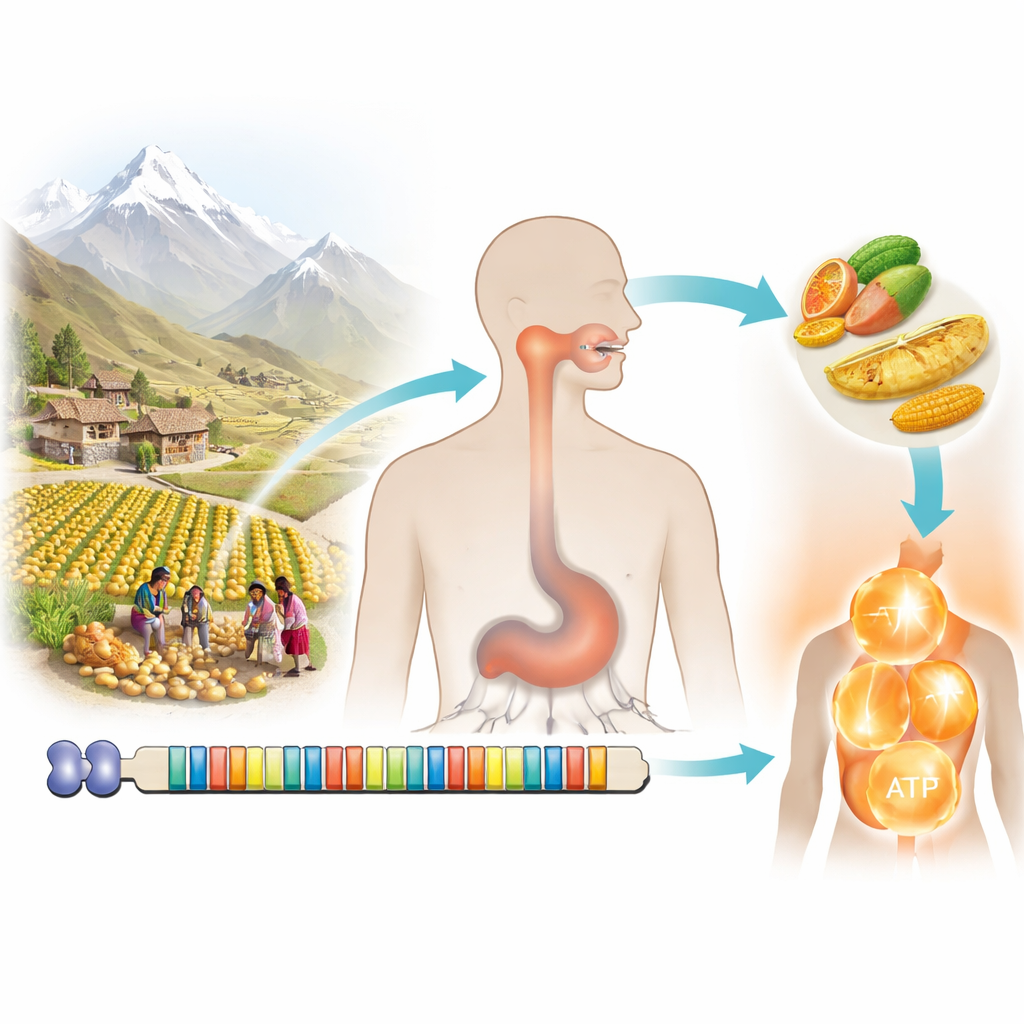
Every time you bite into bread, potatoes, or corn, your saliva immediately starts breaking down the starch into sugar. This everyday process, powered by an enzyme called amylase, turns out to hold clues to how human groups adapted to their traditional diets. This study explores why Indigenous people from the Peruvian Andes carry more copies of the gene for salivary amylase than any other population studied so far, and what that says about our long partnership with starchy crops like potatoes.
Extra copies of a key digestion gene
Humans do not all carry the same number of amylase genes. Some people have only a few copies, while others have many, and more copies generally mean more enzyme in the saliva. The researchers measured the number of copies of the salivary amylase gene, called AMY1, in 3,723 people from 85 populations around the world. They found remarkable diversity, but Indigenous Peruvians with Andean ancestry stood out: on average they had about ten copies per person, clearly higher than the global median of about seven. A Native American group from the southwestern United States, the Akimel O’odham (Pima), showed similarly high values, while many other American groups had relatively low copy numbers.
Andean life, potatoes, and a starch-heavy menu
The Andean highlands were one of the world’s early centers of agriculture. People settled at high altitude thousands of years ago and gradually shifted from foraging to farming. In this region, potatoes were domesticated roughly 10,000 to 6,000 years ago, followed by other local starch-rich crops such as quinoa, with maize arriving later from Mesoamerica. Today, potatoes can still make up more than half of the daily calories in some Andean communities. Because amylase is crucial for digesting starch, the team asked whether the unusually high AMY1 copy numbers in Indigenous Andeans might reflect an evolutionary response to this long-standing, potato-heavy diet rather than just chance or recent mixing with European or African populations.
Finding the genetic footprints of recent adaptation
To move beyond simple counting, the scientists examined tiny DNA markers surrounding the amylase genes and compared Andean Quechua individuals to closely related Maya people from Mexico, who also eat starchy foods but have lower AMY1 copy numbers. They found a distinctive “block” of DNA variants in Andeans that was strongly linked to having at least five copies of AMY1 on a single chromosome. This block reached much higher frequencies in Andeans than in Maya, and statistical tests showed that such a pattern is very unlikely to arise from random population history alone. Instead, the data fit a scenario in which a pre-existing, high-copy version of the region was favored and spread rapidly in Andean ancestors over the past 10,000 years—roughly the same window when potatoes became a staple crop in the highlands.
How these extra gene copies are built
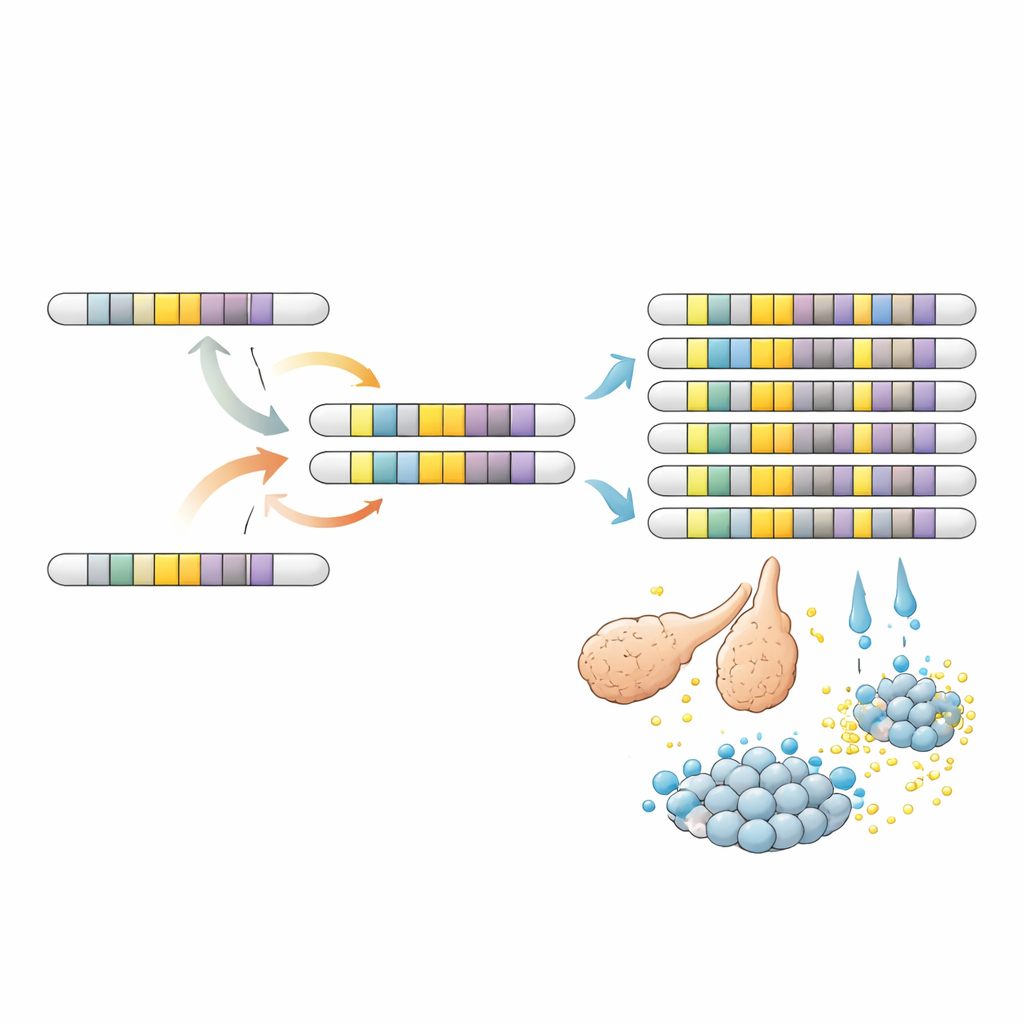
Having many copies of a gene in a row is often the result of the DNA accidentally misaligning during cell division, so that whole chunks are duplicated or deleted. Using ultra-long DNA sequencing reads from Peruvian individuals, the team reconstructed the structure of the amylase region in detail. They found that the Andean high-copy versions did not rely on an exotic or new kind of mutation. Rather, they were produced by the same recombination process, repeatedly duplicating a basic two-gene unit, that has shaped this region in other human groups. Some Andean people even appear to carry extremely long blocks of repeated amylase genes, built by multiple rounds of this ordinary, error-prone copying mechanism.
What more amylase might mean for health
While more AMY1 copies usually mean more salivary amylase, the consequences for health are complex. Higher amylase levels may help people handle a very starch-rich diet by breaking down food faster and possibly altering the gut and oral microbes that feed on leftover carbohydrates. At the same time, studies suggest that individuals with high copy numbers can show stronger blood sugar spikes to certain starchy foods, and high-starch diets are associated with widespread tooth decay in Andean children. The authors emphasize that modern health problems, such as diabetes and poor oral health seen in both Andean and Akimel O’odham communities, arise from a mix of genes, diet changes, and social conditions, not from this single genetic adaptation alone.
A window into how culture shapes our genomes
By showing that Indigenous Andeans carry the world’s highest known levels of amylase gene copies, and that these likely rose under natural selection after the arrival of potatoes, this work links a familiar household food to deep evolutionary change. For non-specialists, the message is simple: as people in the Andes committed to farming and relying on starchy crops in a tough mountain environment, their bodies gradually responded. Extra copies of a saliva enzyme gene helped turn fields of tubers into dependable energy, leaving a lasting imprint of food culture written directly into their DNA.
Citation: Scheer, K., Landau, L.J.B., Jorgensen, K. et al. Rapid adaptive increase of amylase gene copy number in Indigenous Andeans. Nat Commun 17, 3822 (2026). https://doi.org/10.1038/s41467-026-71450-8
Keywords: amylase, Andes, potato diet, gene copy number, human adaptation