Clear Sky Science · en
Sustained visceral fat loss is associated with attenuated brain atrophy and improved cognitive function in late midlife
Why belly fat and brain health are connected
Many of us worry about gaining weight around the waist, but few realize that the fat deep inside the abdomen, wrapped around our organs, may matter even more for the brain than for the belt size. This study followed hundreds of adults for up to 16 years to ask a simple question with big implications: does losing and keeping off this "hidden" belly fat help protect the aging brain and thinking skills, beyond just losing weight in general?
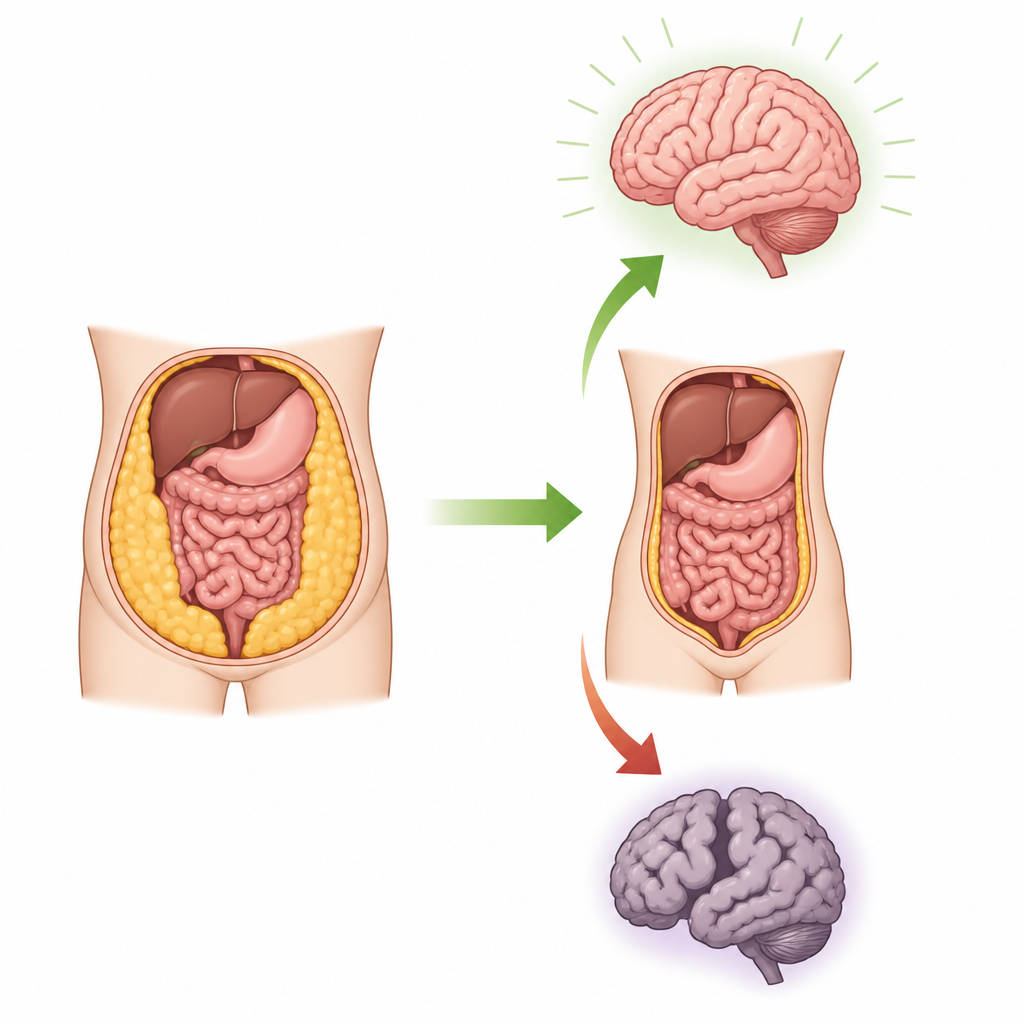
Looking inside the body and the brain
Researchers combined data from four long-term lifestyle trials in which adults with overweight and metabolic problems changed their diets and habits for 18 to 24 months. Using magnetic resonance imaging, they repeatedly measured deep abdominal fat, the kind that sits around the organs, as well as other fat just under the skin. They also scanned the brain to measure total brain size, gray and white matter, and the size of the spaces filled with fluid that tend to grow as the brain shrinks with age. Years after the original diet programs ended, participants took a standard test of thinking and memory called the Montreal Cognitive Assessment.
Hidden belly fat linked to thinking skills
When the researchers looked at a single point in time late in life, people with more deep belly fat tended to perform worse on the thinking test. This link was especially clear among those whose brains still showed relatively preserved volume, suggesting that harmful effects of visceral fat on cognition may start before obvious brain shrinkage appears. In contrast, fat stored just under the skin, whether deep or superficial, did not show a meaningful relationship with thinking scores. Traditional measures such as body mass index were also poor predictors when compared with direct imaging of visceral fat.
Following fat loss and brain changes over years
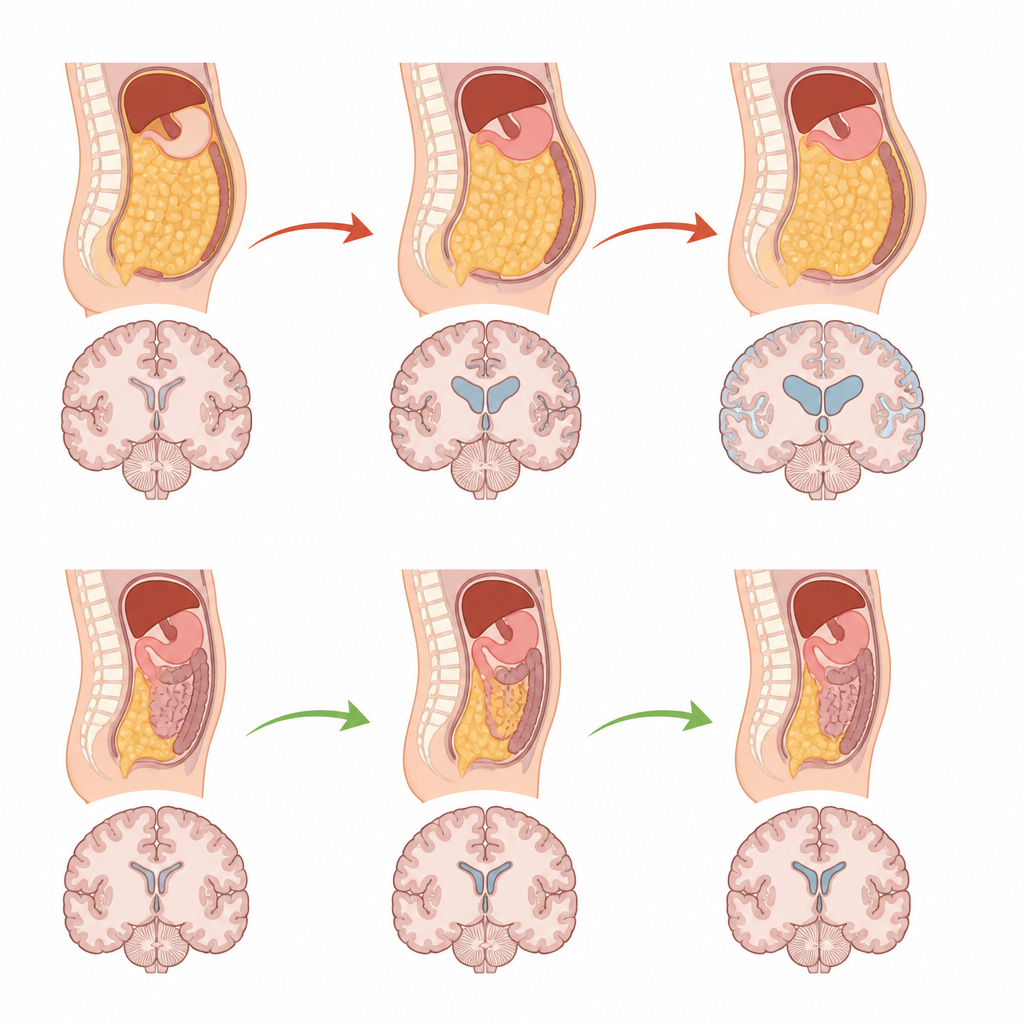
Because many participants had their abdominal fat measured at the start of the trials, after about 18 months, and again 5 to 10 years later, the scientists could calculate each person’s overall exposure to visceral fat across time. Those with lower long-term exposure to this deep belly fat scored higher on tests of overall cognition and memory. Importantly, people who lost more visceral fat during the initial lifestyle programs later showed larger total brain and gray matter volumes and better preservation of a key memory region, even after accounting for overall weight loss and other lifestyle factors. In a subgroup with three brain scans over five years, those who carried more visceral fat across time had faster brain shrinkage and greater expansion of the brain’s fluid spaces, a classic sign of aging.
Why blood sugar control matters
The team also explored which body processes might connect belly fat to brain health. They tested markers related to blood fats, inflammation, and blood sugar control. After accounting for multiple comparisons, only fasting glucose and long-term blood sugar levels were consistently tied to how quickly brain structures changed over time. This pattern suggests that chronic problems with blood sugar, which are strongly influenced by visceral fat, may be a key pathway through which hidden belly fat speeds up brain aging, while improvements in sugar control may help slow it.
What this means for everyday life
This large, long-running study points to a clear message for people in their forties, fifties, and early sixties: it is not just how much you weigh, but where you carry fat that matters for the brain. Sustained loss of deep belly fat, achieved through lifestyle changes, was linked to slower brain shrinkage and better thinking skills up to a decade later, whereas weight alone was a weaker guide. While the study cannot prove cause and effect, it supports the idea that targeting visceral fat and improving blood sugar control may be an important strategy for keeping the brain healthier as we age.
Citation: Pachter, D., Klein, H., Kamer, O. et al. Sustained visceral fat loss is associated with attenuated brain atrophy and improved cognitive function in late midlife. Nat Commun 17, 4434 (2026). https://doi.org/10.1038/s41467-026-71141-4
Keywords: visceral fat, brain atrophy, cognitive function, midlife obesity, glycemic control