Our cells constantly import amino acids, the building blocks of proteins, to fuel growth, brain activity, and immune defense. This study uncovers how a little-known human protein, SLC7A4, helps move the amino acid leucine into cells, and how this process becomes more active when the surroundings turn slightly acidic, as they often do in busy or stressed tissues. Understanding this behavior could deepen our grasp of how cells sense nutrients and may eventually guide new strategies against cancer and other diseases that depend on altered amino acid use.
A hidden gate for leucine
The researchers began by asking what SLC7A4 actually does. Although it belongs to a large family of amino acid transporters, earlier work had failed to show which amino acids it carries. Using a sensitive stability test on purified human SLC7A4, the team found that leucine, a branched-chain amino acid that strongly influences cell growth pathways, was especially effective at stabilizing the protein. When they expressed SLC7A4 in human cells lacking a major background transporter, the cells imported far more radioactive leucine than control cells, clearly indicating that SLC7A4 functions as a leucine transporter at the cell surface.
Acid outside, traffic inside
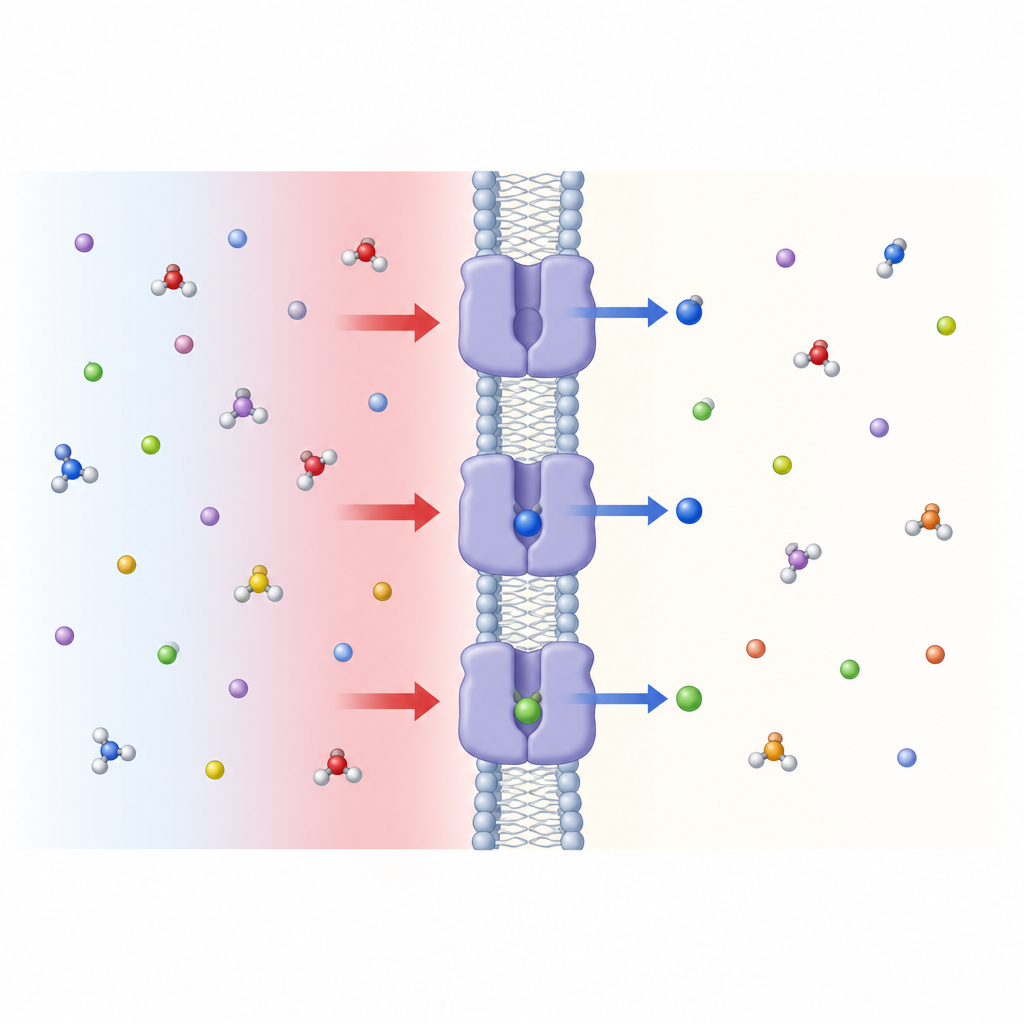
Next, the team tested how acidity outside the cell affects transport. They lowered the external pH from near-neutral values, typical of blood, toward the mildly acidic range often found in active or diseased tissues. Leucine uptake through SLC7A4 rose sharply as the environment became more acidic, both in living cells and in artificial membrane bubbles containing the purified protein. This revealed SLC7A4 as a pH-responsive transporter whose activity is tuned by the proton concentration outside the cell. A single amino acid in the protein, a glutamate called Glu125, turned out to be critical for this behavior: changing it to a non-acidic residue largely removed the pH sensitivity while leaving basic transport capacity intact.
Lessons from a plant cousin Figure 1. Acidic surroundings switch on a cell membrane gate that lets leucine and related amino acids flow into the cell.
To see how this gate works at the atomic level, the researchers turned to a closely related transporter from the plant Arabidopsis thaliana, called AtCAT4, which is easier to study structurally. Using cryo-electron microscopy, they captured detailed snapshots of AtCAT4 with and without a bound amino acid. The plant protein recognizes both positively charged amino acids and leucine, and the images showed how a core region in the transporter rearranges when a ligand sits in the binding pocket. Computer simulations indicated that part of a central helix can switch from a smooth coil to a kinked form when an amino acid binds, an “induced fit” that helps clamp the molecule in place. These motions closely resemble those seen in bacterial relatives, pointing to a shared evolutionary design for this family of transporters.
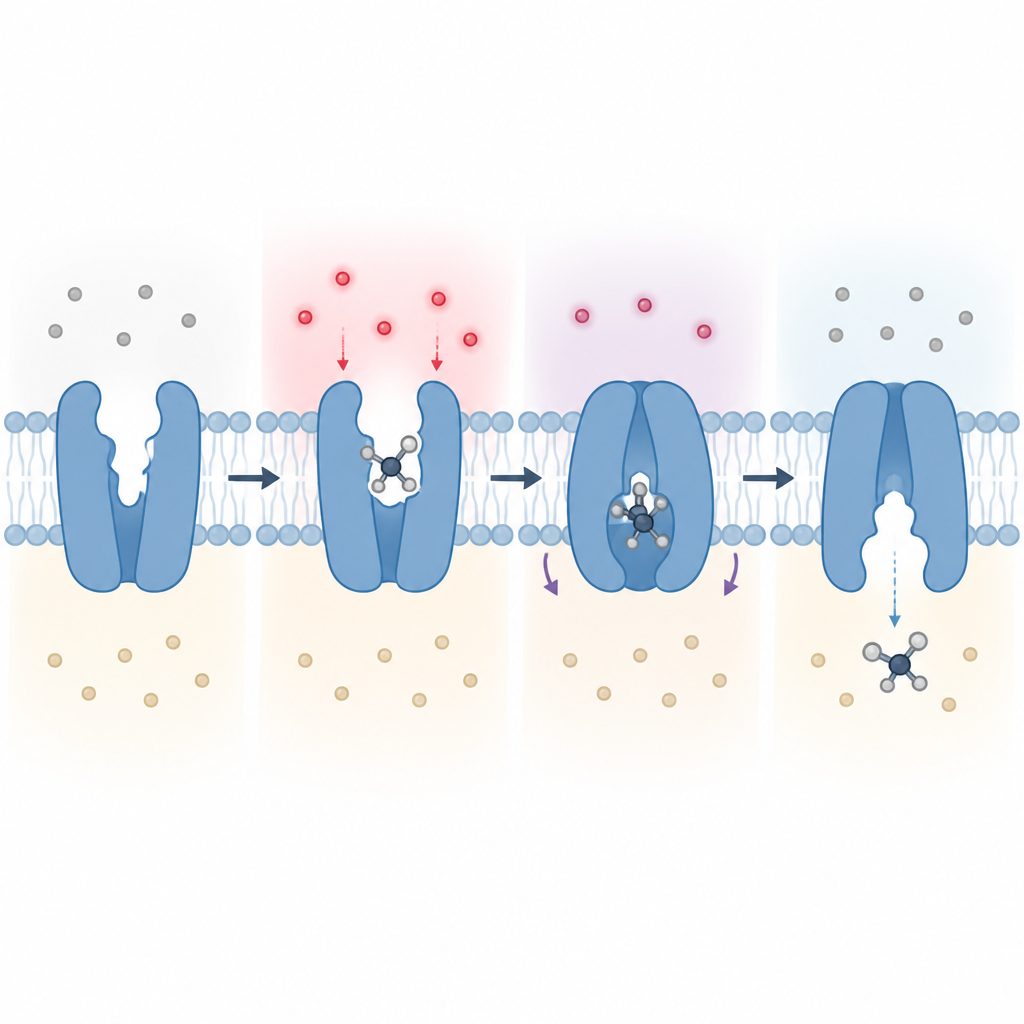
How the pocket picks leucine over other amino acids Figure 2. Stepwise view of how acidity tweaks a single protein site to reshape a transporter and move one leucine molecule across the membrane.
Armed with the plant structure, the team built a detailed model of human SLC7A4 with leucine bound. In this model, leucine’s backbone nestles into a conserved pocket, while its branched side chain tucks into a snug cluster of oily residues deep in the protein. Subtle features of this hydrophobic pocket explain why SLC7A4 prefers leucine over very similar amino acids. By changing just three residues in this pocket to match those of a known carrier for positively charged amino acids, the researchers could flip SLC7A4’s preference: the mutant bound and transported arginine much more strongly, while only modestly weakening leucine binding. This shows that a small set of side chains acts as a switch that tunes which amino acids the transporter favors.
A molecular pH knob on a nutrient valve
Together, the structural data, simulations, and cell experiments support a model in which Glu125 sits at the heart of a pH-sensitive control system. When the outside of the cell is neutral, this residue is mostly uncharged and helps hold parts of the protein in an open, outward-facing shape. When the environment turns acidic, Glu125 can take up a proton, loosening this grip and allowing the transporter to cycle more readily between outward and inward states as it ferries leucine into the cell. This work therefore identifies SLC7A4 as a pH-gated leucine valve at the plasma membrane and outlines in atomic detail how its amino acid preferences and acid sensitivity arise from a few key positions in its binding pocket.
Citation: Kolokouris, D., Bothra, A., Kato, T. et al. Structural basis for pH-responsive amino acid transport via SLC7A4..
Nat Commun17, 4544 (2026). https://doi.org/10.1038/s41467-026-70956-5