Clear Sky Science · en
Octahedral tilting and B-site off-centering in halide perovskites are not coupled
Why crystal wiggles matter for future tech
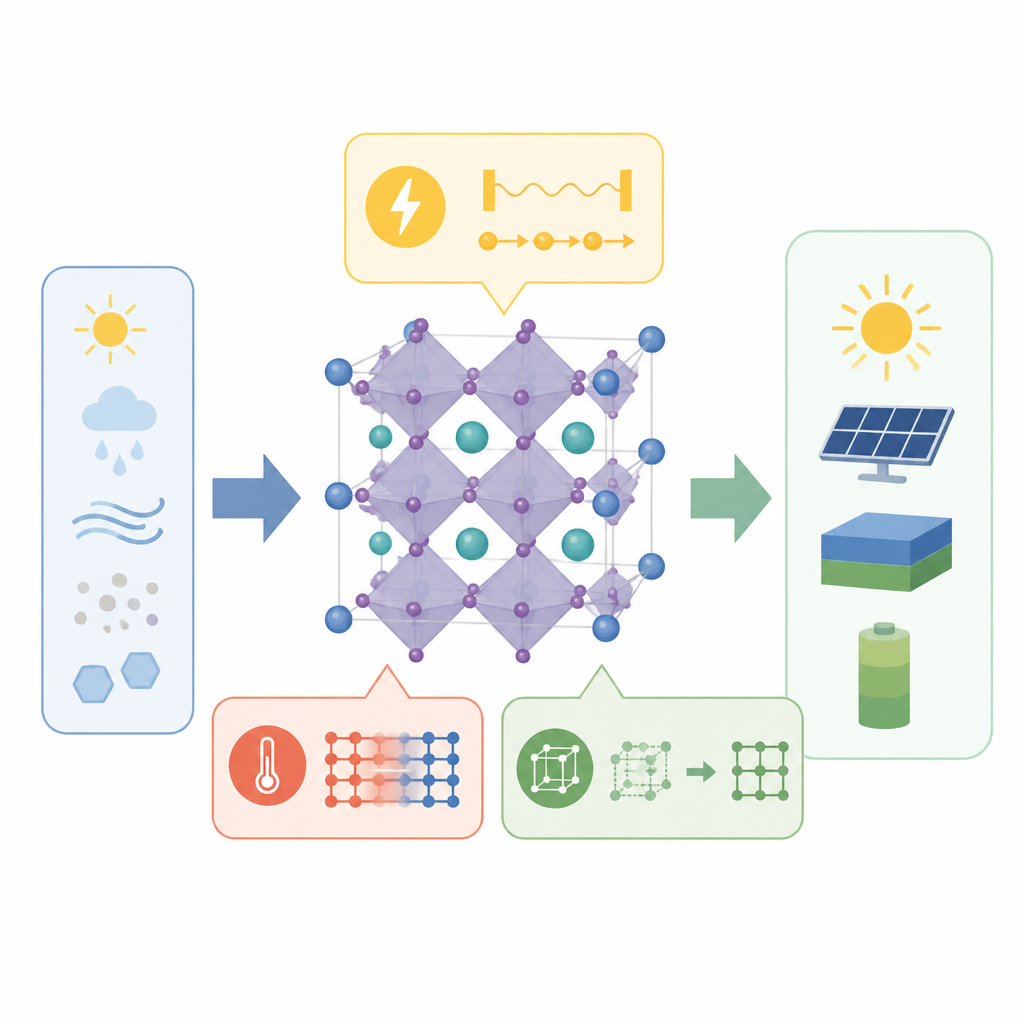
Metal halide perovskites are rising stars for solar cells and thermoelectrics because their atoms and electrons are unusually mobile. This restless motion shapes how well they absorb light, move charge, and carry heat. In this study, researchers ask a simple but crucial question: when the tiny building blocks of these crystals tilt and when their central atoms shift off-center, are these motions linked or do they act independently? The answer changes how scientists think about tuning these materials for cleaner energy technologies.
Two kinds of motion inside a crystal cage
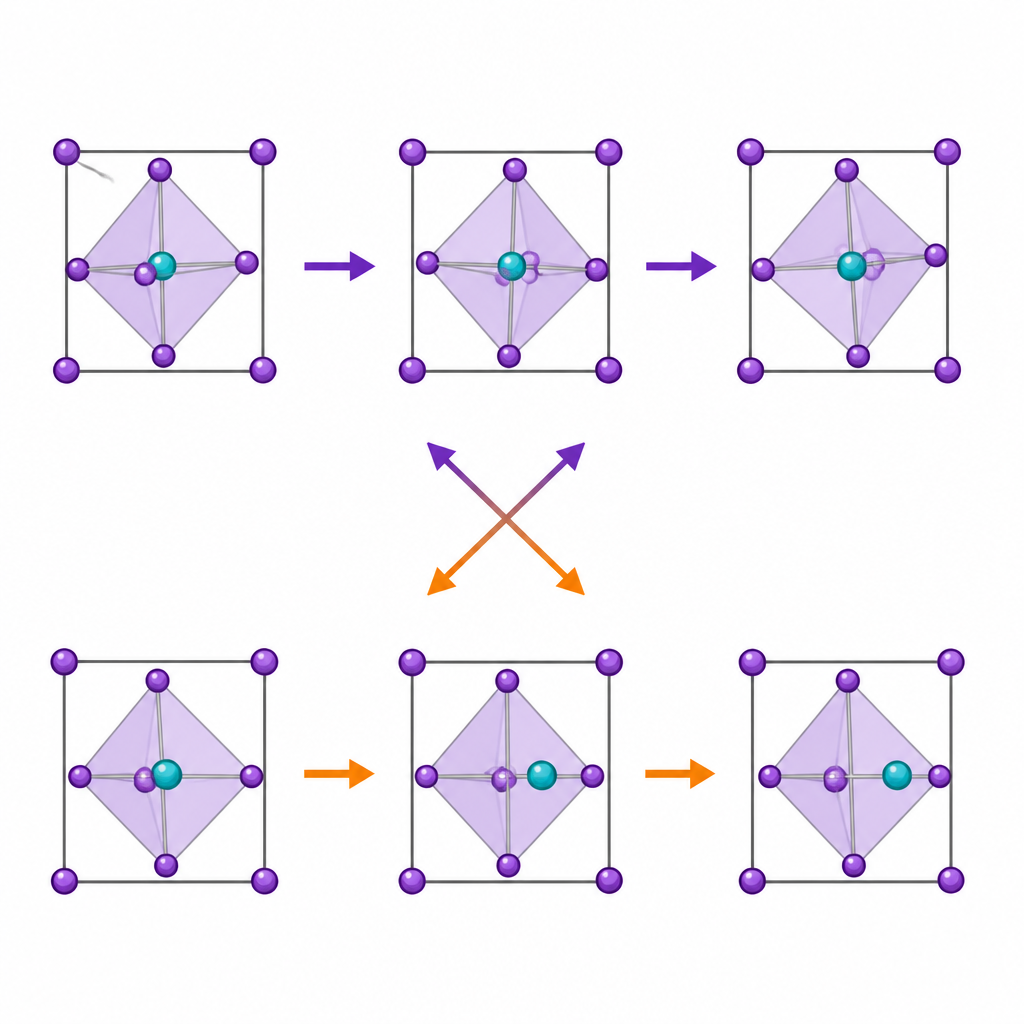
Perovskites are built from repeating cages shaped like octahedra: a central metal atom surrounded by six halide ions. These cages do not sit perfectly still. One key motion is octahedral tilting, where neighboring cages rotate in opposite directions, subtly changing the angles between atoms. Another is off-centering, in which the central metal atom slides away from the middle of its cage, driven by an uneven cloud of its own electrons, known as a lone pair. Both motions influence how electrons move and how the material responds to light and heat, so many researchers assumed they were tied together.
Following electrons as they shift and sway
To probe the link between these motions, the authors simulated three closely related crystals, all with the same overall structure: cesium, bromine, and a metal at the center that is either lead, tin, or germanium. These metals carry lone pairs with increasing strength from lead to tin to germanium. Using first-principles molecular dynamics, they followed both the atomic positions and the electron clouds over time at high temperature. They then analyzed the symmetry of these fluctuations with mathematical tools that act like fingerprints for different patterns of motion, allowing them to separate tilting from off-centering in a precise way.
Shifting centers without driving tilts
The simulations reveal that as the lone pair becomes more pronounced, the central metal shifts farther off-center, especially for germanium. However, the amount of octahedral tilting actually decreases along the same series. Careful statistical tests show that the degree of off-centering and the strength of the lone pair have essentially no direct correlation with the tilting motion. The two distortions occupy different symmetry channels inside the crystal, meaning they do not blend into a single shared mode. Instead of helping each other, they compete: when off-centering is strong, tilting is suppressed, and when tilting is easy, off-centering is more modest.
Hidden role of chemical bonding strength
If the lone pair does not directly drive tilting, what does? The key lies in how strongly the metal and bromine atoms share electrons. As the central atom changes from lead to tin to germanium, the bond between metal and bromine becomes more directional and partly covalent. Electron density on bromine points more clearly toward the metal, stiffening the octahedral framework. This makes it harder for the cages to rotate, even while the same lone pair encourages the metal to move off-center. Time-resolved analyses of the motions confirm this picture: in germanium-based crystals, the off-centered metal moves sluggishly between positions while tilting vibrations are relatively tight and fast; in lead-based crystals, both motions are softer and more flexible.
Design knobs for better materials
Because tilting and off-centering are not locked together, material designers can, in principle, tune them separately. Adjusting bond strength through chemical choice, pressure, or strain can stiffen or soften tilt motions without necessarily switching off the polar shifts of the central atom. This matters because tilting reshapes electronic pathways and heat flow, while off-centering affects dielectric behavior and local electric fields. The study shows that controlling electronic symmetry and bond character offers a route to engineer perovskites where charge travels efficiently, heat is managed effectively, and structural changes can be steered toward desired functions in solar cells, light emitters, and thermoelectric devices.
Citation: Hylton-Farrington, C.M., Remsing, R.C. Octahedral tilting and B-site off-centering in halide perovskites are not coupled. Nat Commun 17, 4345 (2026). https://doi.org/10.1038/s41467-026-70882-6
Keywords: halide perovskites, octahedral tilting, lone pair, off-centering, bond stiffness