Clear Sky Science · en
Polycomb repressive-deubiquitinase complex safeguards oocyte epigenome and female fertility by restraining Polycomb activity
Why healthy eggs matter for future life
Every pregnancy begins with a single egg cell, which must carry not only DNA but also the molecular instructions that guide early development. This study uncovers how a molecular "cleanup crew" inside mouse egg cells keeps their genetic material in good working order, supporting healthy embryos and female fertility. By seeing how this system works when it is intact and what goes wrong when it fails, scientists gain clues that may eventually help explain some forms of infertility.
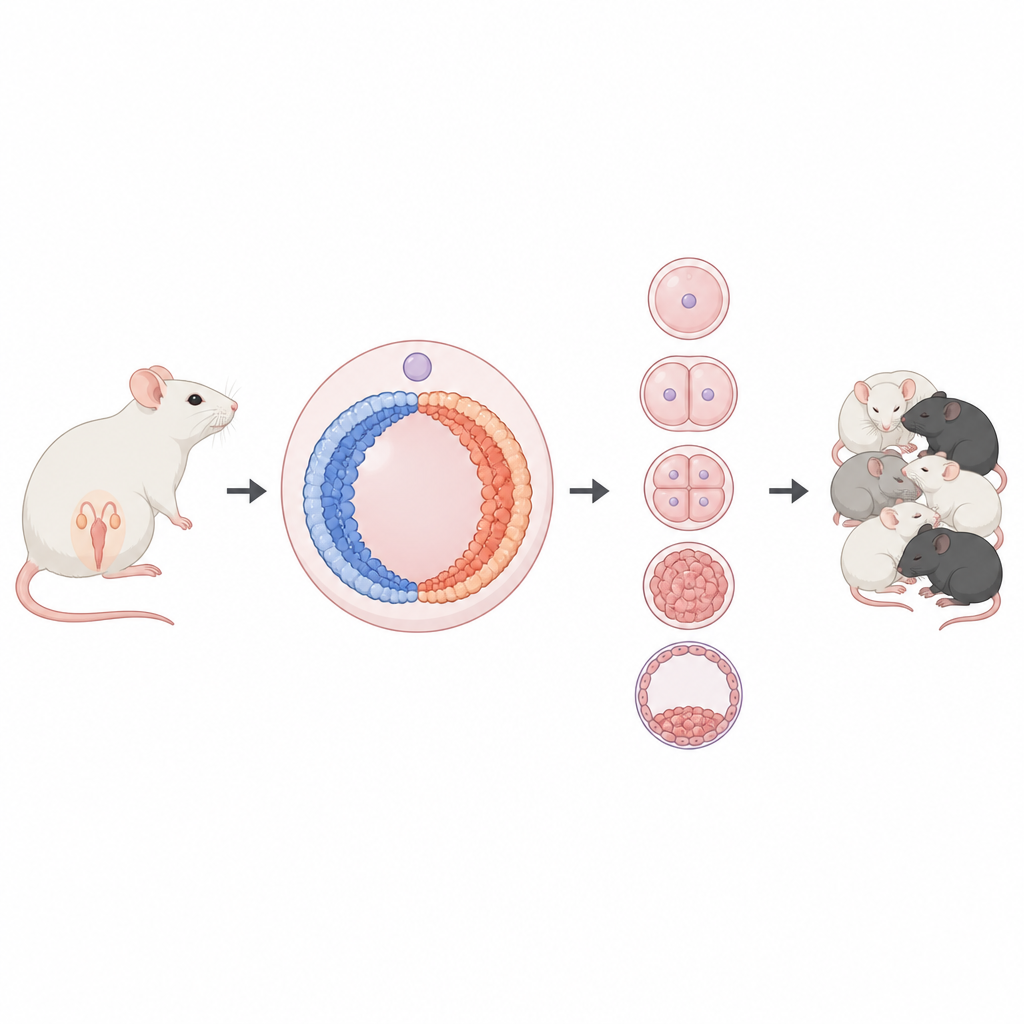
A tug-of-war on the egg’s DNA
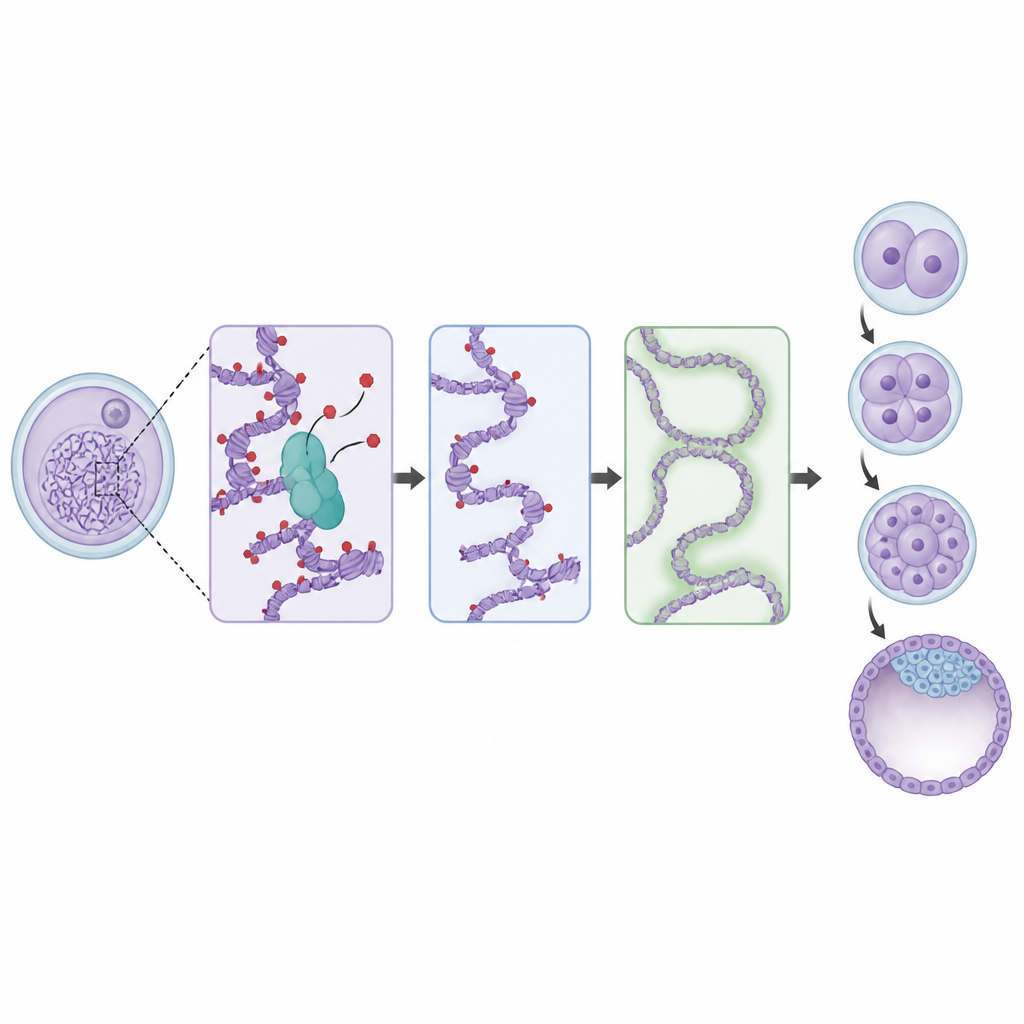
Inside each egg cell, DNA is wrapped around proteins to form chromatin, which can be loosely packed and active or tightly packed and quiet. Two chemical tags on these proteins help mark these states: one is linked to activity, the other to silencing. The authors focus on a protein called BAP1, part of a de-tagging complex that removes a silencing mark from chromatin. In many cell types this complex has been linked to shutting genes off, but in egg cells the team suspected it might play a very different role.
Guarding active regions from creeping silence
Using genetic engineering in mice, the researchers selectively removed BAP1 from growing egg cells and then mapped where different chromatin tags were located. Without BAP1, a silencing tag spread broadly across the genome, especially into stretches of DNA that normally host control elements called enhancers. At many of these sites, the usual activity-linked tag was lost and the silencing tag took its place. The affected regions often lay in gene-poor zones that gain active marks only late in egg growth, suggesting that BAP1 is particularly important for switching on new programs just before the egg is fully mature.
Keeping key egg genes switched on
Next, the authors examined which genes changed their activity when BAP1 was missing. Far more genes were turned down than turned up, showing that in eggs BAP1 mainly supports gene activity rather than silence. Many of the reduced genes help cells stick to one another or respond to growth signals, functions known to be important for egg quality and early embryo development. Interestingly, classic targets of another silencing system, called Polycomb, stayed largely repressed even without BAP1, meaning the main job of this de-tagging complex in eggs is to protect active areas from being silenced rather than to reinforce existing silence.
From faulty eggs to struggling embryos
The team then followed what happened after fertilization. Eggs lacking BAP1 could be fertilized, but their embryos divided more slowly and many stalled before forming healthy blastocysts, the stage that implants in the uterus. When both maternal and early embryonic BAP1 were absent, development often halted at just a few cells. Detailed RNA measurements showed that these embryos struggled with the maternal-to-zygotic transition, the handoff from stored egg messages to the embryo’s own gene activity. Many genes that should switch on early remained weak, while some maternal messages lingered longer than normal. At the same time, new enhancers in the embryo failed to gain strong activity marks, even though inherited silencing marks on certain regions persisted through several stages.
Lasting marks that fade at the right time
By tracking chemical tags on chromatin through later stages, the researchers found that the abnormal silencing marks established in BAP1-free eggs endured into early embryos and morulae but were largely removed after implantation. Despite these early shifts, standard genomic imprinting, which causes some genes to be expressed only from the mother’s or father’s copy, remained mostly intact. This suggests that the main impact of losing BAP1 is not to scramble imprinting but to weaken enhancer activity and gene expression exactly when the embryo most needs them.
What this means for fertility and beyond
Put simply, this work shows that BAP1 acts as a guardian of the egg’s epigenome, stripping away excess silencing marks so that key regions of DNA can stay active. When this guardian is lost, silence creeps into places that should remain on, eggs lose important developmental messages, early embryos falter, and female fertility declines. Although the study was done in mice, it highlights how delicate the balance of chromatin marks is in eggs and early embryos, and how small shifts in that balance can have large consequences for reproduction.
Citation: Kang, J., Liu, P., Ichimura, S. et al. Polycomb repressive-deubiquitinase complex safeguards oocyte epigenome and female fertility by restraining Polycomb activity. Nat Commun 17, 4149 (2026). https://doi.org/10.1038/s41467-026-70845-x
Keywords: oocyte epigenome, maternal-to-zygotic transition, BAP1, early embryo development, female fertility