Clear Sky Science · en
A multi-host mechanistic model of African swine fever emergence and control in Romania
Why this matters for farmers and food security
African swine fever is a deadly disease in pigs that has wiped out millions of animals worldwide, threatening farmers’ livelihoods and raising pork prices. Romania has been one of the hardest-hit countries in Europe, with outbreaks striking both backyard pigs in villages and wild boar in nearby forests. This study uses a detailed computer model to untangle how the virus moved between farms and wildlife during the first big wave of the epidemic in 2018—and tests which control measures might actually help bring such an outbreak under control.
Two linked worlds: village pigs and wild boar
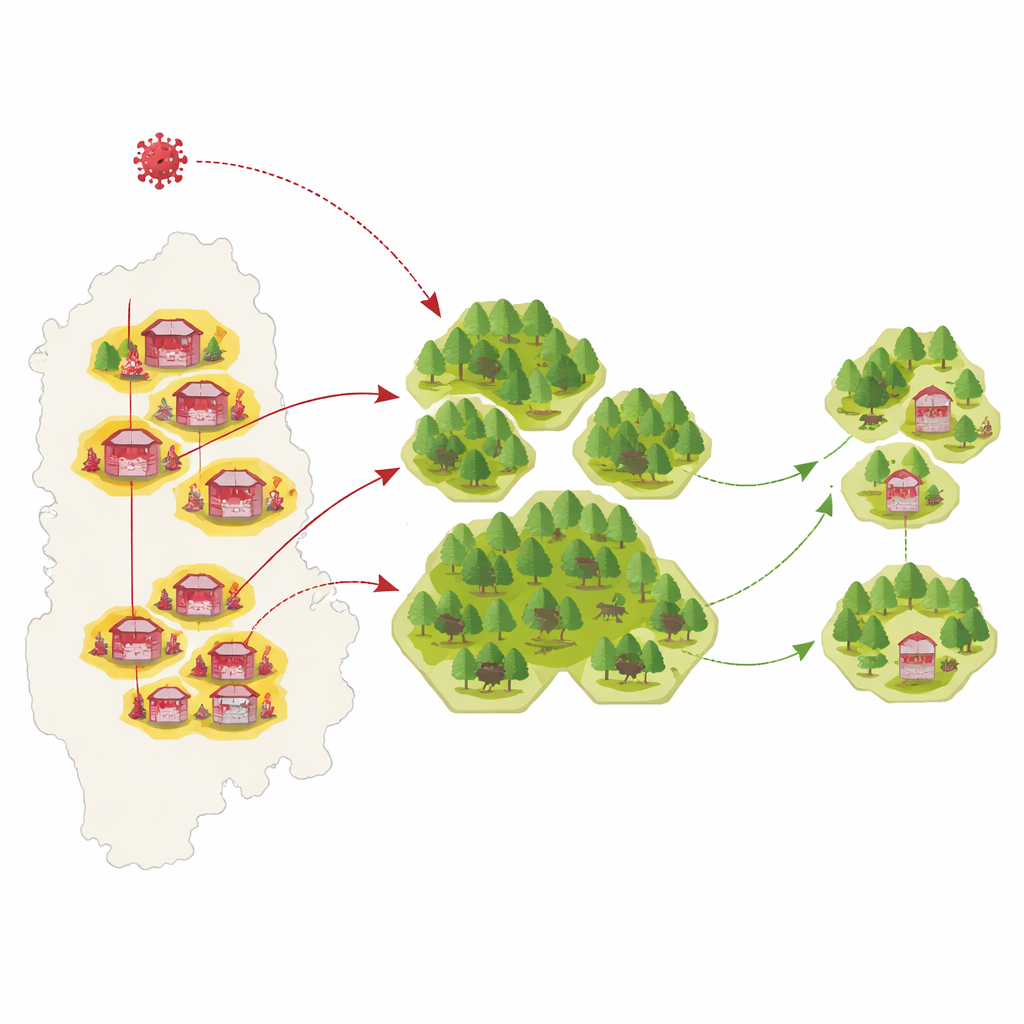
Romania’s countryside is dotted with villages where many households keep a few pigs in simple backyard pens. Nearby forests and fields are home to wild boar. When African swine fever entered southeastern Romania in 2018, cases quickly appeared in both settings. The researchers treated each village as a single large farm and divided the landscape into hexagon-shaped patches that could host wild boar. They then used official reports of infected farms and wild boar carcasses from June to December 2018 to reconstruct how the disease likely jumped from place to place and from one type of host to the other.
Building a digital epidemic on the map
The team created a “mechanistic” model, meaning it follows simple rules about how infection spreads: which farms or wild boar patches can contact each other, how quickly infected locations are detected, and how long they stay infectious. They tested 256 different versions of the model, varying assumptions such as whether farms mainly infect their closest neighbors or spread disease more broadly, and whether long-distance introductions into wild boar need to be added on top of local spread. They then kept only the versions that best reproduced the real epidemic curves—how many new infected farms and wild boar patches appeared each week in each of six counties.
Who infected whom?
Once they found a best-fitting model, the researchers used it to estimate the most likely source of each new infection. For domestic pig farms, they calculated that about three out of five infected farms were linked to other outbreak farms, a bit more than one in four were linked to infected wild boar areas, and the rest were due to infection coming from outside the modeled system, such as long-distance movements. For wild boar patches, most infections came from other infected wild boar areas, but a substantial share came from farms. Forested patches with enough tree cover acted as hot spots: these areas were many times more likely both to become infected and to pass infection on than more open terrain. Together, these patterns show that the two host populations formed a tightly connected network rather than separate epidemics.

Testing what-if control strategies
Romania already applied standard control rules during the 2018 wave, including culling pigs on detected farms and setting up 10-kilometer surveillance zones. The model allowed the authors to explore several “what-if” scenarios: removing wild boar carcasses more quickly, improving passive surveillance on farms so infections are detected sooner, and more aggressive culling strategies that either remove entire farms immediately or pre-emptively cull neighboring farms when wild boar cases are detected nearby. Although these interventions tended to shrink the median epidemic size in simulations, the benefits were modest and highly uncertain, and none came with strong statistical support for clearly beating the baseline response. Social realities, such as resistance to large-scale pre-emptive culling of backyard pigs, further limit what can be done in practice.
Limits of the model and the data
The study also highlights the difficulties of modeling a real-world livestock disease. Wild boar surveillance was patchy and likely missed many cases, especially in remote areas. Within villages, there was limited information about how many households kept pigs or how they interacted, so each village had to be treated as a single unit. Early in the epidemic, detection efforts may have ramped up quickly, but the model assumed a constant level of surveillance. These gaps mean that while the general patterns are robust—particularly the importance of cross-species transmission—the precise percentages carry wide uncertainty bands.
What this means for future outbreaks
For non-specialists, the key takeaway is that controlling African swine fever in places like Romania cannot focus on either farms or wildlife alone. Backyard pigs and wild boar continually re-infect one another, especially in and around forested areas. The model suggests that even fairly strong versions of current strategies are unlikely to stamp out the virus unless they are part of a broader rethink that includes both hosts, better wildlife surveillance, and realistic attention to local culture and economics. Rather than promising quick eradication, authorities may need to plan for long-term management of low-level circulation in wild boar, while using improved biosecurity and monitoring to keep the disease from spilling back into domestic herds.
Citation: Hayes, B., Vergne, T., Rose, N. et al. A multi-host mechanistic model of African swine fever emergence and control in Romania. Nat Commun 17, 2659 (2026). https://doi.org/10.1038/s41467-026-70769-6
Keywords: African swine fever, Romania pig farms, wild boar transmission, disease modeling, livestock disease control