Clear Sky Science · en
An intralayer microcircuit in the temporal association cortex underlies sensory-induced escape in mice
How the Brain Turns Senses into Split‑Second Escapes
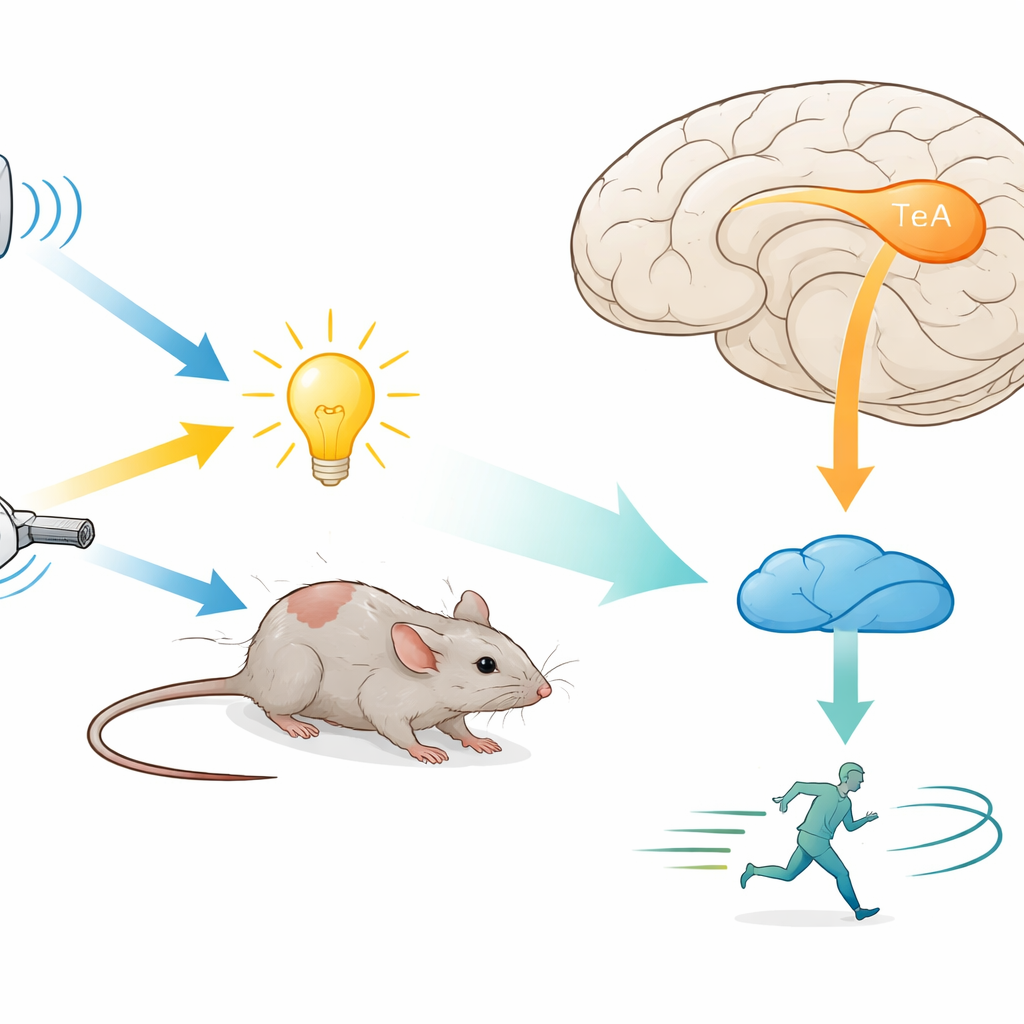
When a mouse suddenly dashes away from a loud noise or a flash of light, its brain is making a rapid life‑or‑death calculation: stay or run. This study asks where in the brain that decision is made and how signals from the eyes, ears, and skin are turned into a single, decisive escape. By dissecting a tiny region of the cortex in mice, the authors uncover a local wiring diagram that links sensory input directly to the command to run, offering clues to how our own brains might turn danger into action.
A Small Brain Hub for Many Kinds of Threats
The researchers focused on the temporal association cortex (TeA), a higher‑order area that receives information from multiple senses and connects to regions controlling movement. They placed mice in controlled environments where sudden sound, light, or air puffs could be delivered. In both a free‑moving arena and a head‑fixed running wheel, each of these cues reliably made the animals flee, with sound being the most potent and fastest trigger. When the team temporarily silenced TeA neurons using designer drugs or light‑driven inhibition, escape behaviour to all three stimulus types was nearly abolished. This showed that the TeA is not just a passive relay but a crucial hub for escape, needed no matter which sense first detects the threat.
From Cortex to Midbrain: A Direct Escape Pathway
To see where TeA sends its output, the authors traced its connections using fluorescent viruses. They found a dense projection to the dorsal periaqueductal gray (dPAG), a midbrain region long known to house “flight” neurons that drive running and other defensive acts. Most of the TeA cells that reached the dPAG were excitatory and sat in a thin band called layer 5a. Turning off just this TeA‑to‑dPAG pathway, either chemically or with light, blocked not only stimulus‑evoked escape but also reduced the animals’ normal spontaneous movement, without increasing anxiety. This suggests that the pathway is a positive driver of locomotion—especially when danger is present.
Three Neuron Roles: Sensing, Deciding, and Commanding
Using fine‑grained recordings from individual TeA cells in awake, running mice, the team identified three functional neuron types. One group responded to sights, sounds, or air puffs but showed little relationship to running speed; these neurons act as sensory detectors. A second group fired strongly when the animal ran but not when stimuli appeared; these cells encoded the motor command itself. The third group did both: they responded to sensory cues and their firing rose in lockstep with how fast the mouse ran. Importantly, their spikes tended to occur a couple of seconds before escape began, implying they help transform “something is happening” into “start running now.”
A Layered Microcircuit that Weighs Danger Over Time
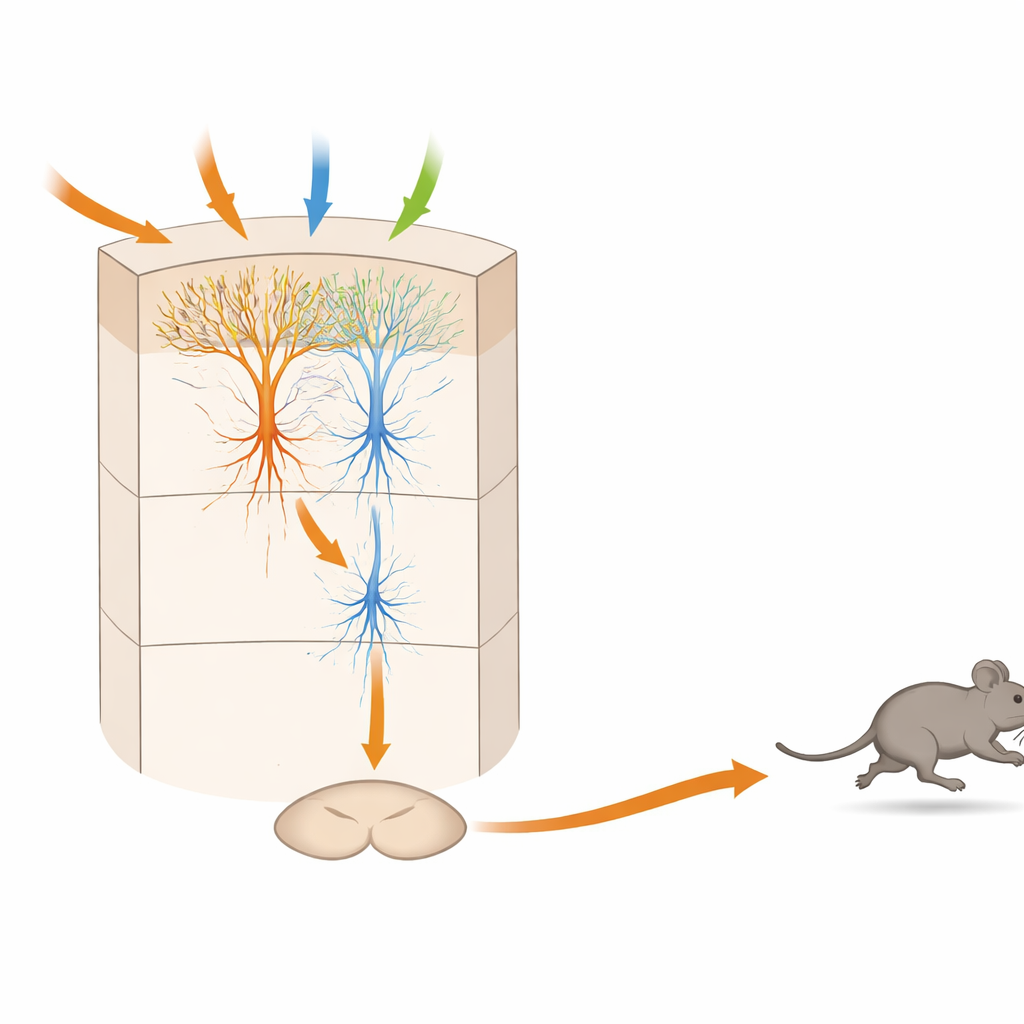
Anatomical and slice‑physiology experiments then linked these functional types to specific wiring inside layer 5 of TeA. Input‑receiving “SensTeA” neurons, which are thick‑tufted and widely branched, collect signals from auditory, visual, and touch‑related areas. They send direct excitatory connections onto more slender “TeAdPAG” neurons that project down to the midbrain. Activating the sensory‑side cells with light could drive firing in the output cells and, with repeated pulses, eventually trigger running. However, the connection was weak enough that a single brief burst was not enough; instead, activity had to build up over hundreds of milliseconds to seconds. This temporal “integration window” matches the observed delay between a threatening cue and the onset of escape, suggesting the circuit accumulates evidence before committing to flight.
Why This Matters for Understanding Survival Decisions
To a non‑specialist, the key message is that a very small patch of cortex contains a full mini‑circuit that can take in different sensory warnings, weigh their strength and combination, and then issue a precise motor command to run. In this mouse model, sensory neurons feed into “decision” neurons, which in turn activate “command” neurons wired directly to a midbrain escape center. The need for repeated activity before the command fires explains why there is a short but meaningful delay between sensing danger and bolting. Similar logic may underlie how human brains integrate noisy, conflicting signals before deciding to flee, freeze, or stay put, and it could inform future work on anxiety, panic, and movement disorders where this delicate balance goes awry.
Citation: Li, H., Chen, J., Zhong, W. et al. An intralayer microcircuit in the temporal association cortex underlies sensory-induced escape in mice. Nat Commun 17, 4088 (2026). https://doi.org/10.1038/s41467-026-70754-z
Keywords: escape behavior, sensory integration, temporal association cortex, neural microcircuits, mouse locomotion