Clear Sky Science · en
Learning earthquake ground motions via conditional generative modeling
Why shaking from future quakes matters
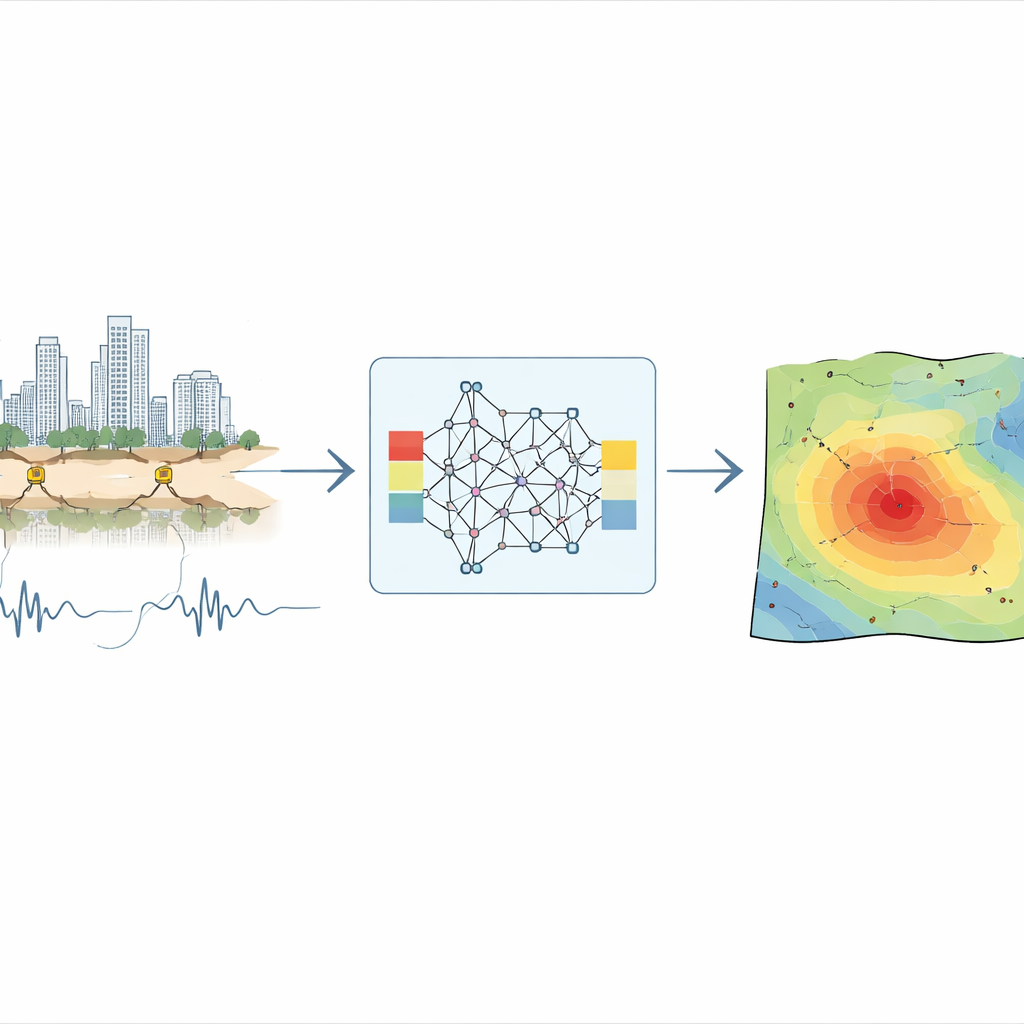
Earthquakes are an unavoidable part of life in many regions, from the San Francisco Bay Area to Japan. What really threatens people and buildings is not the quake itself but the shaking it produces at the ground surface. Engineers and planners need realistic scenarios of how strongly the ground might move at many locations, not just where sensors already exist. Yet today’s methods either rely on simplified statistics that miss local details, or on heavy-duty physics simulations that demand supercomputers and detailed knowledge of Earth’s interior. This study introduces a new artificial intelligence (AI) approach that learns from past shaking to quickly imagine how future earthquakes could rattle an entire region.
A new way to imagine the shaking
The researchers present a model they call Conditional Generative Modeling for Ground Motion (CGM-GM). Rather than solving the equations of wave physics directly, CGM-GM learns patterns from thousands of recorded small earthquakes around the Hayward and San Andreas faults in the San Francisco Bay Area. The key idea is “conditional” generation: the AI is told basic information about an event—its magnitude, depth, and where the earthquake and sensors sit on the map—and then it generates possible ground-motion time series consistent with those conditions. In effect, the model acts like a smart simulator that can fill in what shaking might look like at locations and earthquakes that have never been recorded.
Listening to quakes in time and color
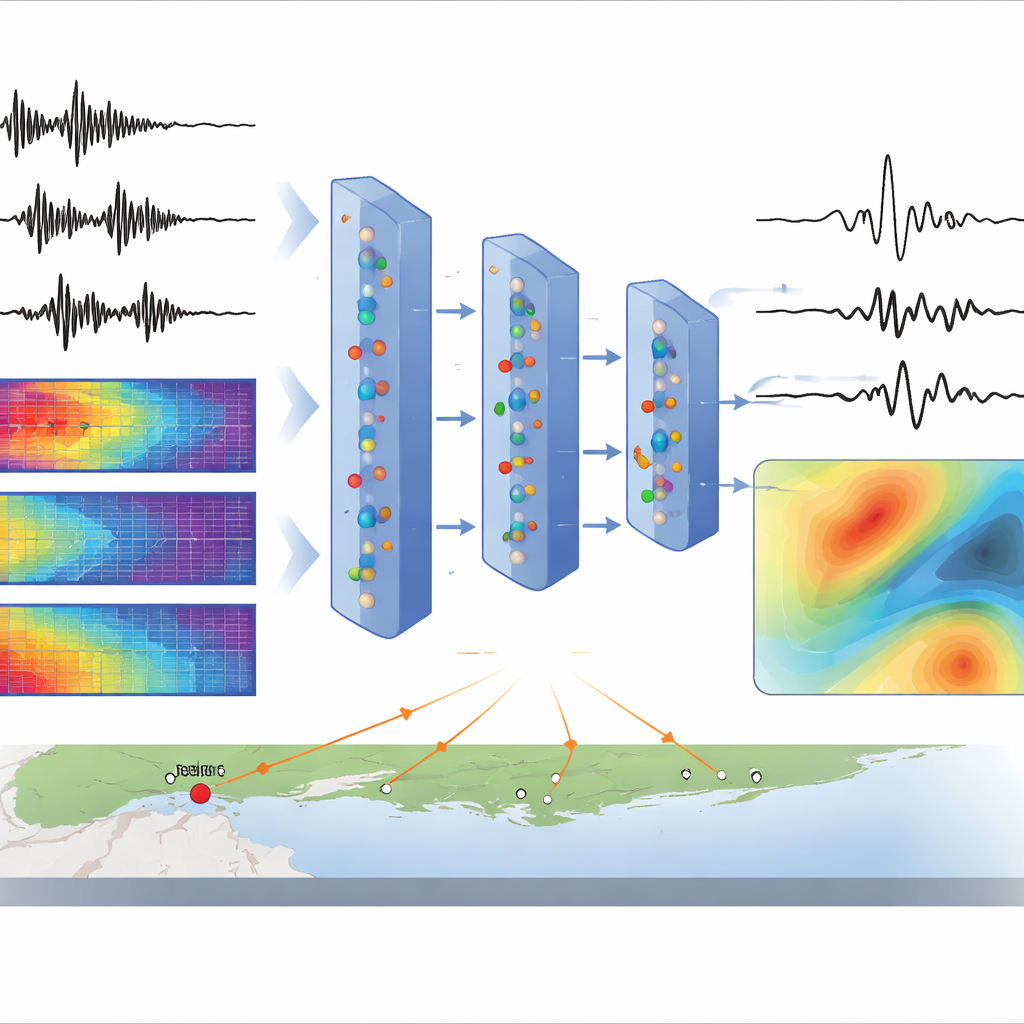
To teach the AI, the team first converts each recorded shaking signal into a kind of colored picture called a spectrogram, showing how the strength of different frequencies changes over time. They use a tool known as the Short-Time Fourier Transform to separate each waveform into amplitude (how strong) and phase (when features occur). A special type of neural network, a dynamic variational autoencoder, learns to compress these amplitude spectrograms into a sequence of hidden variables and then reconstruct them. A companion module uses geographic coordinates and earthquake properties to influence this hidden sequence, so the model naturally associates patterns of shaking with where the waves travel and how big the quake is. During generation, the model draws new hidden sequences, reconstructs amplitude spectrograms, estimates phase, and turns everything back into synthetic waveforms.
Filling in the map between sparse sensors
Once trained, CGM-GM can be asked: “If an earthquake of a given size and location happens, what shaking might we see across a dense grid of points?” The authors test this by generating ten thousand synthetic records over a subregion of the Bay Area, then computing Fourier amplitude spectra (a measure of frequency-dependent shaking strength) at each point. The resulting maps show smooth, realistic variations: shaking tends to weaken with distance from the source, change with direction, and grow stronger in areas known to have soft soils, such as near San Jose and San Francisco Bay muds. Importantly, the spatial patterns look much more realistic than a simpler baseline AI model that only knows distance and depth, and they resemble those from an advanced non-ergodic empirical ground-motion model built by seismologists.
Matching real data in both shape and strength
The team checks the AI’s output against real recordings in several ways. In the frequency domain, the synthetic amplitude spectra agree well with observations from 2 to 15 hertz, the range most important for many buildings. In the time domain, the generated waveforms reproduce not only overall shapes but also peak ground velocities and the arrival times of P and S waves, as determined by an independent picking algorithm. The model can also produce many slightly different versions of shaking for the same scenario, capturing the natural randomness of earthquakes. There are limitations: very low and very high frequencies are harder to match perfectly, durations of shaking for the smallest events show more scatter, and scaling to very large quakes remains challenging without additional training data.
What this means for people and buildings
For non-specialists, the bottom line is that this AI framework can quickly generate realistic, physics-aware earthquake shaking scenarios across an entire urban region, even where no sensors are installed and without running expensive supercomputer simulations. CGM-GM does not replace detailed physics-based models or carefully calibrated empirical equations, but it performs comparably to state-of-the-art methods while being flexible and fast. With further refinement and more data, such generative models could become practical tools to explore “what-if” earthquakes, improve hazard maps, and help engineers design buildings and infrastructure that are better prepared for the next big shake.
Citation: Ren, P., Nakata, R., Lacour, M. et al. Learning earthquake ground motions via conditional generative modeling. Nat Commun 17, 4021 (2026). https://doi.org/10.1038/s41467-026-70719-2
Keywords: earthquake ground motion, generative AI, seismic hazard, San Francisco Bay Area, variational autoencoder