Clear Sky Science · en
Asymmetric global urban cooling potential demands accelerated and context-specific actions
Why hot cities matter to everyone
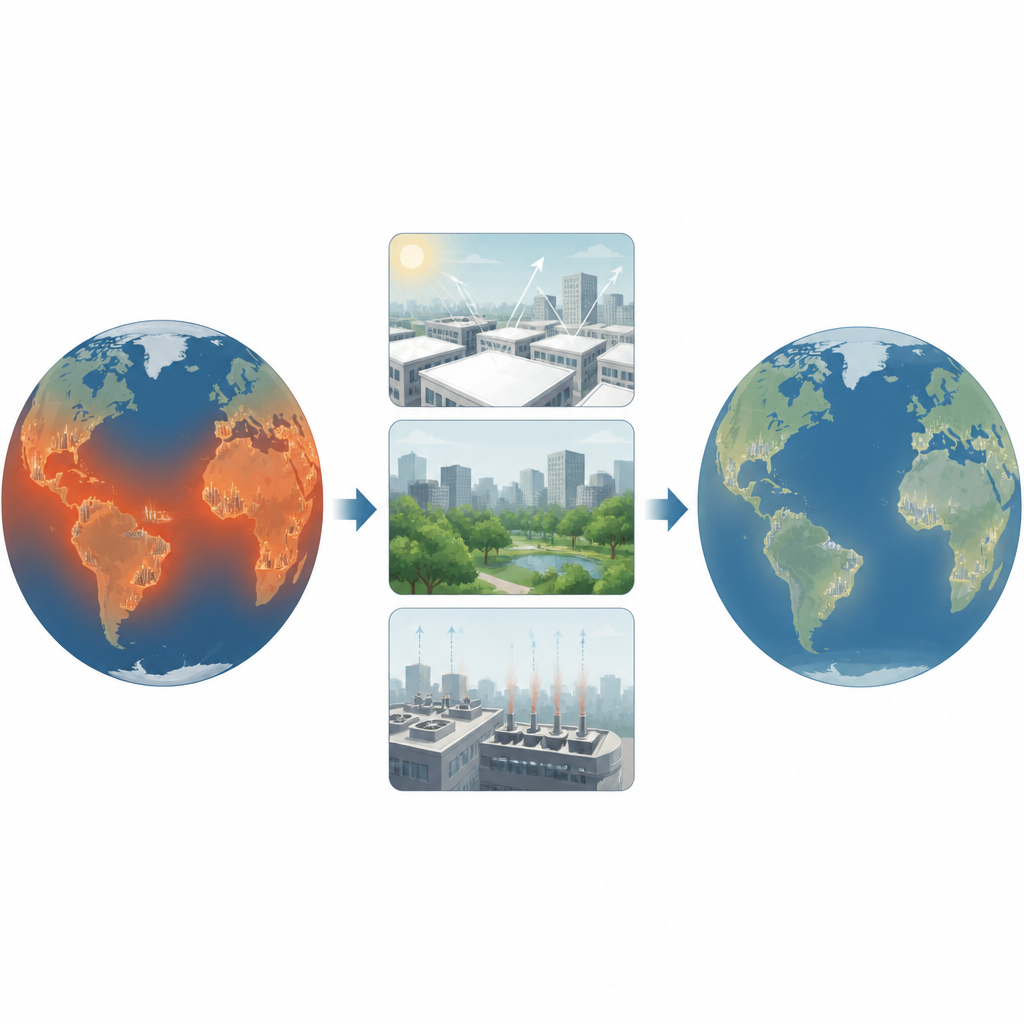
More and more people live in cities that are getting hotter, especially during heatwaves. High temperatures, combined with humidity, can make it hard for the human body to cool itself, raising the risk of illness, lost work, and even death. This study asks a simple but urgent question: how much can we actually cool our cities by mid century using tools we already know about, such as reflective surfaces, more greenery, and cutting waste heat from buildings? The answer turns out to depend strongly on where a city sits on the globe and on the time of day.
Where heat hits hardest
The authors examined 2,265 cities worldwide and looked ahead to the 2050s under a high greenhouse gas emissions scenario. They used a detailed weather and urban climate model to estimate how often people in each city would face dangerous heat, measured with a heat stress index that combines air temperature and humidity. They found that the highest risk of extreme heat is concentrated in a band between roughly 10 and 40 degrees north, stretching across parts of South Asia, the Middle East, and other densely populated regions. In these cities, people may endure hundreds of hours each summer above a danger threshold, with humid climates faring even worse than dry ones.
How much cooling cities can expect
The same model was then used to test a combined package of three strategies: installing highly reflective roofs and pavements, converting about 30 percent of urban land back to greener surfaces, and improving air conditioning systems so they waste less heat and run at slightly higher indoor setpoints. The team compared summers with and without these measures to estimate the average drop in heat stress. They found that the overall cooling potential increases with latitude. Cities in higher latitudes, such as many in Europe and North America, could see relatively large percentage cuts in dangerous heat hours, even though their starting risk is lower. In contrast, tropical and subtropical cities, where heat risk is greatest, show more modest percentage reductions.
Day versus night in the city
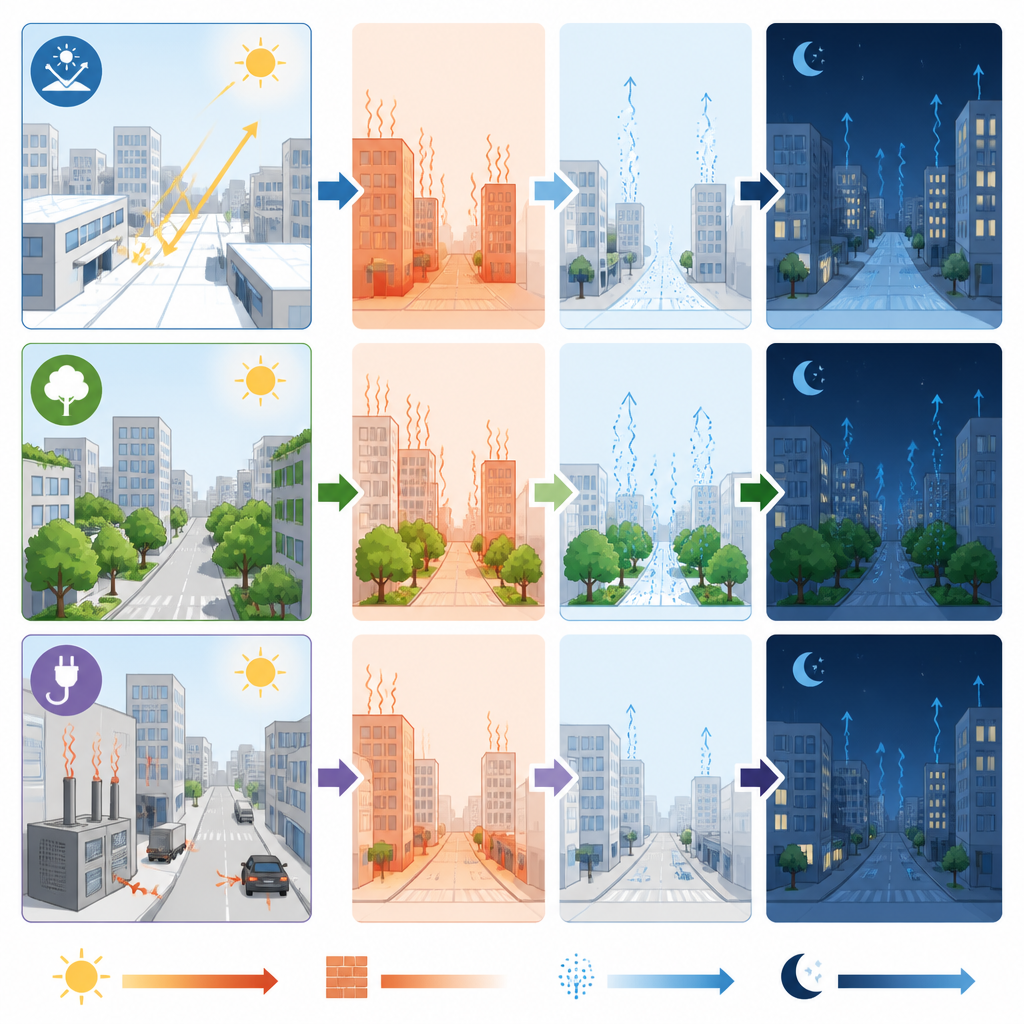
A key finding is that this bundle of measures cools cities much more at night than during the day. In high risk regions, dangerous heat hours are cut by about one fifth overall, but nighttime hours see average reductions of more than one third, while the hottest afternoon hours shrink by only about one tenth. This happens because the strategies directly reduce how much energy is stored and later released by buildings and pavements, and they cut the waste heat poured into the air by machines such as air conditioners. At night, when the lower atmosphere is more stable and shallower, these changes translate more efficiently into cooler conditions for people on the ground.
What actually makes cities cooler
To understand why cooling potential varies from place to place, the researchers dissected how each measure alters the balance of heat at the surface. Reflective roofs and pavements work mainly by bouncing away more sunlight, which is especially effective in sunny, dry regions and at higher latitudes where summer days are long. Green transformation adds parks and vegetated areas that evaporate water and reduce heat storage, which helps, but the gain in moisture can slightly limit the drop in perceived heat during the day. Cutting waste heat from air conditioning and other sources turns out to be particularly powerful at night, when even modest reductions in added heat have a strong impact on urban temperatures. Across all cities, reflective materials stand out as the single most influential tool, especially where heat risk is high but the overall physical potential for cooling is limited.
Why local action must differ by place
The study concludes that there is no one size fits all recipe for cooling cities. The places that suffer the most from extreme heat, mainly low and mid latitude humid regions, also tend to have less physical room to lower temperatures using broad citywide measures alone. At the same time, they often have fewer financial and technical resources to act. This global mismatch means that efforts must both accelerate and adapt to local conditions, pairing citywide steps like reflective materials and greener land use with neighborhood scale solutions such as street trees, shading structures, and better ventilation of streets and courtyards. Together, these locally tailored strategies can help close the gap between where heat is most dangerous and where cooling is easiest to achieve.
Citation: Ding, X., Fan, Y., Zhao, Y. et al. Asymmetric global urban cooling potential demands accelerated and context-specific actions. Nat Commun 17, 4239 (2026). https://doi.org/10.1038/s41467-026-70662-2
Keywords: urban heat, heat mitigation, reflective surfaces, urban greening, climate adaptation