Clear Sky Science · en
A meta learning and task adaptive approach for drug target affinity prediction
Teaching Computers to Pick Better Medicines
Finding new medicines often means testing millions of possible molecules to see which ones stick to the right protein targets in the body. Doing this in the lab is slow and expensive, and even today’s powerful artificial intelligence tools can stumble when only a handful of measurements are available for a new disease protein. This paper introduces AdaMBind, a learning system designed to make reliable guesses about how strongly drugs will bind to previously unseen targets, even when data are scarce. 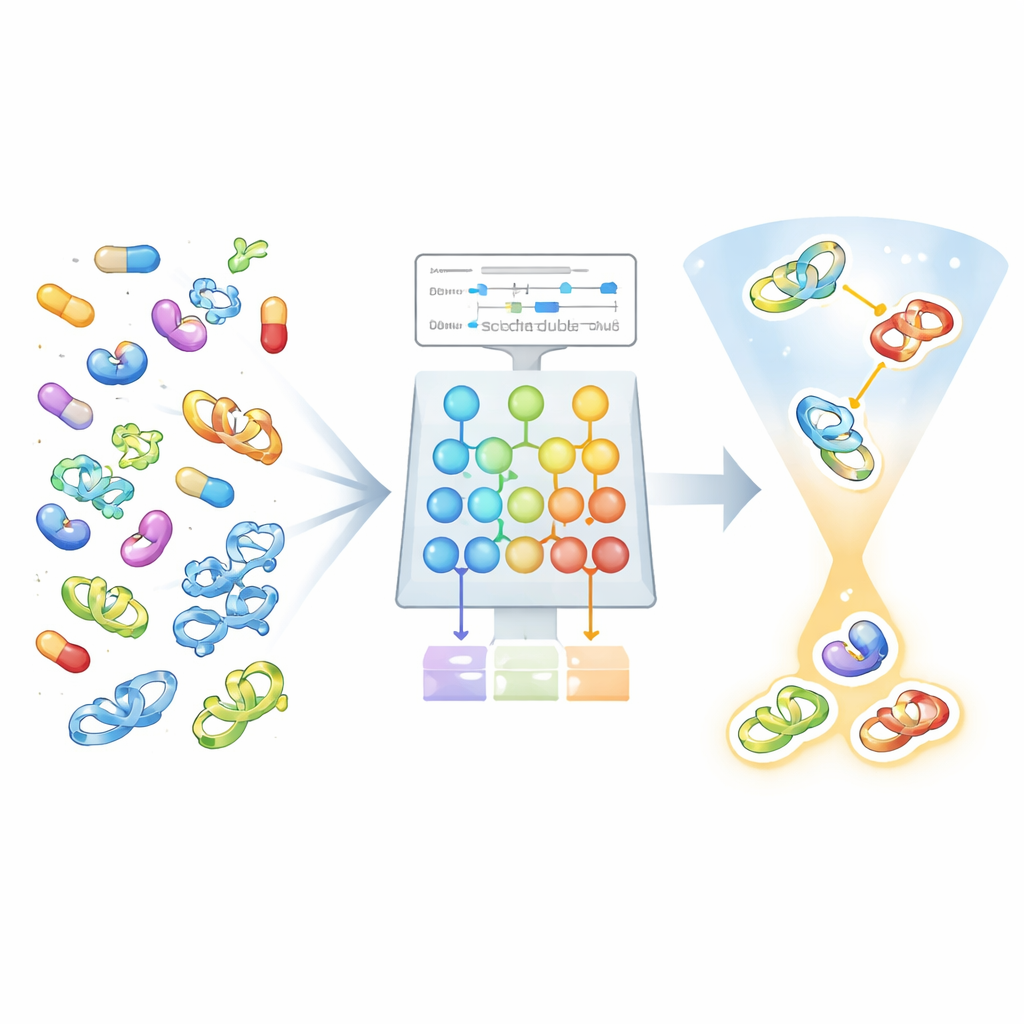
Why Drug–Target Stickiness Matters
When a drug works, it is usually because it latches onto a specific protein and changes what that protein does. The strength of this grip, called affinity, is a key ingredient in turning a promising molecule into a real treatment. Classic lab techniques can measure affinity very precisely, but they demand specialized instruments, expert handling, and a lot of time. Computer models promise much faster screening, but most current deep-learning approaches assume they will see plenty of examples for each protein. In real drug discovery, many interesting proteins have only a few known compounds, so models trained in the usual way tend to overfit well-studied targets and fail on new ones.
Learning How to Learn From Many Small Problems
AdaMBind tackles this challenge with meta-learning, sometimes called “learning to learn.” Instead of treating the whole dataset as one big problem, the method breaks it into many smaller tasks, each centered on a single protein and all the drugs tested against it. The model then trains across these tasks so that it acquires an internal starting point that can be quickly adjusted for a new protein using only a few known measurements. Under the hood, the system represents drugs as graphs of atoms and bonds, and proteins as amino acid sequences. Separate neural networks digest each side and then combine their features to predict binding strength, but the crucial twist is how the model is trained across tasks.
From Easy Lessons to Hard Ones
Not every task is equally informative. Some protein–drug collections are noisy or unusually difficult and can mislead the training process if treated the same as cleaner tasks. AdaMBind adds an adaptive task module that constantly scores tasks according to how well learning on a small “support” subset carries over to a held-out “query” subset. Tasks that produce lower errors and whose learning directions agree between support and query sets are treated as “easier” and more reliable. The module gives these tasks higher sampling weight, so the model first consolidates what it can learn confidently, then gradually incorporates harder tasks. This easy-to-hard scheduling mimics how people often learn and makes the final system more stable and less sensitive to outliers. 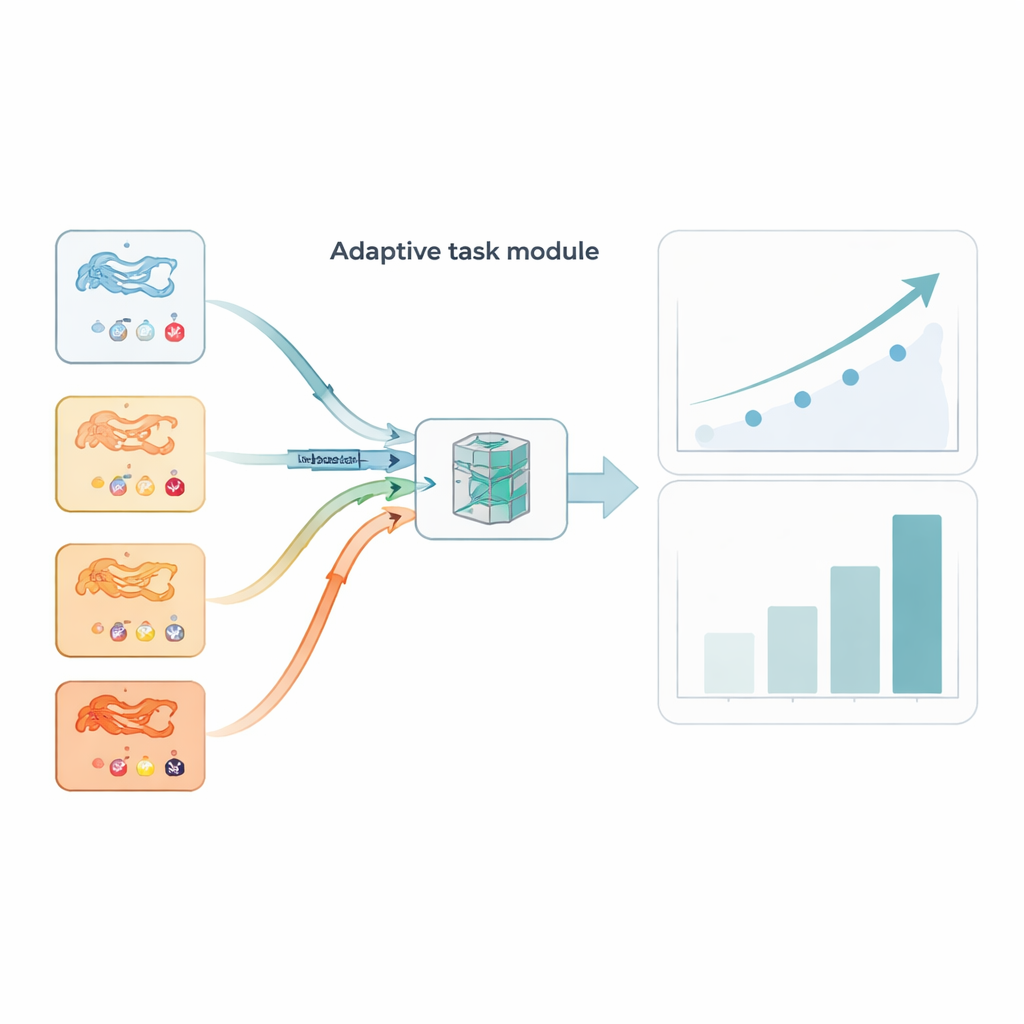
Standing Out in Data-Scarce Conditions
The authors tested AdaMBind on three standard drug–target affinity collections—BindingDB, KIBA, and Davis—using both generous and very small sample sizes per protein, and with either random splits or intentionally dissimilar test targets. Across nearly all conditions, AdaMBind beat eight strong comparison methods, especially when only five known drug–protein pairs were available for adapting to a new target. Additional tests showed that its performance stayed strong even when the new protein had few close relatives in the training set, suggesting that the model is not just memorizing similar tasks but extracting broadly useful patterns. A label-noise strategy, which gently perturbs affinity values during training, further improves robustness by discouraging the model from clinging too tightly to possibly imperfect measurements.
From Benchmarks to Real Drug Leads
To gauge its practical value, the team asked AdaMBind to help with virtual screening problems that resemble real-world projects. On a challenging dataset where only a tiny fraction of compounds are truly active against targets such as ESR and TP53, the method was able to push many of the true hits toward the top of the ranking list, outperforming other models on measures that reward “early enrichment.” They then applied AdaMBind to the leukemia-linked protein FLT3, scanning a large drug database for strong binders. Among its top suggestions was the compound staurosporine. Follow-up docking simulations and lab kinase assays confirmed that staurosporine inhibits both the normal and mutant forms of FLT3 with sub-nanomolar potency, even more strongly than a known clinical inhibitor, demonstrating that the model’s predictions can point to genuinely powerful molecules.
A Smarter Starting Point for Future Drug Hunters
In everyday terms, AdaMBind provides a way for an AI system to learn good “instincts” about drug–protein binding from many small, imperfect lessons, and then rapidly apply those instincts when confronted with a new, poorly studied target. By deciding which training tasks to trust first and by remaining relatively insensitive to how closely a new protein resembles past examples, the method offers a more reliable guide for virtual screening under tight data budgets. While there is room to grow—such as incorporating richer 3D information and pushing toward true zero-data predictions—this framework marks a step toward faster, more flexible, and more data-efficient discovery of future medicines.
Citation: Wan, M., Zhao, Y., Zhang, Y. et al. A meta learning and task adaptive approach for drug target affinity prediction. Nat Commun 17, 3734 (2026). https://doi.org/10.1038/s41467-026-70554-5
Keywords: drug-target affinity prediction, meta-learning, virtual screening, few-shot learning, FLT3 inhibitors