Clear Sky Science · en
Continuing industrial emissions are delaying the recovery of the stratospheric ozone layer
Why this matters for everyday life
The world has celebrated the Montreal Protocol as a rare environmental success story: by banning many ozone-destroying chemicals, it put the planet’s protective ozone shield on a path to recovery. This study asks a sobering question: have we overlooked a hidden source of these chemicals that could slow that recovery? The answer is yes. The authors show that certain industrial uses of ozone‑depleting chemicals, previously thought to be minor and tightly controlled, are leaking far more into the air than expected—enough to delay ozone recovery by several years and add to climate warming.
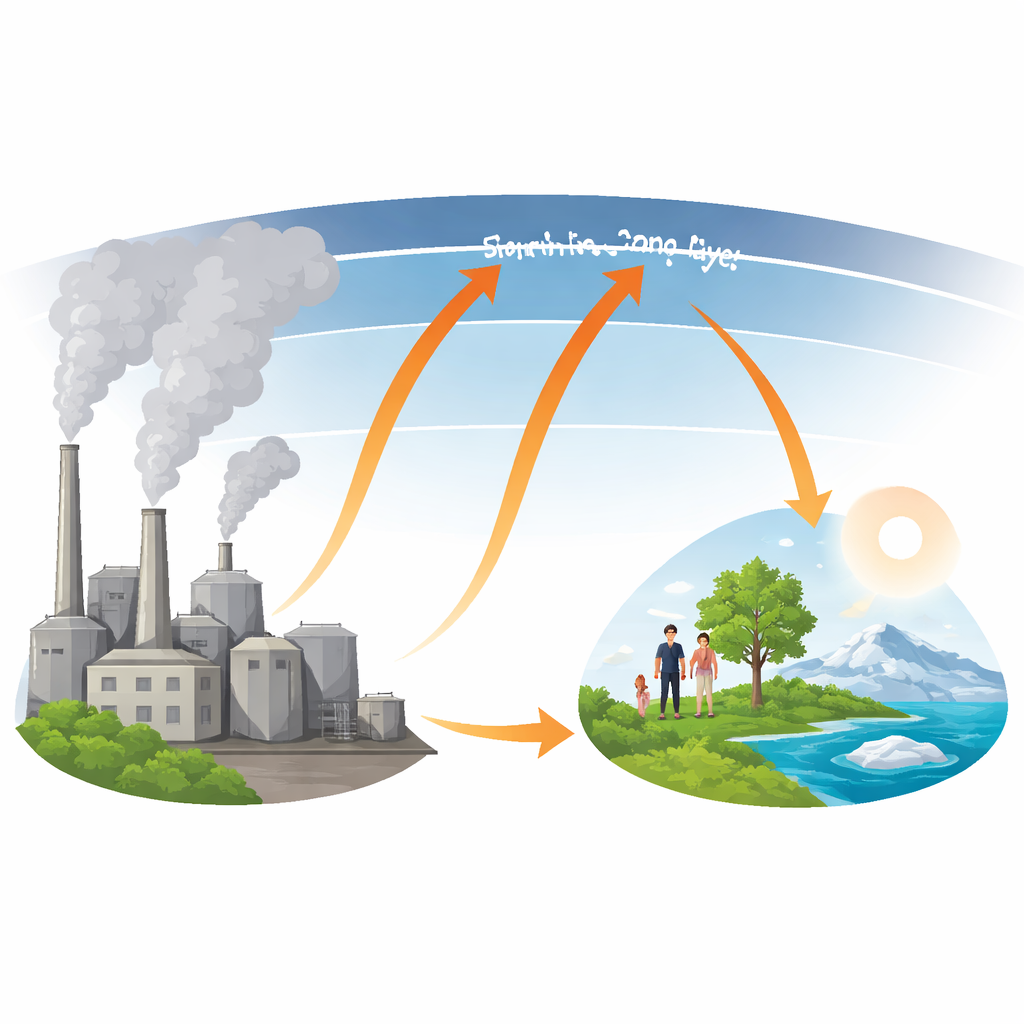
A hidden loophole in a global success story
The Montreal Protocol has largely banned the use of powerful ozone‑depleting substances (ODS) like chlorofluorocarbons (CFCs) in applications such as refrigeration and spray cans. But a crucial exception was made: these same chemicals can still be produced and used as “feedstocks,” meaning intermediate ingredients used to manufacture other products. At the time, experts believed that only about 0.5% of the feedstock chemicals would escape to the atmosphere and that their use would soon shrink. Under those assumptions, emissions from feedstocks seemed too small to seriously affect the ozone layer or climate.
How industry’s chemistry has changed
Industrial chemistry has evolved in ways that upend those early assumptions. Today, ozone‑depleting feedstocks are widely used to make newer fluorinated products, including hydrofluorocarbons (HFCs), short‑lived hydrofluoroolefins (HFOs), related chemicals, and specialized plastics used in items such as advanced batteries and non‑stick or high‑performance coatings. Some of these production chains also create unwanted by‑products—additional ODS that can leak if not captured and destroyed. The authors group together emissions from feedstocks, intermediates, and by‑products as “feedstock emissions,” recognizing that all stages of the production chain can leak to the air.
What the measurements reveal in the air
Global atmospheric monitoring networks operated by NOAA and the AGAGE collaboration measure tiny amounts of these gases around the world. By combining these measurements with an atmospheric transport model, the researchers infer how much of each substance must be emitted. Comparing those emissions with industry’s reported production shows that typical leak rates are not 0.5%, but closer to 3.6% for most feedstock chemicals, and about 4.3% for carbon tetrachloride (CCl₄). Crucially, the overall use of ODS feedstocks has grown by more than 160% since 2000, rather than declining. For several key chemicals—including CCl₄, HCFC‑22, HCFC‑142b, and CFC‑113/a—observed emissions cannot be explained by old equipment or leftover stores alone; current feedstock production must be a major source.
Looking ahead: three futures for ozone and climate
Using these updated leak rates and projections of how feedstock use may evolve to 2100, the authors examine three futures. In a “business‑as‑usual” case, current high emission fractions continue alongside rising demand for certain fluorochemicals and polymers. In a “low‑emission” case, industry rapidly improves controls so leaks fall back to the long‑assumed 0.5% of production. In a “zero” case, feedstock use continues but with no leaks at all, leaving only emissions from past banks and other legacy sources. All three futures show total ODS emissions declining in coming decades as older uses fade. But under business‑as‑usual, emissions from feedstocks remain large enough to flatten that decline around mid‑century, particularly due to ongoing use of CCl₄ and HCFC‑22 and‑142b. The team then translates these emissions into a standard measure of ozone impact and radiative forcing to see how they delay the return of the ozone layer to its 1980 condition and how much they add to warming.

The cost of delay for the ozone shield and climate
The calculations show that, if feedstock emissions stay high, the recovery of mid‑latitude ozone to 1980 levels—often used as the yardstick for success—could be delayed by about seven years compared with the low‑emission case, with an uncertainty of roughly six to eleven years. Cutting leaks, especially from CCl₄ and CFC‑113/a, would be the most effective way to avoid this delay. From a climate perspective, the extra warming from business‑as‑usual feedstock emissions in 2050 is equivalent to around 0.8% of today’s global carbon dioxide emissions, and by 2100 the added heating from these emissions would be comparable to several times the present influence of the potent greenhouse gas SF₆. The message is clear for non‑specialists: the ozone layer remains on a path to recovery, but a largely unregulated corner of industrial chemistry is quietly slowing that progress and adding to climate change. Tightening controls on feedstock emissions, using technologies that already exist, would protect the ozone shield sooner and modestly help the climate at the same time.
Citation: Reimann, S., Western, L.M., Lickley, M.J. et al. Continuing industrial emissions are delaying the recovery of the stratospheric ozone layer. Nat Commun 17, 3190 (2026). https://doi.org/10.1038/s41467-026-70533-w
Keywords: ozone layer, Montreal Protocol, industrial emissions, ozone-depleting substances, climate warming