Clear Sky Science · en
Global implications of uncertainty in China’s climate policy delivery
Why China’s Climate Choices Matter to Everyone
What China does about climate change will strongly influence how hot the planet becomes this century. As the world’s largest carbon polluter and a major user of coal, oil, and gas, China’s promises to cut emissions can either help keep global warming in check or make it much harder. This study asks a simple but crucial question: not just what China has pledged, but how believable those promises are, and what it means for the world if China delivers them fully, partially, or not at all.
Checking Promises Against Reality
The authors begin by examining 292 specific targets in 58 national climate and energy policy documents, including China’s new 2035 pledge to cut greenhouse gases below their peak level. They focus on 47 targets that are numeric and measurable, spanning power generation, transport, buildings, and industry. For each target, they build a “credibility score” based on three things: how high in the political system the target is set, whether it appears in the powerful Five-Year Plans that guide national development, and how far real-world progress has gone compared with the time remaining. Targets that are already met or well on track score highly; vague or slow-moving goals score poorly.
Four Different Futures for China
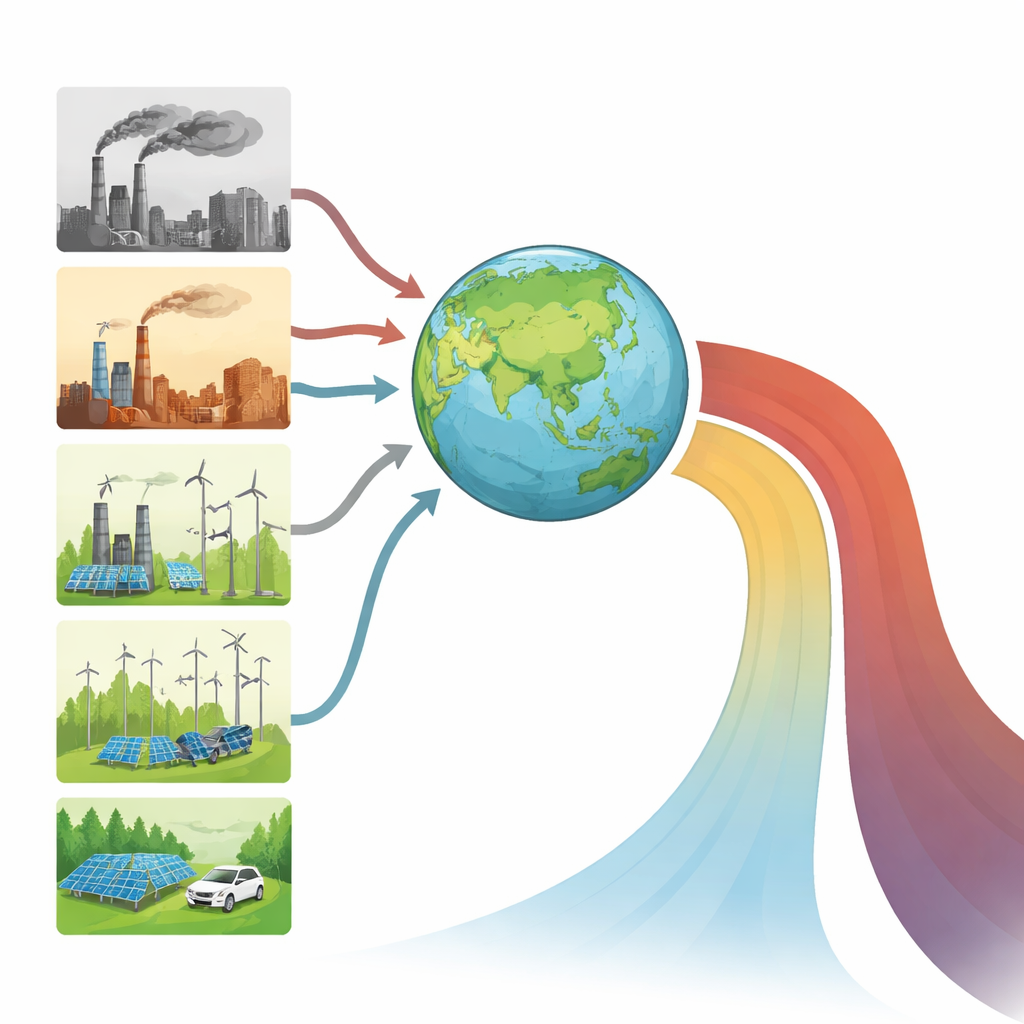
To explore what these grades mean in practice, the team builds four storylines for China’s future using a structured scenario method. One path, called Great Wall, imagines sluggish growth, policy drift, and slow climate action. Red Sun shows strong economic expansion that sidelines green goals. Calm Sea assumes steady growth and faithful delivery of today’s climate policies, including net-zero emissions by 2060. Green Lights is the most ambitious future, with rapid clean-technology deployment, vigorous climate leadership, and net-zero reached by 2050. These scenarios are then run through a detailed energy–economy model that tracks how China’s use of coal, oil, gas, renewables, and electricity could evolve in each case.
Electric Growth Versus Coal Dependence
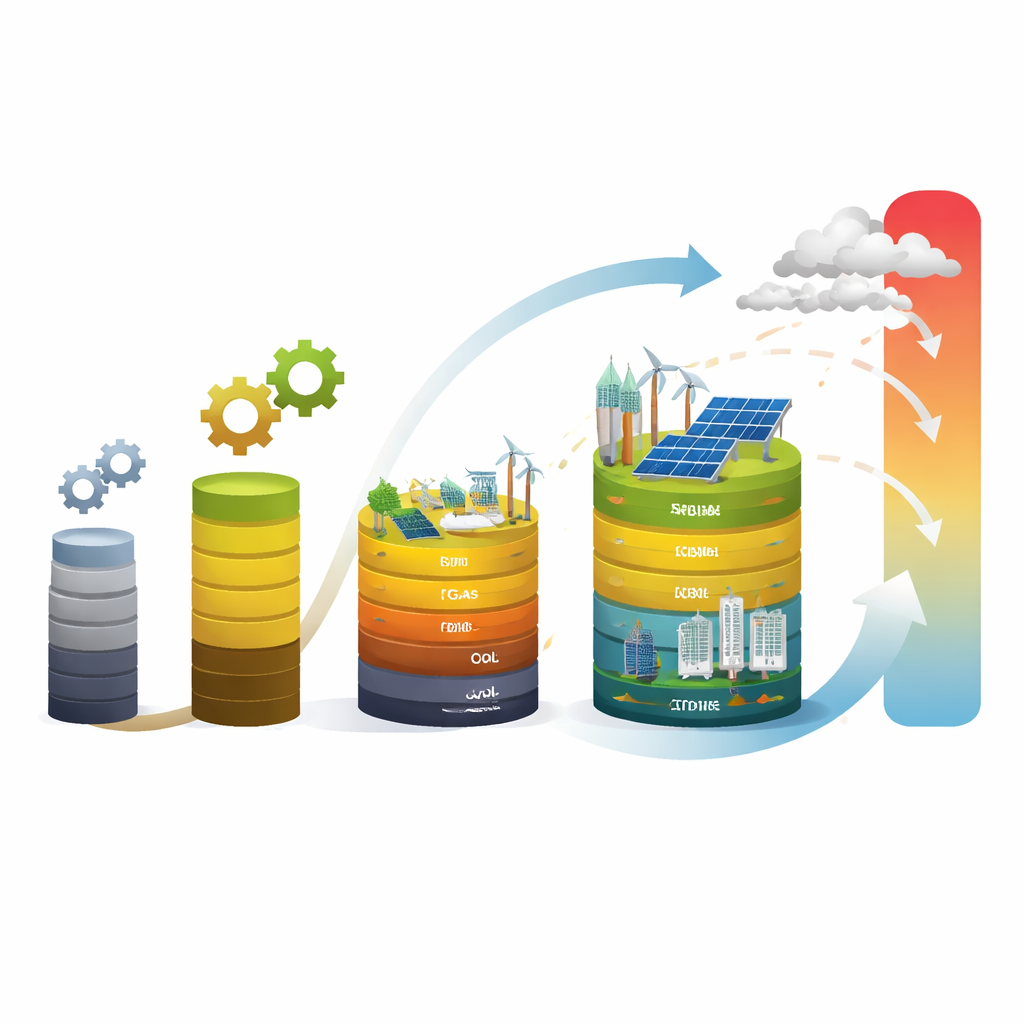
The modelling reveals that China is already on a firm path toward more electrification and rapid growth of wind and solar power, driven by credible policies on electric vehicles and renewable capacity. Even in the more pessimistic future, coal power eventually declines and renewables expand. But the speed and depth of this shift depend heavily on how seriously China follows through on its net-zero pledge. To hit its goals, coal use in both power plants and heavy industry must fall much faster, while electricity and cleaner fuels, such as hydrogen and bioenergy, take over. Weak and uncertain policies around industrial efficiency and fossil fuel phaseout leave large question marks over whether this deeper transformation will actually happen.
Oil, Gas, and the World’s Carbon Budget
Oil and gas play smaller but long-lasting roles, especially as raw materials for chemicals. China’s focus on energy security and domestic production encourages continued investment in these fuels, which risks locking them into the system for decades. The authors then place China’s four futures inside two global settings: one where other countries do only what they currently promise, and another where the world as a whole aims for net-zero emissions. They find that differences in China’s policy delivery alone can add or remove about 500 billion tonnes of carbon dioxide by 2100—almost half of the remaining global budget compatible with limiting warming to around 2 °C. This translates into a swing of about 0.17 °C in global average temperature.
What This Means for the Global Effort
From a layperson’s perspective, the study’s message is twofold. First, whether China simply talks about climate action or actually follows through—especially on phasing down coal and cleaning up industry—has enormous consequences for how much the planet warms. Strong and believable policies in China could partly make up for weaker action elsewhere for a few decades, buying precious time. Second, even China’s most ambitious path cannot, by itself, compensate for long-term inaction in the rest of the world. The world stays safer if China’s climate promises are credible and delivered on schedule, but those efforts must be matched by serious, sustained cuts from other major emitters to keep dangerous levels of warming at bay.
Citation: Zhang, D., Pye, S., Watson, J. et al. Global implications of uncertainty in China’s climate policy delivery. Nat Commun 17, 3544 (2026). https://doi.org/10.1038/s41467-026-70400-8
Keywords: China climate policy, energy transition, net-zero emissions, global warming, carbon emissions scenarios