Clear Sky Science · en
Governing principles of hydration of mixed proton conducting Co-based double perovskites
Why water-loving crystals matter for clean energy
Turning hydrogen into a practical clean fuel depends on devices that can move charged particles efficiently through solid materials. In proton ceramic electrochemical cells, a key step is getting tiny positively charged particles, protons, into the solid electrode by reacting with water vapor. This study asks a simple but crucial question: what makes certain cobalt-based crystal materials “thirsty” for water and good at accepting protons, while others stay almost dry, even in humid, hot air?
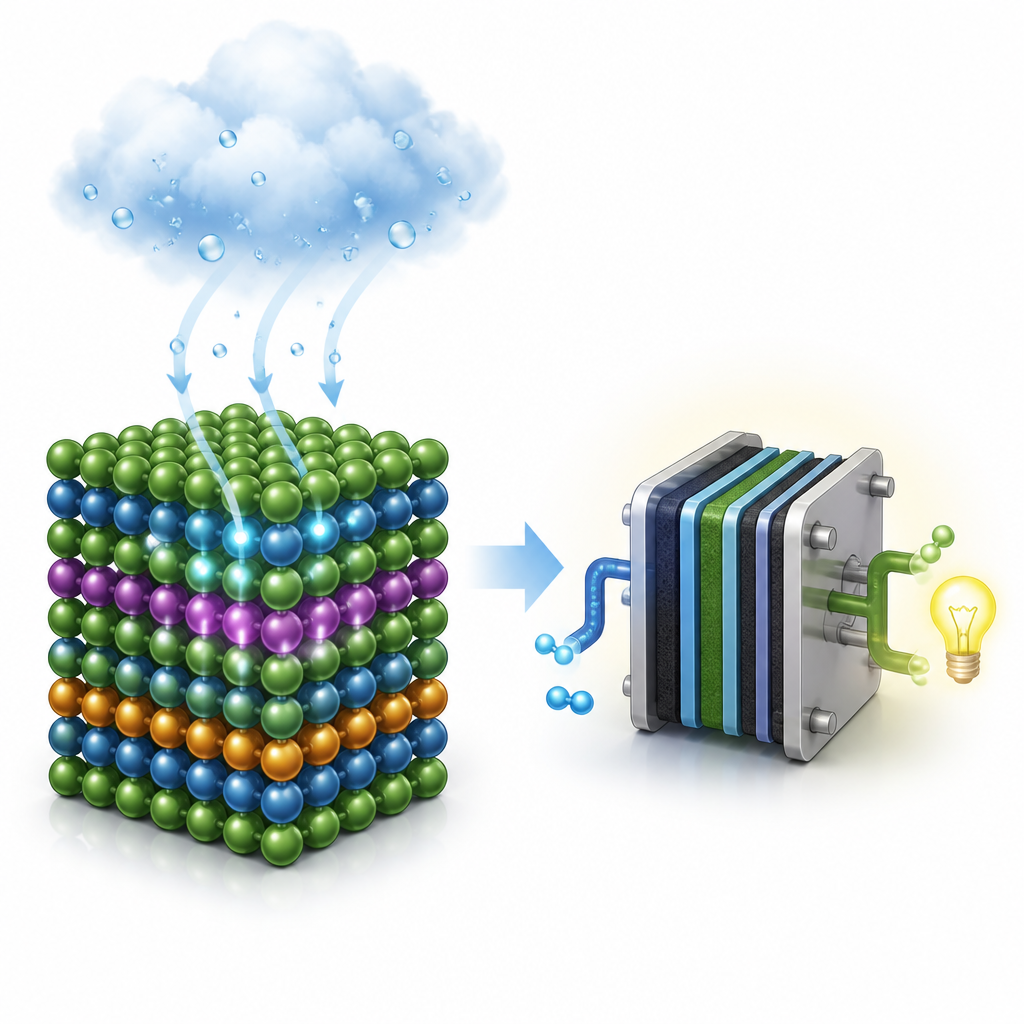
Special building blocks for proton-friendly solids
The materials explored here are double perovskites, a family of oxides whose atoms sit on a repeating three-dimensional grid. By swapping different large “A-site” atoms into this grid, researchers can tune how the crystal shares electrons and how easily it accommodates defects such as missing oxygen atoms and mobile protons. The team systematically examined 45 related compositions, mostly containing barium and mixtures of rare earth elements like lanthanum, gadolinium, and lutetium, all combined with cobalt and oxygen. They measured how much water each composition could take up at moderate temperatures, and how that water uptake related to the chemistry and arrangement of the atoms.
Hidden role of rare earth electrons
A central discovery is that only a subset of rare earth elements make the structure truly welcoming to protons. When the rare earth atoms on one of the A-sites have either empty, half-full, or full so‑called 4f electron shells, the crystals show clear water uptake and measurable proton content. In practice, that means compositions based on lanthanum, gadolinium, or lutetium stand out. Elements with partly filled 4f shells, or complicated mixtures of several rare earths, strongly reduce hydration. This pattern reveals that subtle differences in how electrons sit around the rare earth atoms ripple through the lattice and change the bonding between cobalt and oxygen, which in turn affects how stable protons are inside the material.
Watching water and oxygen enter the crystal
To go beyond simple weight measurements, the researchers combined several advanced tools. X-ray absorption spectroscopy probed how electrons are shared between cobalt and oxygen, showing that the proton-friendly compositions have a more ionic, less strongly shared bond character and fewer “electron holes” in specific orbitals. When water is introduced, protons are repelled from these holes, pushing electrons into different orbitals and revealing the presence of hydrated states. Neutron and synchrotron X-ray diffraction mapped where oxygen atoms and vacancies sit in the lattice and how bond lengths and angles change. In parallel, isotope experiments that swap normal water for heavy water allowed precise tracking of proton uptake and movement into the bulk of the crystal, even up to 600 degrees Celsius.
Slow structural rearrangements behind the scenes
The study uncovered that hydration is not a single, simple reaction. When these materials meet humid, oxygen-rich air, two processes occur: fast incorporation of protons and slower uptake of extra oxygen that changes the overall oxidation state of cobalt. At the same time, the large A-site atoms can gradually shuffle between their preferred positions, turning an ordered arrangement into a more disordered one. This A-site disordering actually creates new oxygen sites that are easier to protonate, so water exposure can drive a feedback loop: more protons, more disorder, and further oxidation. Under low-oxygen conditions, in contrast, water reacts mainly by adding protons while the material slightly reduces, a process the authors describe as hydrogenation rather than simple hydration.
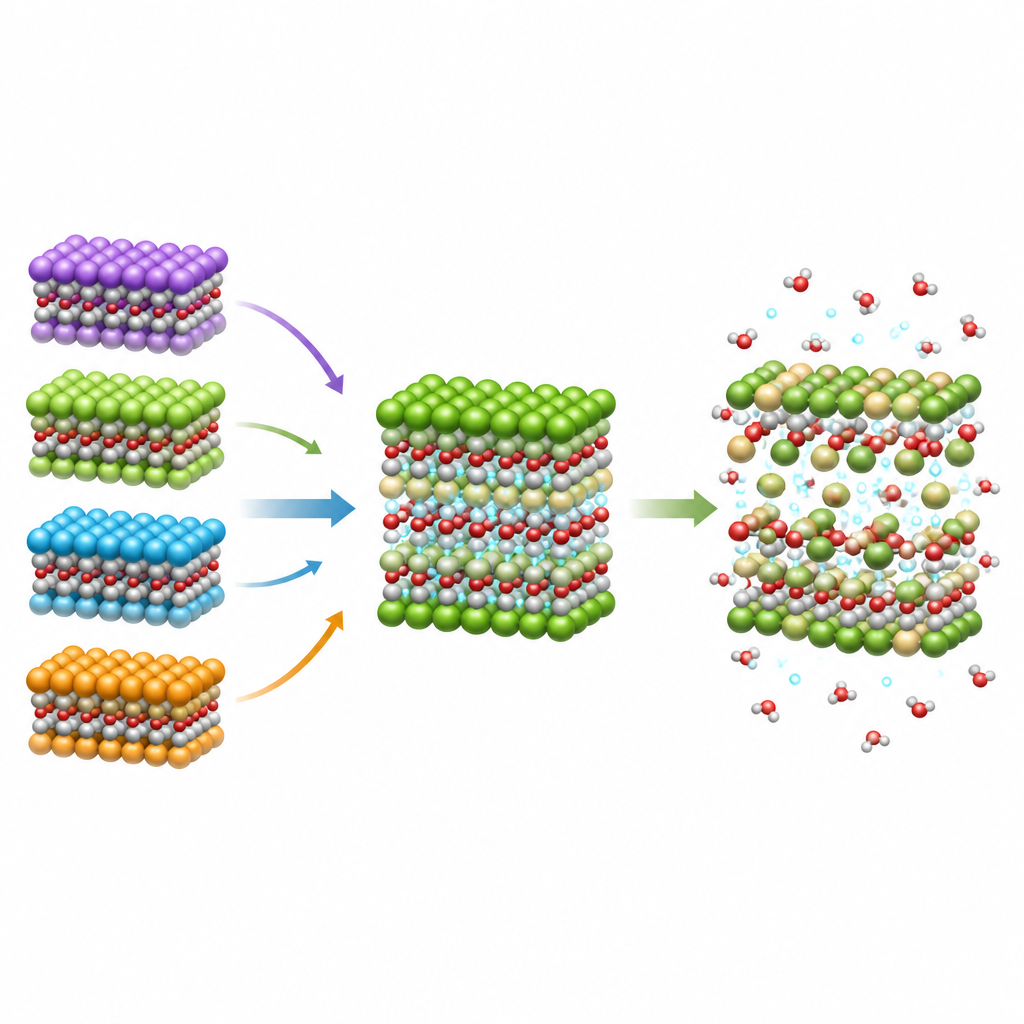
Design rules for better hydrogen devices
By piecing together data from 45 compositions and multiple techniques, the authors outline governing principles for making cobalt-based double perovskites that hydrate well. Strong hydration requires rare earth elements with empty, half-full, or full 4f shells on the A-site, a relatively ionic cobalt–oxygen bond with limited negative charge transfer, and crystal structures that can tolerate some A-site disorder when exposed to water. They also show that traditional weight-based measurements can overestimate proton content if slow oxygen uptake is not separated from true hydration. For designers of proton-conducting electrodes, these insights offer a practical recipe: choose the right rare earth building blocks and structural arrangements to tune the internal electron landscape, so that water from the gas phase can reliably leave behind mobile protons that boost the performance of hydrogen-based energy technologies.
Citation: Strandbakke, R., Wachowski, S.L., Balaguer, M. et al. Governing principles of hydration of mixed proton conducting Co-based double perovskites. Nat Commun 17, 4344 (2026). https://doi.org/10.1038/s41467-026-70212-w
Keywords: proton-conducting perovskites, hydration, cobalt oxides, proton ceramic fuel cells, rare earth elements