Clear Sky Science · en
Mechanisms of gene regulation by SRCAP and H2A.Z
How Stem Cells Keep Their Future Options Open
Our bodies depend on stem cells that can both renew themselves and later specialize into many tissue types. This delicate balance is controlled by how DNA is wrapped and unwrapped inside the cell’s nucleus. This study reveals how a molecular “remodeling” machine called SRCAP and a special DNA-packaging protein, H2A.Z, work together to keep stem cells poised between staying the same and becoming something new.
The DNA Spools That Control Gene Activity
Inside each cell, DNA is wound around protein spools called nucleosomes, forming chromatin. Most nucleosomes use standard proteins, but some carry a variant called H2A.Z that is especially common near gene switches such as promoters and enhancers. In mouse pluripotent stem cells, H2A.Z is known to be important for both self-renewal and the ability to differentiate. The SRCAP complex is a large machine that swaps standard components in nucleosomes for H2A.Z, but until now it was unclear whether its effects on genes came only from placing H2A.Z or if SRCAP itself had additional, more direct roles.
A Rapid Switch Between Standard and Variant Spools
To see what SRCAP does in real time, the researchers engineered stem cells so that SRCAP could be destroyed within hours by adding a small molecule. When SRCAP was removed, H2A.Z quickly disappeared from almost all its usual spots and was replaced by the standard histone, especially around active gene starts and enhancers. This rapid turnover happened throughout the cell cycle and was even faster during cell division, suggesting that SRCAP is constantly reloading H2A.Z as other processes push it off. Interestingly, the overall packing of nucleosomes and their basic physical properties changed far less than expected, indicating that the key effects of SRCAP and H2A.Z are not simply to loosen or tighten DNA, but to influence who can bind there.
Holding Back Master Regulators of Cell Fate
When SRCAP was degraded, the activity of hundreds of genes shifted within a few hours. Many genes that normally sit in a “poised” state—often important regulators of future cell fates—became more active, while many broadly required housekeeping genes became less active. Detailed mapping of protein–DNA contacts showed that a large number of transcription factors, especially so‑called pioneer factors that can bind to closed chromatin, suddenly gained access to their target sites when SRCAP was gone. Yet the levels of these factors in the cell did not change, pointing to SRCAP as a physical barrier that usually keeps them away from certain stretches of DNA.
Separating the Roles of SRCAP and H2A.Z
To tease apart the functions of SRCAP and H2A.Z, the team built a mutant version of SRCAP that can still sit on nucleosomes but can no longer install H2A.Z. Comparing cells expressing the normal or mutant version, with and without degradation of the original SRCAP, revealed two distinct layers of control. H2A.Z itself mostly acted as a brake, helping to keep many lineage-specific genes repressed. SRCAP, in contrast, played a positive role in supporting many housekeeping genes and a separate, H2A.Z‑independent role in blocking transcription factor binding at numerous enhancers. Single-molecule tracking of a key stem cell regulator, NANOG, confirmed that when SRCAP is removed, NANOG molecules find and bind their targets much more frequently, consistent with SRCAP literally getting in their way.

How a Molecular Shield Guards Stem Cell Identity
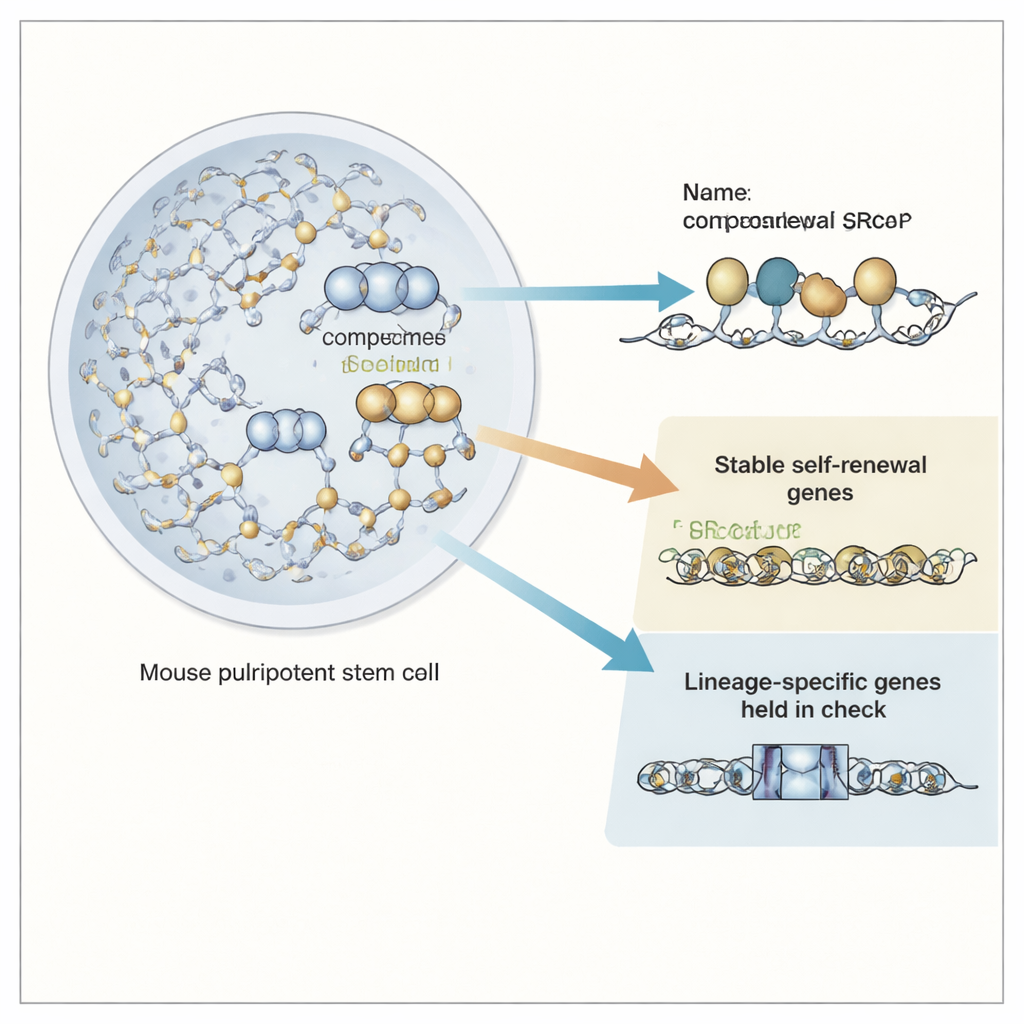
Together, these findings paint SRCAP as more than just the installer of a special chromatin part. SRCAP acts as a dynamic shield along the DNA, physically limiting when and where powerful transcription factors can land, while H2A.Z helps keep differentiation genes in check. By coordinating these distinct roles, the SRCAP–H2A.Z pair allows pluripotent stem cells to robustly maintain their core identity yet remain ready to activate new gene programs when the right signals arrive.
Citation: Tollenaere, A., Ugur, E., Dalla Longa, S. et al. Mechanisms of gene regulation by SRCAP and H2A.Z. Nat Commun 17, 3560 (2026). https://doi.org/10.1038/s41467-026-70087-x
Keywords: chromatin remodeling, stem cell identity, histone variant H2A.Z, transcription factors, gene regulation