Clear Sky Science · en
A hardware-adaptive learning algorithm for superlinear-capacity associative memory on memristor crossbars
Why smarter memory hardware matters
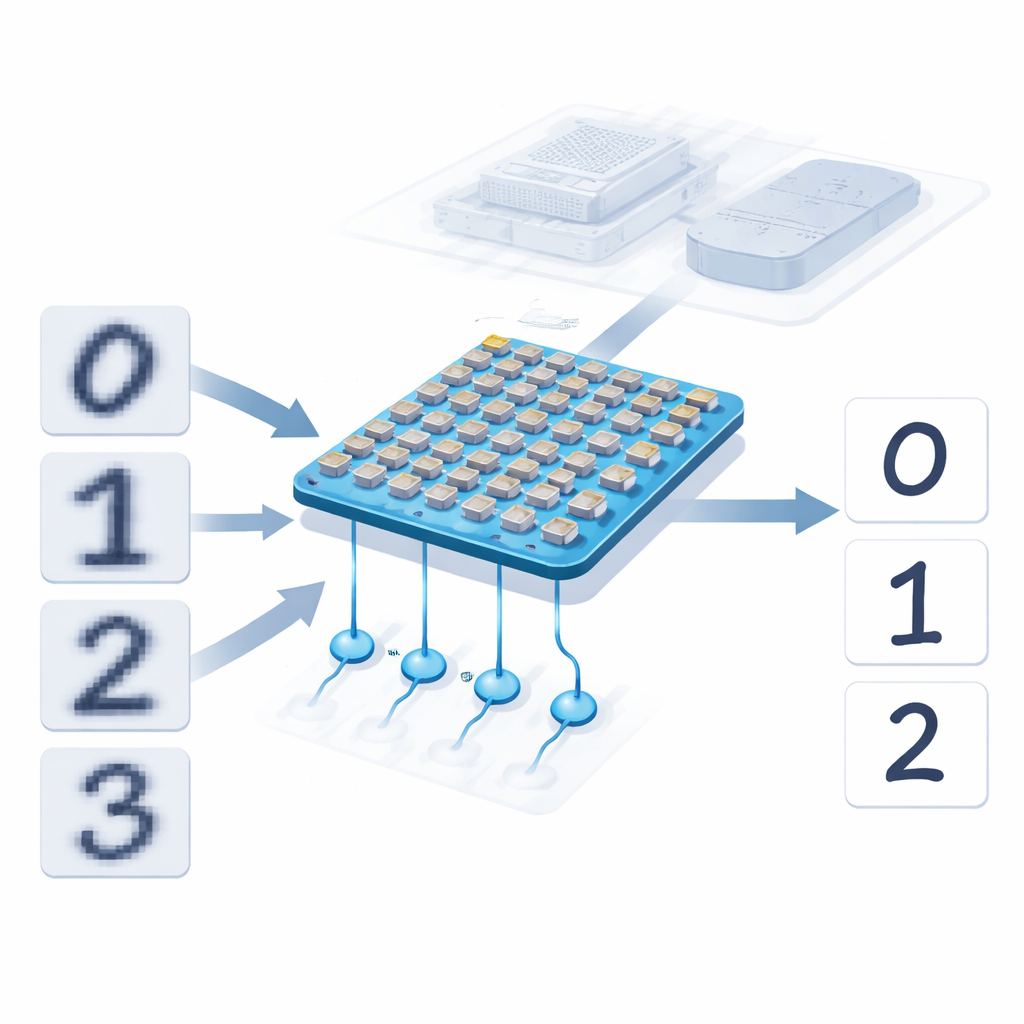
Imagine glancing at a blurry, half-erased phone number and still dialing it correctly. Our brains routinely fill in missing information like this, but today’s computers struggle to do the same efficiently. This paper explores a new kind of electronic memory that can recall complete patterns from noisy hints—closer to how the brain works—while using far less energy. By redesigning both the learning rules and the hardware, the researchers show that these systems can store more memories than expected and keep working even when many of their components are faulty.
From brain-like recall to electronic memory
Decades ago, scientists proposed “associative memories” that, like the brain, can recover a full stored pattern when given only a partial or corrupted version. A popular mathematical model for this is the Hopfield neural network, which behaves like a landscape of valleys: each valley represents a stored memory, and a noisy input rolls downhill into the closest one. On standard digital chips, however, this process is slow and power-hungry, because data must shuttle back and forth between separate processor and memory units. The authors instead rely on memristor crossbars—grids of tiny electronic devices that both store information and perform calculations in place—promising massive parallelism and much lower energy use.
Teaching imperfect hardware to work with its own flaws
Real memristors are far from perfect. Some get stuck and never change their electrical conductance again, while others vary slightly each time they are programmed. Previous designs treated learning as a purely mathematical exercise, ignoring these real-world quirks and then trying to copy the computed weights into the hardware afterward. The new work flips this approach: the learning algorithm is made "hardware-adaptive," meaning it is trained using a detailed model of the actual chip, including which devices are stuck and what conductance range they can reliably reach. During training, faulty devices are explicitly masked out, and the remaining ones are adjusted so the whole network still converges to the right memories when given noisy cues.
Storing more memories with layered networks
Classic Hopfield networks use a single layer of connections and are known to store only a number of patterns proportional to their size. The authors extend their hardware-aware learning method to multilayer networks—adding hidden layers between input and output—implemented on memristor crossbars. These extra layers act like a smart compression stage: for structured data such as handwritten digits, the system can store a number of patterns that grows faster than linearly with the number of input units, a behavior the authors describe as superlinear capacity. In tests with downsampled MNIST digit images, the multilayer design not only stored more patterns but did so with dramatically fewer memristor devices than a single-layer counterpart, offering a clear path to scaling up without exploding hardware cost.
Handling shades of gray, not just black and white
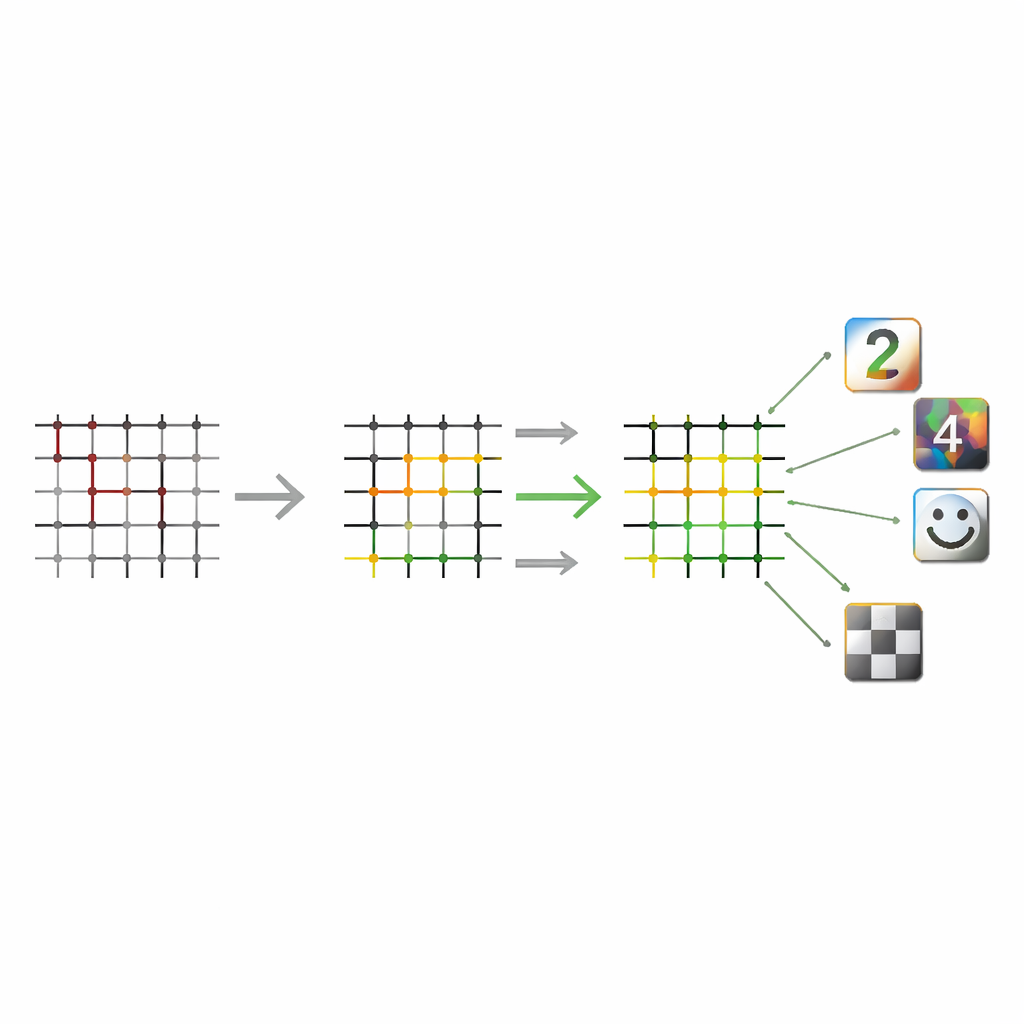
Most earlier associative memories worked only with simple on/off patterns, while real-world data—images, sounds, sensor signals—vary smoothly. By replacing the abrupt “sign” activation with a smooth “tanh” function and combining it with their multilayer, hardware-adaptive training, the authors show that the same memristor system can reliably recall continuous-valued patterns. Even when the input is heavily corrupted by noise, the network’s iterative dynamics pull it back toward the correct stored pattern. For these continuous cases, the number of memories the system can hold also grows faster than linearly with size, indicating that the benefits of the architecture extend beyond toy binary examples.
Speed, efficiency, and resilience in practice
Because memristor crossbars perform many operations in parallel, the researchers update all neuron states at once, rather than one at a time as in traditional schemes. On a 64-neuron prototype, this synchronous updating slashes processing time by roughly a thousandfold and cuts energy use severalfold compared with earlier asynchronous approaches. Crucially, the system maintains high recall quality even when up to half of the devices are permanently stuck, and its performance barely changes under realistic programming noise. Overall, the work presents a practical blueprint for brain-inspired memories that are fast, energy-efficient, tolerant of defects, and capable of storing rich, continuous patterns—bringing hardware a step closer to the associative power of biological brains.
Citation: He, C., Jiang, M., Shan, K. et al. A hardware-adaptive learning algorithm for superlinear-capacity associative memory on memristor crossbars. Nat Commun 17, 3096 (2026). https://doi.org/10.1038/s41467-026-69958-0
Keywords: associative memory, memristor crossbar, neuromorphic hardware, Hopfield network, in-memory computing