Clear Sky Science · en
Celcomen: spatial causal disentanglement for single-cell and tissue perturbation modeling
Why mapping living tissues matters
Every organ in our body is built from billions of cells constantly talking to each other. These conversations, carried out through genes switching on and off, decide whether a tissue stays healthy, fights an infection, or turns cancerous. New microscopes can now read the activity of thousands of genes in individual cells while keeping their positions in the tissue intact. But making sense of this mountain of data—and predicting what would happen if we change a gene or a cell type—requires powerful and reliable mathematical tools. This study introduces such a tool, called Celcomen, designed to untangle how cells influence themselves and their neighbors in space, and to forecast how tissues will respond to disease or therapy.
Separating a cell from its neighborhood
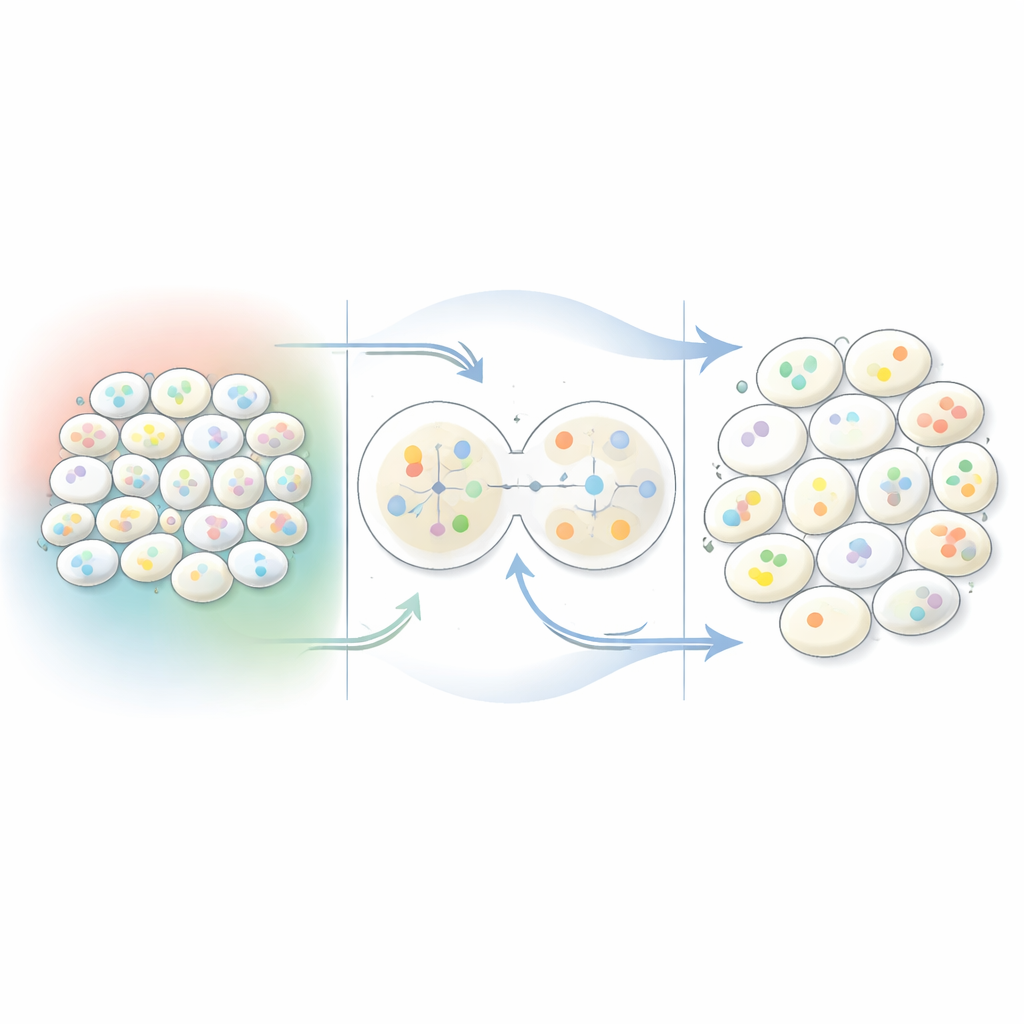
Each cell’s gene activity reflects both its own built-in program and the signals it receives from surrounding cells. Existing methods often blur these two influences together or depend on incomplete prior knowledge about which genes talk to which. Celcomen takes a different route. It treats the tissue as a network, where each cell is a node and nearby cells are connected by links. Within this framework, it mathematically separates interactions happening inside a cell from those that cross cell boundaries. In plain terms, it asks: which gene changes can be explained by the cell’s internal wiring, and which require messages coming from its neighbors?
A causality-inspired engine under the hood
At the heart of Celcomen is a graph-based neural network that is tightly constrained by principles from causal inference. Instead of being a “black box” that merely fits patterns, the model is built to satisfy identifiability: for a given dataset there should be essentially one best underlying interaction structure that explains it. The authors show, both with mathematical arguments and with computer simulations, that Celcomen can recover the basic skeleton of the true gene–gene network operating within and between cells. The system first learns an interaction map from data and then uses a second module to generate realistic synthetic tissue profiles and to predict how gene activity patterns would change under specific perturbations.
Testing predictions in human brain cancer
To see whether Celcomen captures real biology, the team applied it to high‑resolution spatial data from human glioblastoma, an aggressive brain tumor. Without being told which genes code for secreted factors or internal signaling proteins, the model automatically assigned secreted, cell‑to‑cell signaling genes to external interaction programs and confined many internal signaling genes to within‑cell programs. They then performed a virtual experiment: turning off interferon‑related genes in a single tumor cell. Celcomen predicted not only a collapse of the interferon response inside this cell but also a weakening of interferon‑driven immune programs in nearby cells—mirroring how interferon signals are known to spread through tissues and influence local immunity.
Checking virtual tissues against real animal tumors
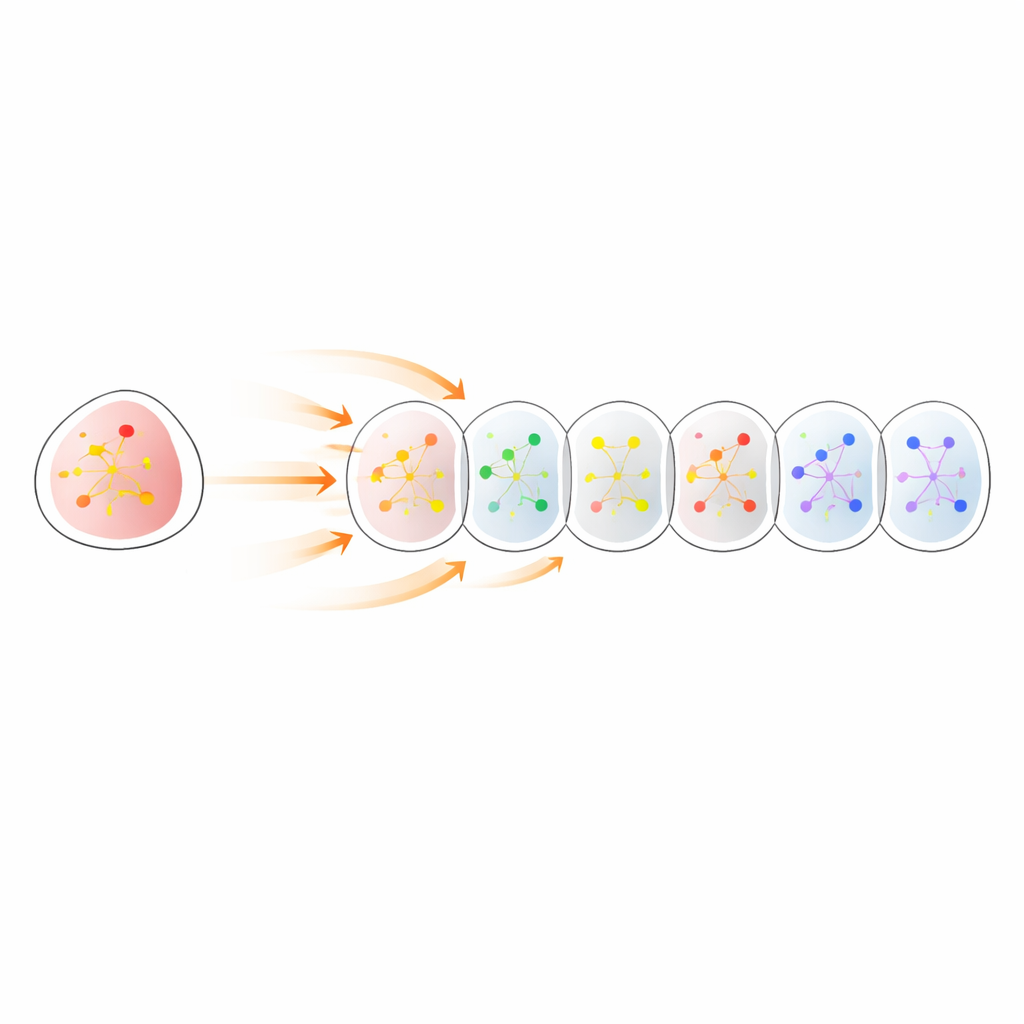
Next, the researchers challenged Celcomen with data from a mouse model of lung cancer where specific genes had been experimentally knocked out in defined tumor regions. They trained the model only on unperturbed or mixed lesions and then asked it to simulate what would happen if a chosen gene were disabled in particular tumor spots. The predicted shifts in gene activity were compared to real measurements from tumors where those genes had truly been deleted in vivo. Across multiple lesions and genes, Celcomen’s forecasts showed strong positive correlations with the actual changes, and these correlations were far stronger than would be expected by chance. This suggests that the model’s virtual experiments are closely aligned with biological reality.
What this means for future medicine
Celcomen offers a way to build “virtual tissues” that can be probed on a computer instead of in the lab. By distinguishing how much of a cell’s behavior comes from its own wiring versus its neighborhood, and by providing stable, interpretable predictions, the method can help scientists explore how diseases such as cancer disrupt local cell communities and how targeted therapies might restore them. As spatial and single‑cell technologies grow more widespread and detailed, tools like Celcomen could guide which experiments to run, highlight unexpected weak points in diseased tissues, and ultimately speed the design of treatments that act not just on single cells, but on the complex cellular societies that make up our organs.
Citation: Megas, S., Chen, D.G., Polanski, K. et al. Celcomen: spatial causal disentanglement for single-cell and tissue perturbation modeling. Nat Commun 17, 4126 (2026). https://doi.org/10.1038/s41467-026-69856-5
Keywords: spatial transcriptomics, cell–cell communication, causal modeling, cancer microenvironment, virtual tissues