Clear Sky Science · en
Social status and the relationship between income rank and well-being in 109 nations
Why your place on the ladder matters
Why do some people feel satisfied with modest pay while others feel unhappy despite earning more? This study examines a simple but powerful idea: what seems to matter most for happiness is not how many dollars you take home, but where that income places you compared with others in your country. Using survey responses from more than 90,000 people in 109 nations, the authors ask whether people’s well-being is driven mainly by their absolute income, by how deprived they are compared with richer neighbors, or by their position in the income pecking order.
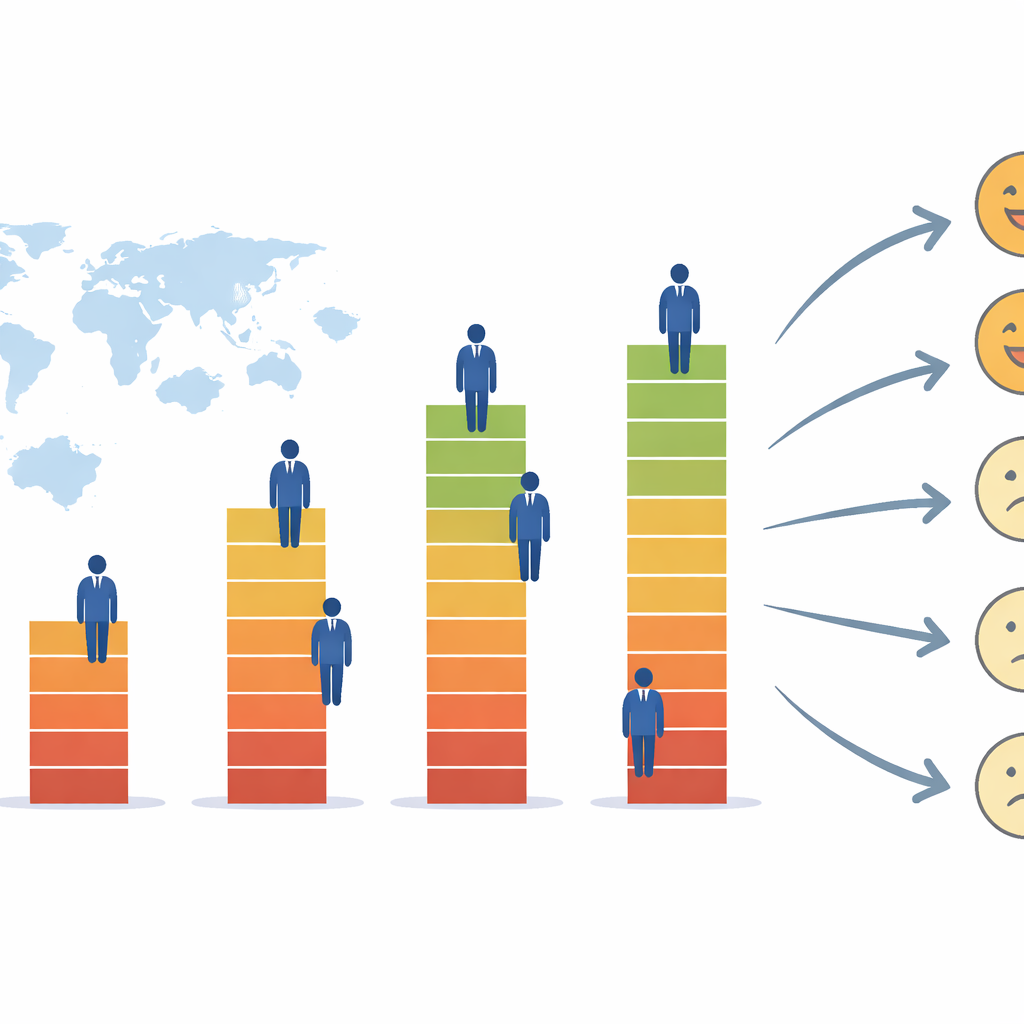
Looking beyond the size of the paycheck
Earlier research has long debated whether money buys happiness, focusing either on absolute income (how much you earn) or on various notions of relative income (how you stack up against others). Relative income itself can be defined in several ways. One view is that people care about the gap between their income and others’ incomes: being far below the wealthy could hurt more than being slightly below them. Another view emphasizes rank: only the number of people above and below you matters, not how far ahead or behind they are. These perspectives imply different psychological stories—envy and deprivation versus social status and rank—and point to different policy responses.
Testing income rank against other explanations
The authors build a general mathematical model that can mimic both deprivation-based and rank-based comparison processes as special cases. They then use data from the Gallup World Poll, which asks people around the world to rate their lives and report their household income. By cleverly comparing individuals across many countries with very different average incomes, and by controlling for national features such as health spending, unemployment, and inequality, they reduce the usual problem that income and income rank are almost perfectly correlated within a single country. This allows them to estimate how much each factor—absolute income, deprivation, and pure rank—relates to how people judge their lives and their daily positive and negative emotions.
Rank wins in most countries
Across nations and across several measures of well-being, a person’s position in the national income ranking is more strongly tied to reported life satisfaction than the amount of income itself. When both are included in the same statistical model, absolute income typically adds little once rank is known, whereas rank continues to have a sizeable association. Further, when the authors allow their model to place extra weight on large income gaps (a deprivation story) or on incomes that are very close or very distant, they find that these refinements rarely improve the fit. In around 80 percent of countries, the simplest version—where each richer or poorer person counts equally—describes the data best. This pattern supports the idea that what matters psychologically is social status defined by rank, rather than finely graded feelings of deprivation based on the exact size of income gaps.
When community softens the sting of low rank
The strength of the link between income rank and well-being is not the same everywhere. The effect is larger in societies where material success and wealth are strongly valued, and somewhat larger in poorer countries than in richer ones. In contrast, it is much weaker in countries where social capital is high—places where people report strong community ties, civic engagement, social support, and openness toward migrants. In the most civically engaged societies, the association between income rank and life evaluation is about 80 percent smaller than in those with the lowest engagement. At the individual level, people who feel supported by friends and neighbors, who trust institutions, or who are active in their communities also show a smaller impact of income rank on their happiness.
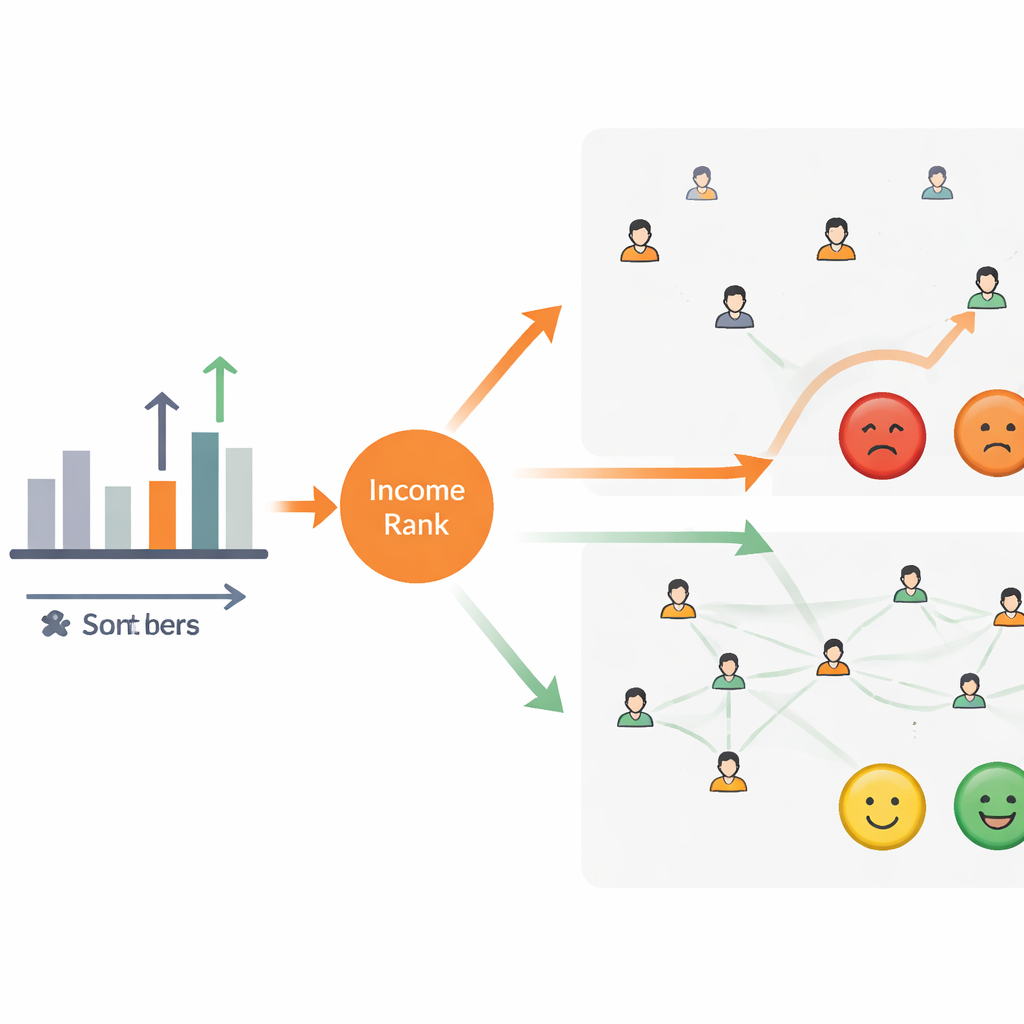
What this means for everyday life and policy
For a layperson, the core message is straightforward: feeling well-off depends less on how much money you earn in isolation and more on whether you see yourself as near the top, middle, or bottom of your society’s income ladder. The study suggests that improving well-being cannot rely solely on raising incomes across the board, because rank is by definition relative and zero-sum. Instead, efforts that build social capital—such as fostering trust, community involvement, and social support—may buffer people from the harmful effects of low economic status. While the research is observational and cannot prove cause and effect, it points strongly toward social status, rather than sheer purchasing power or precise income gaps, as a key bridge between money and how people feel about their lives.
Citation: Quispe-Torreblanca, E., De Neve, JE. & Brown, G.D.A. Social status and the relationship between income rank and well-being in 109 nations. Nat Commun 17, 2962 (2026). https://doi.org/10.1038/s41467-026-69729-x
Keywords: income rank, social status, subjective well-being, social capital, relative income