Clear Sky Science · en
Eelgrass ecosystem collapse and social-ecological regime shift driven by hydropower development and climate change
Why this northern shoreline matters to all of us
Along the remote coast of eastern James Bay in subarctic Canada, underwater meadows of eelgrass once fed vast flocks of geese and sustained Cree (Eeyou) families who have lived there for generations. This article traces how those meadows suddenly collapsed in the late 1990s, how large hydropower projects and a rapidly warming climate combined to push the ecosystem past a tipping point, and what this means for coastal communities and future energy development worldwide.
A living pantry in the shallow sea
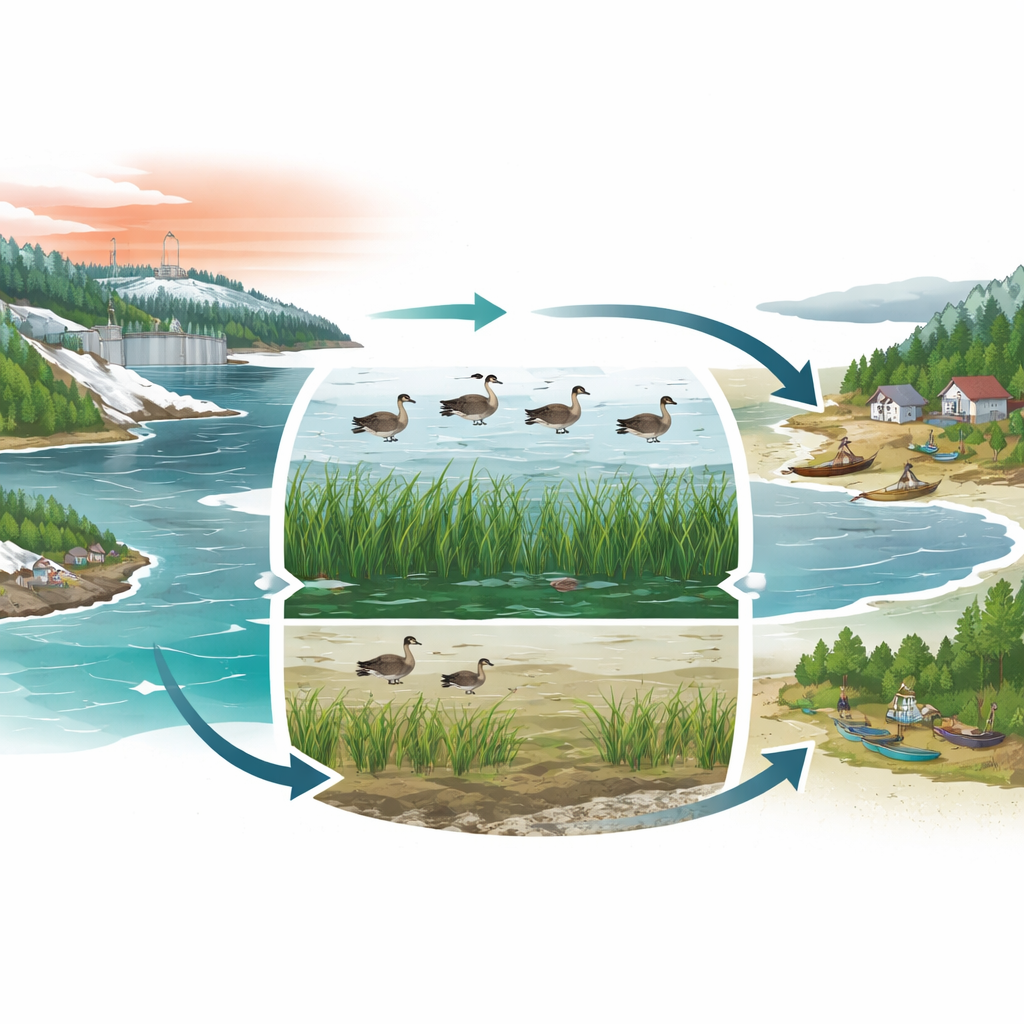
Before major river dams were built, James Bay’s north‑eastern coast supported one of North America’s largest eelgrass meadows, covering roughly 250 square kilometers. Eelgrass forms lush underwater fields in shallow water, offering food and shelter for fish and shellfish and, crucially here, for migrating geese. Each fall, tens of thousands of Canada Geese and Brant stopped to graze in these meadows, and Cree hunters harvested many thousands of birds for food. The eelgrass, the geese and the people formed a tightly linked social‑ecological system: healthy plants meant predictable goose migrations and successful hunts that reinforced knowledge passed down through families.
Big dams, changing rivers
Starting in the 1970s, Québec’s La Grande River system was transformed into a massive hydropower complex with multiple large reservoirs and diversions from neighboring rivers. This engineering feat altered how much water, sediment and nutrients flowed to the coast and when they arrived. Winter river discharge increased about ten‑fold, sending a far larger, fresher plume of water under the sea ice and along the shoreline. At the same time, reservoir flooding and riverbank erosion released huge amounts of silt and organic matter. Cree land users noticed the consequences firsthand: waters that had long been clear enough to see the bottom several meters down turned murky brown, and eelgrass near the river mouth began to thin or disappear.
Climate shocks that tipped the balance
For more than two decades, the eelgrass meadows showed surprising resilience, persisting despite this altered river regime. That changed abruptly around 1998. That year brought an unusually warm El Niño winter, very early sea‑ice breakup and a series of prolonged marine heat waves in the bay. These conditions arrived just when eelgrass plants were low on stored energy after months under ice. Warmer, clearer surface waters also allowed more winds and waves to stir up bottom sediments. Combined with years of extra material pouring from the river, this reduced underwater light to levels too low for eelgrass to thrive along much of the coast. Within a few years, eelgrass biomass crashed by about 90 percent, and dense meadows were replaced by patchy, shallow beds, bare mud and drifting algal mats.
A feedback loop that resists recovery
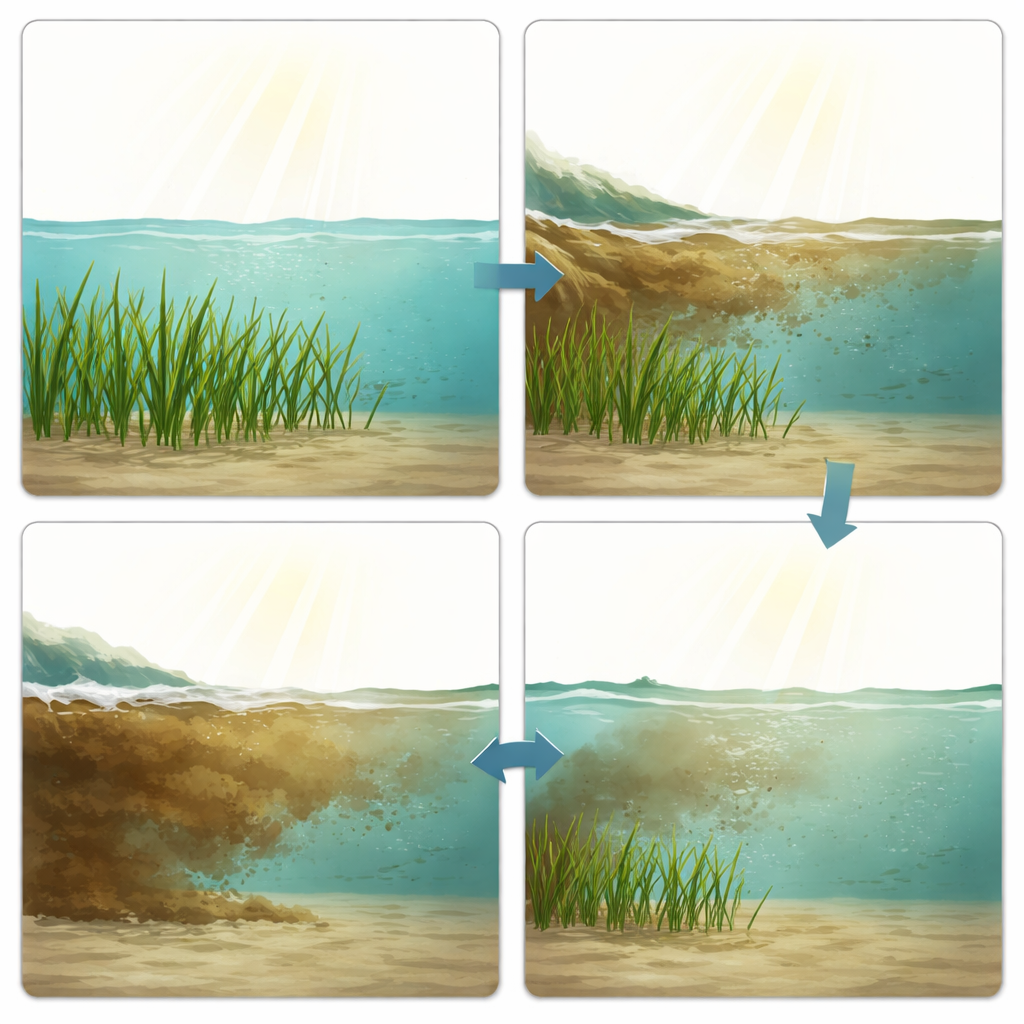
The authors show that once eelgrass declined, a self‑reinforcing feedback took over. In healthy meadows, dense shoots slow waves and currents, helping sediments settle and keeping the water clear enough for plants to photosynthesize. When plants are lost, the seabed is exposed, sediments are easily resuspended by storms and a longer ice‑free season, and the water stays cloudy. In James Bay, additional “browning” from dissolved organic matter in river water further dims the light. Experiments and field measurements indicate that current light levels during the short growing season are often below what eelgrass needs to rebuild energy reserves for the long, dark winter. Genetic analyses also suggest the local eelgrass population may be especially vulnerable to warming, making natural recovery even harder.
People adapting to a changed shore
The collapse of eelgrass transformed the Cree goose hunt. With shorter, sparse eelgrass and more turbid water, geese now stop less often and in less predictable locations. Hunters report smaller and more uncertain harvests and describe a broader regime shift in how they use and understand the coast. To reconstruct this story, the study combines decades of Cree observations and interviews with satellite records, ocean measurements, field experiments and historical monitoring. Together they point to the cumulative effects of hydropower development as the main long‑term pressure that weakened the system, and the climate shift of the late 1990s as the trigger that pushed it past a tipping point.
Lessons for future energy choices
For a general reader, the study’s message is that big engineering works and climate change can interact in subtle ways, slowly eroding the resilience of coastal ecosystems until an extreme event causes sudden collapse. Once key feedbacks like the eelgrass–sediment–light relationship are broken, even halting the original disturbance may not be enough to bring the system back. The authors argue that as hydropower is promoted as a climate‑friendly energy source, assessments must consider downstream coastal habitats and Indigenous knowledge, and anticipate how future warming and extreme events could amplify impacts. In James Bay, eelgrass, geese and Cree hunters together reveal how tightly human well‑being is bound to the health of hidden underwater meadows.
Citation: Kuzyk, Z.Z.A., Leblanc, M., Ehn, J. et al. Eelgrass ecosystem collapse and social-ecological regime shift driven by hydropower development and climate change. Nat Commun 17, 2917 (2026). https://doi.org/10.1038/s41467-026-69553-3
Keywords: eelgrass, hydropower, James Bay, climate change, Indigenous knowledge