Clear Sky Science · en
IOA-244, a novel p110δ PI3K inhibitor, blocks breast tumour progression on either mono- or combined-therapy
Why this new breast cancer study matters
Many women diagnosed with breast cancer still face the risk that their tumors will grow, spread, or return despite standard treatments. This study explores a new drug, IOA-244, that targets both cancer cells and supportive immune cells inside tumors. The work, done in mice and human tissue samples, suggests that IOA-244 could help stop early breast tumors in their tracks, and that combining it with a second drug may be especially helpful once tumors are more advanced.
A new way to hit a familiar cancer pathway
Cancer cells often rely on a molecular pathway called PI3K to survive and divide. Existing drugs that block one part of this pathway, called p110δ, have helped patients with certain blood cancers but caused serious side effects that limit their use. IOA-244 is different: it blocks p110δ in a more selective way and does not compete with the cell’s main energy molecule, ATP. Earlier work hinted that IOA-244 can reshape the tumor environment with relatively low toxicity. In this study, researchers tested how well IOA-244 works against aggressive breast tumors, and whether its impact depends on how far the tumor has already progressed.
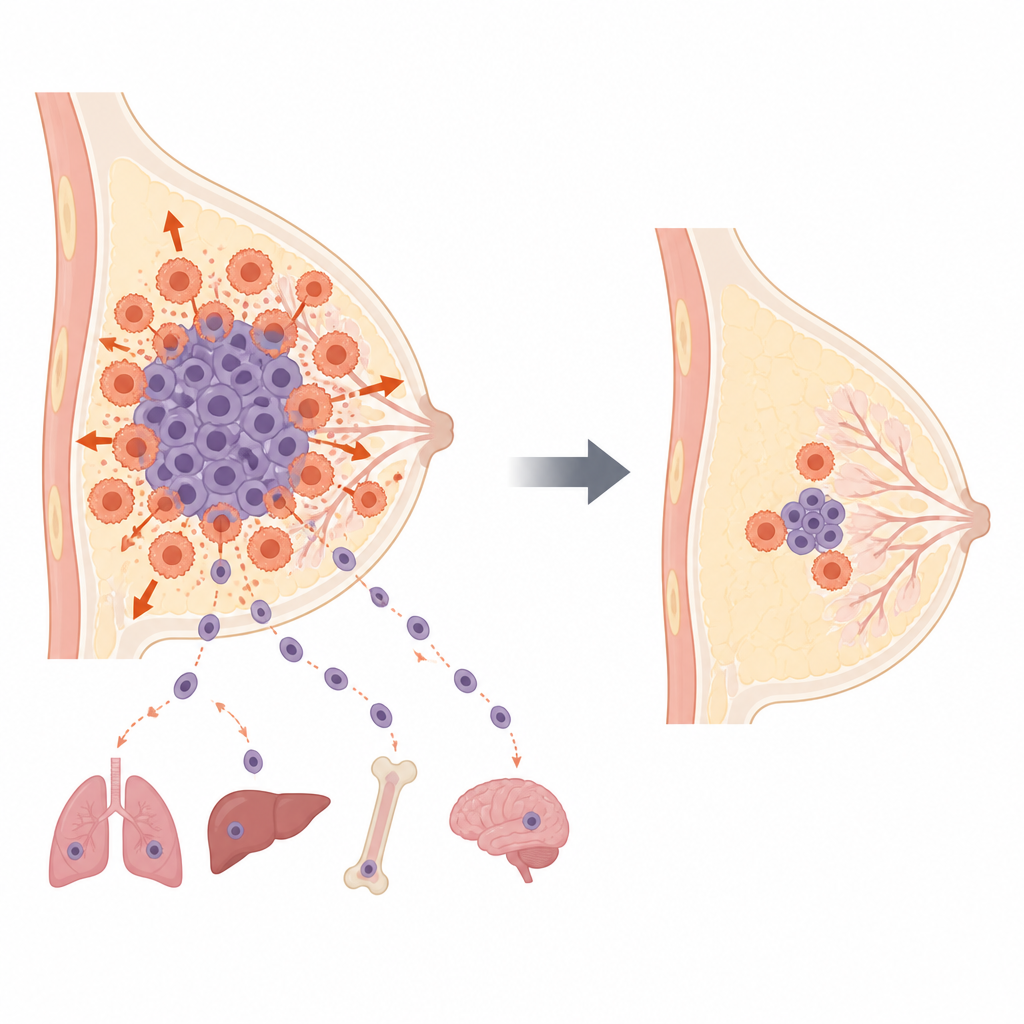
Stopping early tumors by targeting cancer and support cells
The team implanted an aggressive, triple-negative breast cancer cell line into mice and began IOA-244 treatment either when tumors were still small (“early phase”) or when they were already larger (“established”). When given early, IOA-244 almost completely blocked tumor growth. It reduced signals that keep cancer cells alive, slowed their division, and increased signs of programmed cell death, all without causing toxic cell rupture. The drug also sharply cut the number of circulating tumor cells in the blood and reduced signs of invasion into the lungs, suggesting that it can limit both local growth and distant spread, even when started later in tumor development.
Re-educating tumour helper cells and cutting a growth-promoting loop
Breast tumors are packed with immune cells called macrophages that can either fight cancer or help it. A subtype known as M2-like macrophages, marked by proteins such as CD163 and CD204, tends to support tumor growth and dampen immune attack. These cells are also a key source of an enzyme called autotaxin (ATX), which produces a fatty molecule that further fuels cancer cell survival and spread. IOA-244 treatment reduced overall macrophage numbers in tumors, regardless of when treatment began. When started early, it strongly lowered M2-like macrophages and increased markers of more hostile, M1-like macrophages. At the same time, ATX levels in tumor macrophages dropped steeply, weakening a self-reinforcing loop that normally drives tumor expansion. In contrast, when treatment began in established tumors already rich in M2-like cells and ATX, these harmful features were only modestly reduced.
Why timing and combination therapy matter
The researchers also examined human breast tumors of low (grade I) and high (grade III) severity. High-grade tumors contained many more CD163- and CD204-positive macrophages and much more ATX, and these markers rose together with p110δ levels. In cancer cells from high-grade tumors, IOA-244 reduced a key survival signal, but a specific ATX blocker, and especially the combination of IOA-244 with an ATX inhibitor, did even more. In mice with established breast tumors, either IOA-244 or an ATX inhibitor alone slowed growth, but together they almost completely halted it without weight loss or obvious toxicity. Similar dual treatment also stopped growth of breast tumors directly derived from patients, while tumors that lacked strong p110δ or relied less on macrophages did not respond as well.
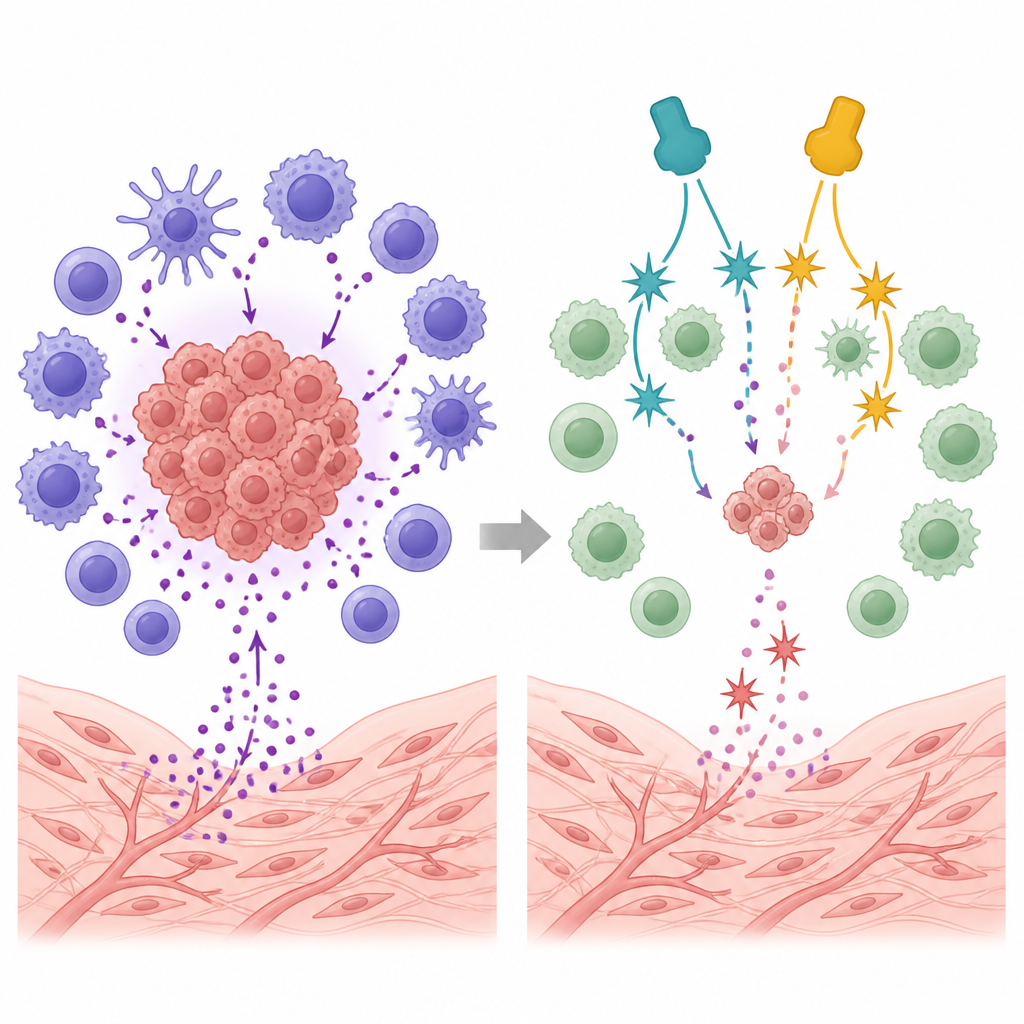
What this could mean for future breast cancer care
To a lay reader, the study’s message is that IOA-244 works on two fronts: it weakens the cancer cells themselves and disarms the friendly helpers that normally protect the tumor. In early-stage tumors, this one drug was enough to nearly stop growth and reduce spread in mice. In more advanced tumors, where supportive macrophages and ATX are already abundant, adding a second drug that blocks ATX turned partial control into near-complete shutdown of tumor progression. While these results are preclinical and not yet ready to guide treatment decisions for patients, they suggest that timing and smart combinations of targeted drugs could make breast cancer therapies more effective and possibly better tolerated in the future.
Citation: Goulielmaki, E., Tsapara, A., Xenou, L. et al. IOA-244, a novel p110δ PI3K inhibitor, blocks breast tumour progression on either mono- or combined-therapy. Cell Death Discov. 12, 229 (2026). https://doi.org/10.1038/s41420-026-03073-3
Keywords: breast cancer, tumor microenvironment, macrophages, PI3K p110 delta, autotaxin ATX