Clear Sky Science · en
Autism-associated learning patterns show reduced credit assignment to outcome-irrelevant features
Why this study matters
Everyday choices, from picking a snack to choosing a route home, are shaped by what we learn from past outcomes. Yet our brains often latch onto details that do not truly matter, like the side of the screen a winning option appeared on. This study asks a surprising question: might autistic people be better than others at ignoring these distracting details, leading to more accurate learning in noisy situations?

Learning from what counts and what does not
The researchers focused on a basic ingredient of decision making called credit assignment, which is how we decide what part of an experience deserves the “credit” for a good or bad outcome. In real life, that process can go wrong. You might link the taste of your favorite ice cream to the color of the spoon instead of the flavor itself. Such outcome-irrelevant learning has long been seen as a source of human bias and a mark of less-than-optimal reasoning. Earlier work suggested that autistic people may be less swayed by many common decision biases, but most of those tests used simple, one-off choices rather than fast-paced learning from trial and error.
A game of changing rewards
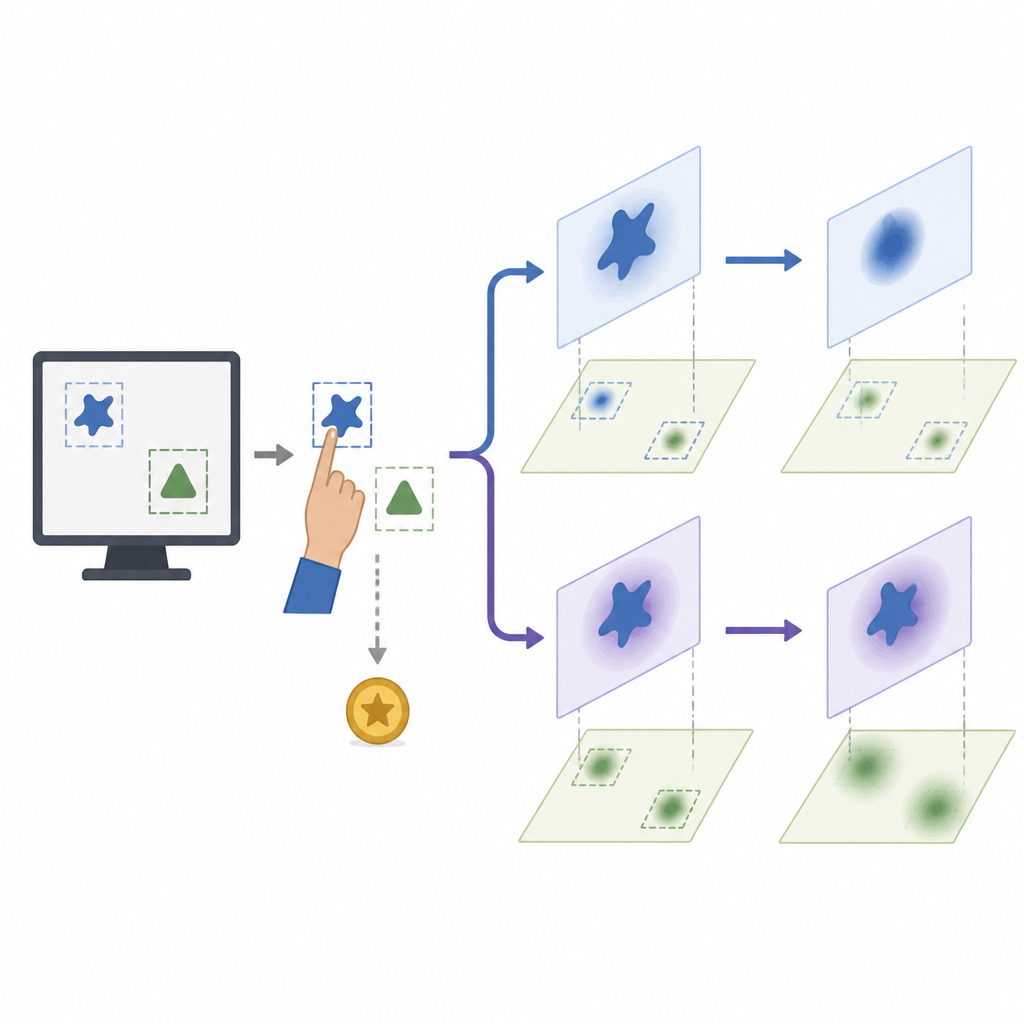
To explore this in a more realistic setting, the team recruited 154 adults online, about half of whom reported having an autism diagnosis. Everyone played a computer game in which they repeatedly chose between abstract shapes to earn virtual coins. The chance that each shape would pay off slowly drifted over time, so players had to keep updating what they had learned. Crucially, the shapes kept jumping between left and right positions on the screen, and the instructions clearly stated that only the identity of the shape affected rewards, not its position. This set-up allowed the researchers to see whether people would still, automatically, start treating location as if it mattered.
Peering inside the learning process
Instead of just tallying how often people won coins, the researchers used detailed computer models to estimate how each person updated values for relevant and irrelevant features on every trial. The key model parameter captured how strongly location information influenced choices. A lower value meant that a person was letting the side of the screen sway them, even though it had nothing to do with reward. The models fit the behavior of both autistic and non-autistic participants well, and additional checks showed that this parameter closely matched a simple behavioral signature: being more likely to repeat the same side after a win, even when entirely different shapes appeared on the next trial.
Autistic cognition and resistance to distraction
The patterns were clear. Non-autistic participants showed robust outcome-irrelevant learning: they were more likely to stick with the same location after it paid off, and their choices were better predicted by values tied to position. Autistic participants, in contrast, relied much more heavily on the shapes themselves and largely ignored where they appeared. On average, their learning parameter indicated far less influence of location. This difference remained even after accounting for individual variation in intelligence and working memory, suggesting it was not simply due to general cognitive strengths or weaknesses. When the researchers looked across all participants, those with more autistic traits, especially in communication style, tended to show less outcome-irrelevant learning as well.
Balancing strengths and trade-offs
The authors interpret these findings as one example of “enhanced rationality” in autism: a tendency to focus on task-relevant information and to be less pulled by tempting but misleading cues. They connect this to theories that autistic perception and thinking place less weight on prior assumptions and more on incoming evidence. That cognitive style may be especially helpful when the world is noisy but the rules stay stable, as in this game where position never mattered. At the same time, the study notes potential trade-offs. In truly shifting environments, previously irrelevant details can suddenly become important, and being too strict about ignoring them might slow adaptation. Still, within the carefully controlled setting of this task, autistic participants showed a clear advantage in resisting a common human bias, highlighting a domain where autistic cognition appears not just different, but more accurate.
What this means for everyday thinking
For a lay reader, the takeaway is that autism is not only about difficulties or deficits. In this study’s learning game, autistic adults were better at giving credit where it was due and not being misled by random patterns. Their choices were less cluttered by noise, and this bias resistance extended as a gradual trait across the whole sample, not just as an all-or-nothing group difference. Understanding these strengths, alongside challenges, can deepen our picture of how diverse minds navigate complex decisions and may eventually inspire new ways to reduce harmful biases in everyone’s everyday thinking.
Citation: Ben-Artzi, I., Rozenkrantz, L. & Shahar, N. Autism-associated learning patterns show reduced credit assignment to outcome-irrelevant features. Transl Psychiatry 16, 240 (2026). https://doi.org/10.1038/s41398-026-04000-x
Keywords: autism, decision making, reinforcement learning, cognitive bias, credit assignment