Clear Sky Science · en
Nanosecond-latency all-optical fiber sensing with in-sensor computing
Light that Senses at Lightning Speed
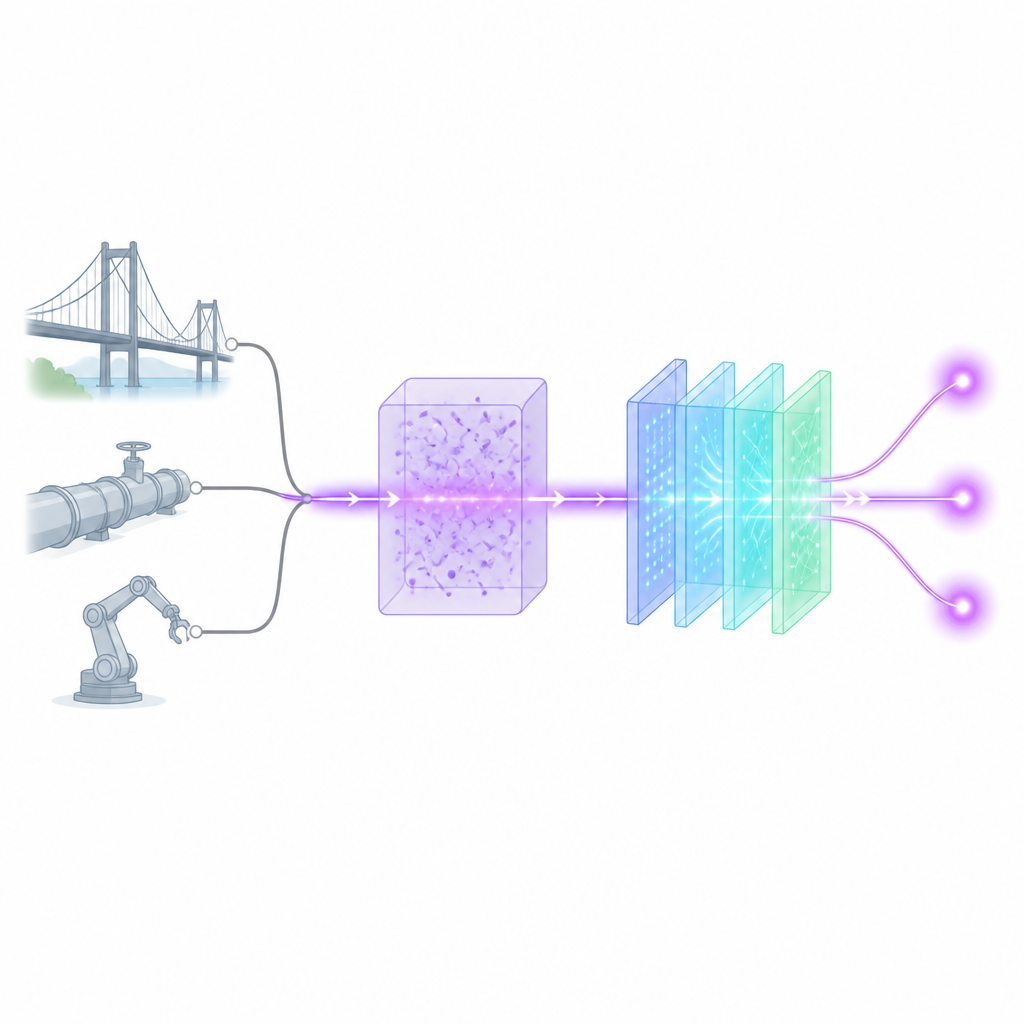
Imagine a world where bridges, pipelines, and robots can feel tiny strains and twists almost as soon as they happen, without relying on power-hungry electronics. This study introduces a way to let light itself do the sensing and thinking inside optical fibers, cutting response times down to billionths of a second and shrinking the need for bulky computing hardware.
Why Fibers Are Great, But Electronics Hold Them Back
Optical fibers are already widely used to monitor temperature, vibration, strain, and other physical changes in everything from tunnels and railways to oil wells and aircraft. They are thin, immune to electromagnetic interference, and can stretch over kilometers. However, today’s systems split the job in two: the fiber collects signals as light, then electronics convert that light into electrical signals and run heavy digital algorithms to figure out what is happening. This conversion and processing introduce delays, often far above a microsecond, and require devices such as powerful processors and specialized signal analyzers that consume significant energy.
Letting Light Do the Computing Inside the Sensor
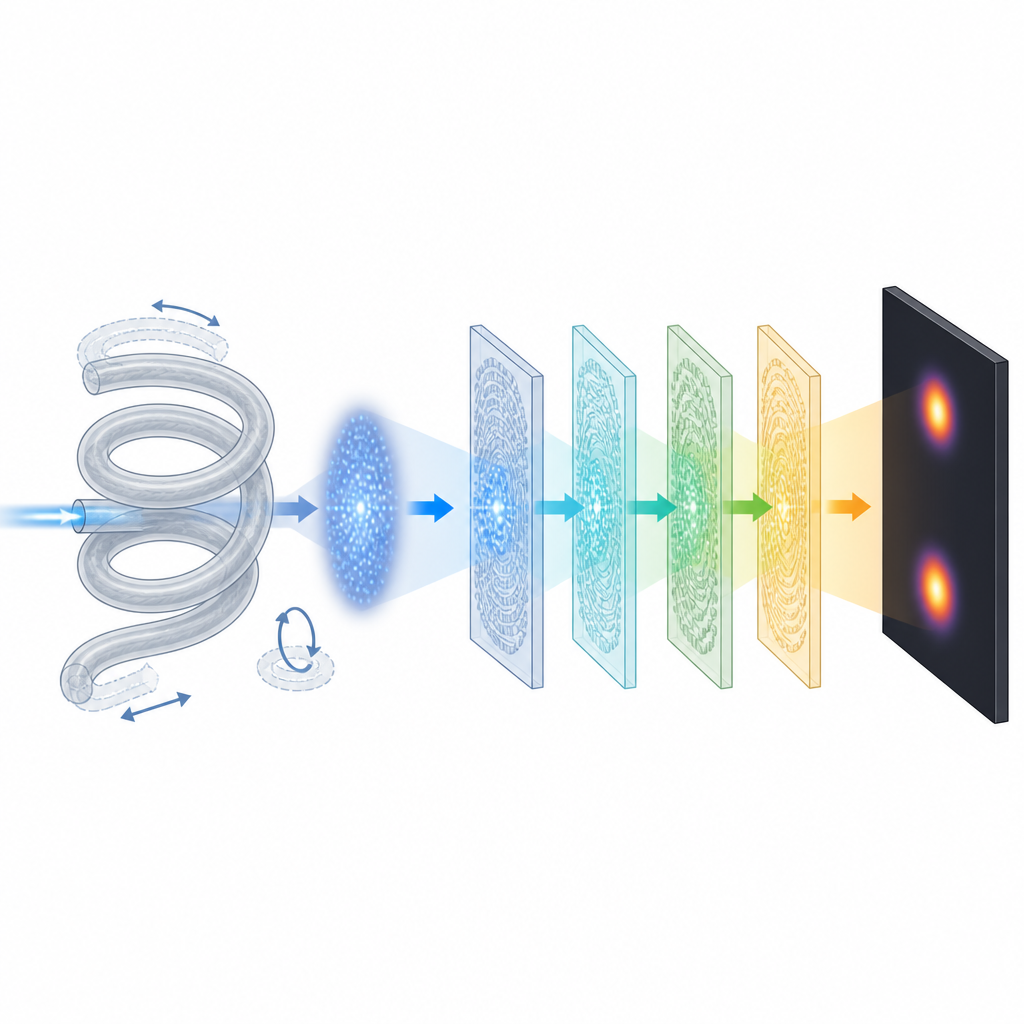
The researchers propose an all-optical fiber sensing architecture with in-sensor computing, called AOFS-IC. Instead of sending light signals into electronics for decoding, the system keeps everything in the optical domain. Light emerging from a sensing fiber first passes through a carefully chosen scattering medium, such as a multimode fiber. Tiny changes in wavelength, polarization, or intensity caused by strain, bending, or temperature are transformed into intricate speckle patterns. These speckles then travel through a diffractive optical network made of phase-modulating layers. That network has been trained so that the brightness at specific spots in the output light pattern varies in a simple, nearly linear way with the physical quantity being measured, such as strain or twist. A basic photodetector can then read the light intensity at those spots and directly report the sensing result with no digital demodulation.
From Strain and Twist to Many Signals at Once
To test how well this works, the team first attached a standard fiber Bragg grating sensor, which shifts its reflected color when stretched. Instead of using a conventional spectrum analyzer, they sent the reflected light through their optical computing module. The resulting output intensity tracked strain over a wide range with a clear linear trend and could resolve changes as small as a few picometers in wavelength or a few microstrains in stretching, rivaling traditional instruments. They then showed that the same approach could classify discrete torsion angles in a twisted multimode fiber with perfect accuracy across nine different states. By dividing the output plane into a grid of regions, each torsion angle produced a bright spot in a distinct region, acting like an all-optical classifier that uses patterns of light instead of numbers on a processor.
Watching Multiple Changes in Many Places
A key strength of the approach is that a single speckle pattern can embed information about different types of changes and locations along the fiber. In a proof-of-concept experiment, one multimode fiber section was used as two sensors at once: one region was twisted while another was stretched. After passing through the scattering medium and diffractive network, the output light contained two separate bright regions, whose intensities gave the torsion angle and strain independently with errors only a few percent of their ranges. By choosing suitable detectors, the system can either focus on high-speed measurements with a single photodiode or handle many sensing points in parallel using arrays. With a single photodiode, the setup achieved nanostrain resolution over a narrow range and tracked vibrations up to the limits of the detector’s bandwidth.
Bringing Optical Sensing to Smarter Machines
To illustrate a real-world use, the authors wrapped a single multimode fiber along the joints of a three-joint robotic arm. As the joints rotated, they bent the fiber and changed the light traveling within it. AOFS-IC converted these changes into three separate light spots, each corresponding to one joint’s angle. The system could estimate each angle within a few degrees while monitoring all three joints at once. Because the demodulation happens purely with light and simple detectors, the method lends itself to embedded, low-latency sensing that does not draw heavily on the robot’s main processors. In principle, the same fiber and optical module could evolve to not only monitor the arm but also participate in its feedback control loops.
What This Means for Future Sensing
This work shows that it is possible to move much of the signal processing in fiber sensors from electronics into light itself. By using scattering to turn tiny changes into rich speckle patterns, and trained diffractive optics to translate those patterns into easy-to-read intensities, AOFS-IC reaches sub-3-nanosecond demodulation delay while keeping accuracy competitive with established tools. For a lay reader, the main takeaway is that light in a fiber can now both sense and compute, promising faster, more energy-efficient monitoring of structures, machines, and robots without relying on heavy digital hardware.
Citation: Tao, Y., Wan, Y., Long, Z. et al. Nanosecond-latency all-optical fiber sensing with in-sensor computing. Light Sci Appl 15, 251 (2026). https://doi.org/10.1038/s41377-026-02265-x
Keywords: optical fiber sensing, all-optical computing, speckle patterns, strain sensing, robotic arm monitoring