Clear Sky Science · en
USEtox modeling of children’s exposures to Bisphenol A (BPA) and alternatives in toys
Why the chemicals in toys matter
Many parents assume that toys on store shelves are automatically safe, yet some plastics in children’s toys can shed tiny amounts of chemicals as kids play, chew, and crawl through dusty rooms. This study looks closely at one well known chemical, bisphenol A (BPA), and eleven BPA “replacements” in common toys to find out how much young children might actually take into their bodies and which kinds of toys and play habits matter most.
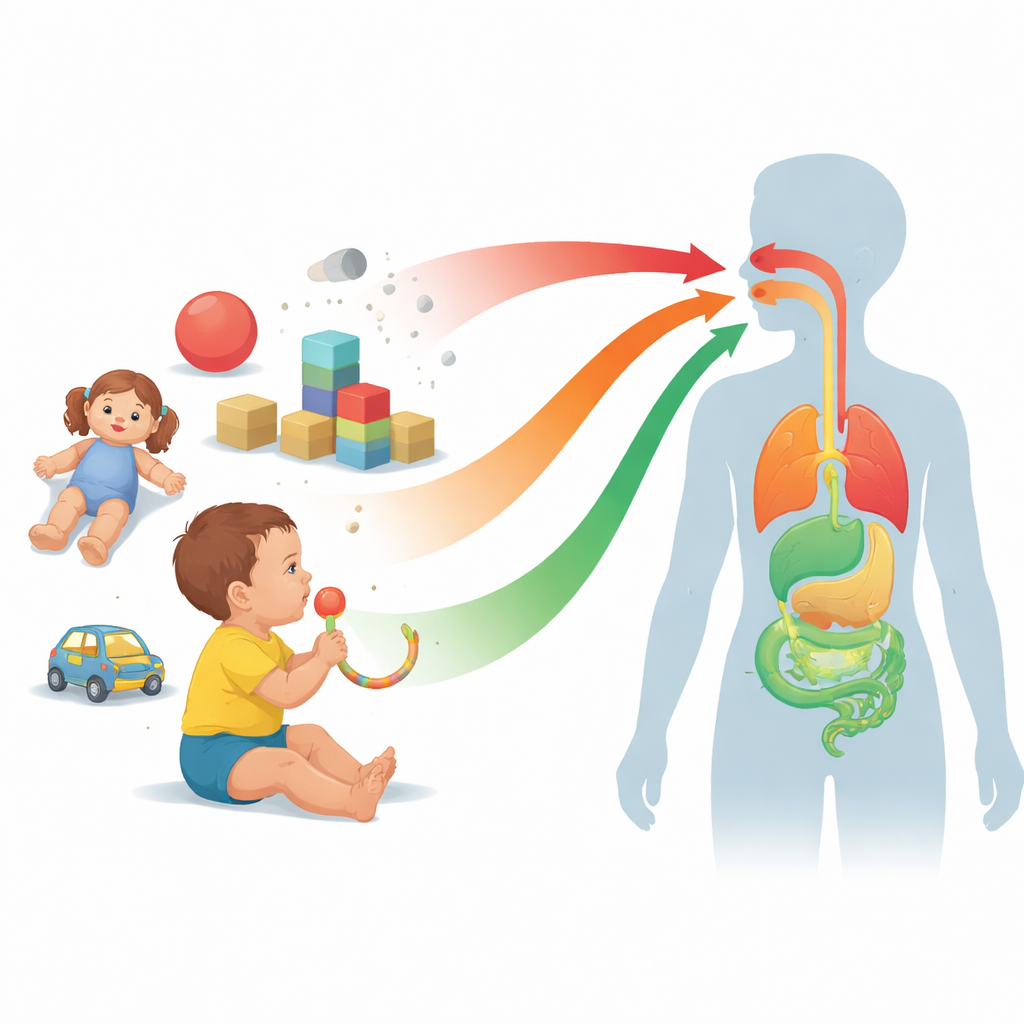
What BPA is and where children meet it
BPA has long been used to make hard, clear plastics and special coatings because it adds strength and heat resistance. It is also an endocrine disruptor, meaning it can interfere with hormones that guide growth and development. While food containers and baby bottles have received a lot of attention, toys remain a quieter source of concern, especially for babies and toddlers who mouth, squeeze, and cuddle toys daily. Companies now sell many BPA free products that use chemical stand ins such as BPS and BPF, but scientists know far less about how much of these alternatives children actually encounter.
How the researchers modeled playtime exposure
Instead of testing a few toys in the lab, the authors used a detailed computer model called USEtox to follow chemicals from toys into a child’s body. They created eight “toy archetypes” that represent broad groups such as teething rings, dolls, balls, foam bath letters, building blocks, toy vehicles, costumes, and marker pens. For each, they combined information on toy materials, typical ages of users, how often children touch or mouth those toys, and how chemicals move from solid plastic into air, dust, skin, and saliva. They assumed a realistic but uniform chemical content of 300 parts per million for BPA and each alternative to compare them on equal terms.
Which toys and play paths matter most
The model shows that not all toys are equal. For BPA itself, the highest daily doses came from teething rings, balls, and dolls, with exposure generally decreasing as children grew older and heavier. Three main paths dominated: direct skin contact, mouthing, and swallowing dust that had picked up chemicals from toy surfaces. For babies using teething rings and foam bath letters, mouthing clearly ruled; for older toddlers and preschoolers playing with balls, dolls, and blocks, skin contact and dust ingestion became more important. The materials used in toys were crucial: simply switching a teething ring from silicone rubber to a different plastic cut the estimated BPA dose by about fivefold.
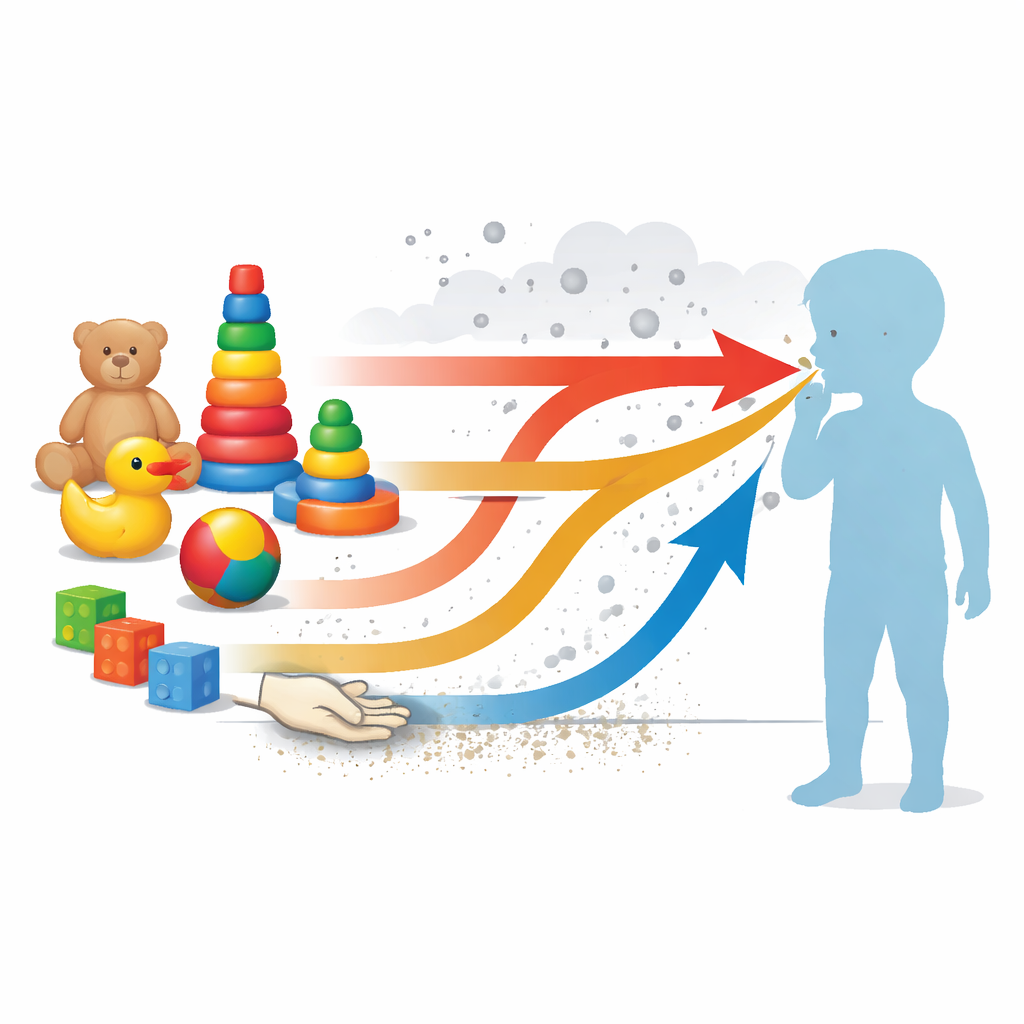
How BPA alternatives compare
When the team ran the same scenarios for eleven BPA substitutes, they found striking differences tied to the chemicals’ physical properties. Some analogs, especially BPF and BPS, produced higher daily exposure than BPA for three to six year olds, even though they were present at the same assumed level in the toys. Others, such as BPAP, BPAF, and BADGE, led to much lower modeled doses. Depending on how easily a chemical moves into air or dust or through skin, different paths took over: for some substitutes inhalation and gas like uptake through skin were key, while for others dust or mouthing dominated. Overall, a child’s total exposure across all toys from six months to eleven years was estimated at about 13.4 milligrams of BPA, with several substitutes yielding even higher totals.
What this means for safety and future choices
To gauge health concerns, the authors compared their exposure estimates for BPA, BPS, BPAF, and BADGE with existing toxicity benchmarks. Typical modeled levels for three to six year olds did not exceed these safety yardsticks, but BPA’s dose for reproductive and developmental effects came within a factor of four, and could surpass the benchmark if toys contained higher BPA levels than assumed. The work also shows that some “BPA free” replacements may not reduce children’s overall exposure and in some cases could increase it. For families and regulators, the takeaway is that toy safety cannot rely on swapping one molecule for another without understanding how it behaves in real play settings. For scientists and policymakers, the study highlights the need for better data on chemical content in toys and for looking beyond chewing alone to include skin, dust, and air when judging the safety of children’s products.
Citation: Huang, L., Nakayama Wong, L., Zhou, X. et al. USEtox modeling of children’s exposures to Bisphenol A (BPA) and alternatives in toys. J Expo Sci Environ Epidemiol 36, 425–437 (2026). https://doi.org/10.1038/s41370-025-00827-6
Keywords: bisphenol A, children’s toys, chemical exposure, endocrine disruptors, BPA alternatives