Clear Sky Science · en
Material characterization of mortars plasters and stones in the Terzi Hasan Eroğlu House Stratonikeia Eskihisar settlement
Why an Old Village House Still Matters Today
In southwestern Türkiye, a modest village house sitting atop an ancient city is helping scientists answer a surprisingly modern question: how do we repair historic buildings without silently damaging them? This study zooms in on the Terzi Hasan Eroğlu House in the Stratonikeia–Eskihisar settlement, analysing tiny fragments of its mortars, plasters, and stones. By understanding exactly how these materials behave—how strong they are, how they handle moisture, and how they were originally made—the researchers provide a practical roadmap for designing repairs that keep historic walls breathing, stable, and authentic.
A Town Built on Top of an Ancient City
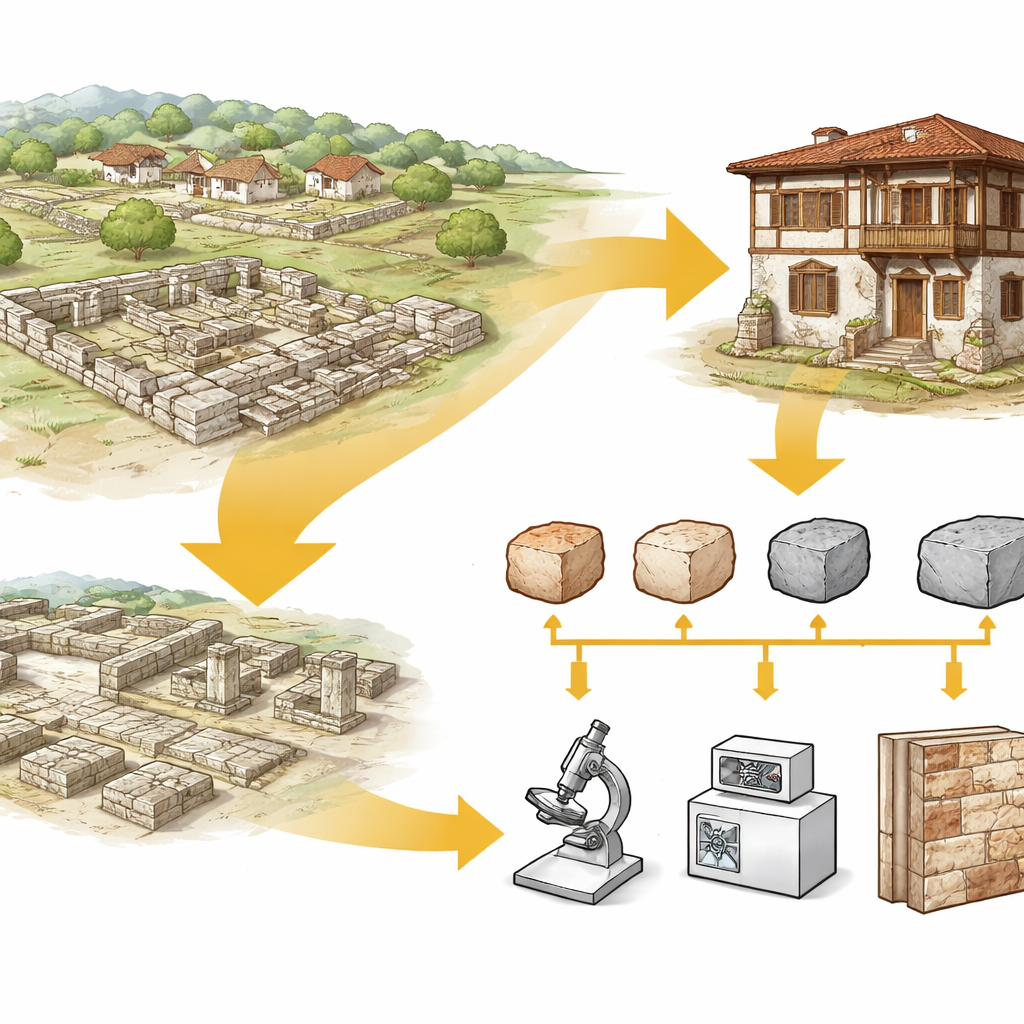
Stratonikeia is an ancient city whose life stretches from the 3rd millennium BC through Hellenistic, Roman, Byzantine, Ottoman, and Republican periods. Over time, a rural settlement, Eskihisar Village, grew directly over its ruins, creating a rare multilayered landscape where ancient theatres, Ottoman baths, and 20th-century houses share the same ground. The Terzi Hasan Eroğlu House and Store, built in 1961 and once home to a family of four, stands at the intersection of old stone-paved roads and the path to the ancient theatre. Its rubble-stone walls, timber elements, and lime-based finishes mirror long-standing regional traditions, making it an ideal case study for how building know-how has been passed down across generations.
What the Walls Are Really Made Of
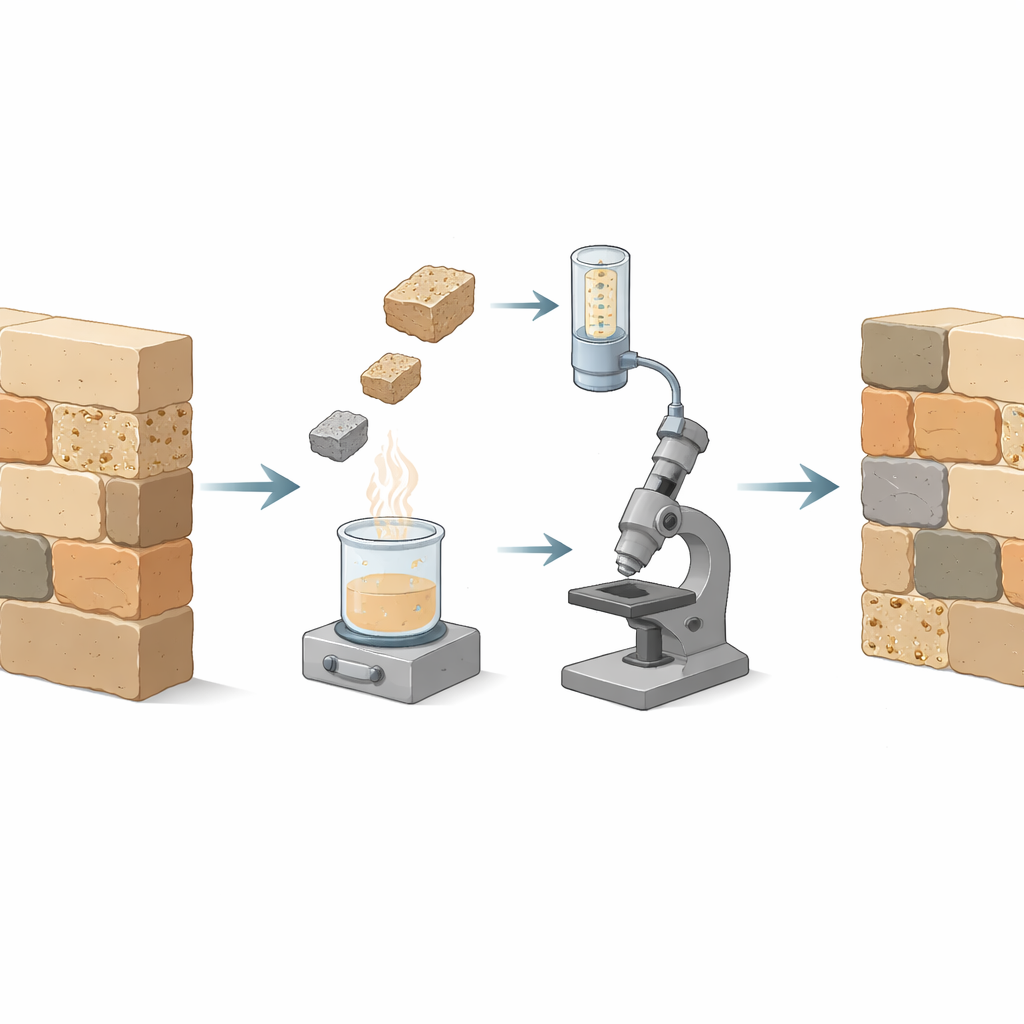
To avoid harming the building, the team collected only fragments that had already detached from walls, joints, and surfaces. In the laboratory, they used a suite of standard tests to probe the materials: heating samples to track weight loss, dissolving them in acid to separate binder from sand, sieving aggregates by size, measuring density and porosity, applying controlled point loads to gauge strength, and examining stones under X-ray and electron microscopes. The results paint a clear picture: the mortars and plasters are lime-based, relatively light, and highly porous, while the stones are dense, calcite-rich limestones with low water uptake. This combination creates a deliberate hierarchy where stones provide strength, while mortars and plasters act as more flexible, breathable layers.
How the Materials Behave in Moisture and Stress
Chemical tests showed that the binders in most samples are rich in calcium carbonate, sometimes with modest amounts of reactive components that help them set in damp conditions. The so‑called hydraulic index values, derived from heating tests, indicate that all mortars and plasters have at least some capacity to harden in the presence of moisture. At the same time, physical measurements reveal high porosity—often over a third of the material volume—and significant water absorption for plasters and mortars. Instead of being a flaw, this “openness” allows historic walls to take in and release moisture, preventing pressure build-up and damage. Mechanical tests confirm that these mixes are intentionally weaker than the stones they bind, so that cracking and movement occur in sacrificial layers rather than in the main structural blocks.
Clues from Stone and Mortar About Past Know-How
Detailed analyses of stone fragments show that the building uses mainly calcitic limestones, very similar to stones known from local ancient quarries. One variety is purer and slightly more porous; another is denser and contains small amounts of quartz and clay minerals, giving it extra compactness. When the team compared their measurements with data from nearby Ottoman baths, mosques, houses, and the ancient theatre, they found striking similarities in density, porosity, aggregate grading, and lime-to-sand ratios. This suggests that early Republican builders in Eskihisar did not abruptly switch to modern cement technology; instead, they continued to rely on lime-based recipes that had long proven effective in the local climate and soils, occasionally adding new ingredients or hybrid mixes in specific spots.
What This Means for Saving Historic Buildings
For non-specialists, the key message is that “stronger” is not always “better” when repairing old walls. The study shows that the original mortars and plasters of the Terzi Hasan Eroğlu House were purposefully made porous, moderately strong, and highly breathable, matching the properties of the surrounding stones and the region’s damp–dry cycles. Introducing very hard, dense, or waterproof repair mortars—especially cement-rich ones—may trap moisture, create hidden stresses, and accelerate decay of the original fabric. By turning detailed lab data into concrete reference values for strength, porosity, and moisture behaviour, this research offers conservation professionals a science-based template for formulating lime-based repair mixes that work in harmony with existing materials. In doing so, it helps ensure that the centuries-long dialogue between landscape, building craft, and everyday life in Stratonikeia–Eskihisar can continue into the future.
Citation: Akbulut, D.E., Varol, R.N. & Dinç-Şengönül, B. Material characterization of mortars plasters and stones in the Terzi Hasan Eroğlu House Stratonikeia Eskihisar settlement. npj Herit. Sci. 14, 224 (2026). https://doi.org/10.1038/s40494-026-02454-2
Keywords: historic mortars, lime-based materials, Stratonikeia Eskihisar, heritage conservation, compatible repair mortars