Clear Sky Science · en
Belonging to a community of European fans? European common in-group identity formation through football fandom
Why football fans matter for Europe
For many people in Europe, football is more than a sport; it is a weekly ritual that shapes friendships, routines, and emotions. This article asks a surprising question: can the shared passion of football fans help people feel that they belong to a wider European community, not just to a club or a country? In a time of political strain and social division, understanding how everyday activities like watching matches might knit people together across borders is of interest to anyone who cares about how societies hold together.
From local club pride to wider circles of belonging
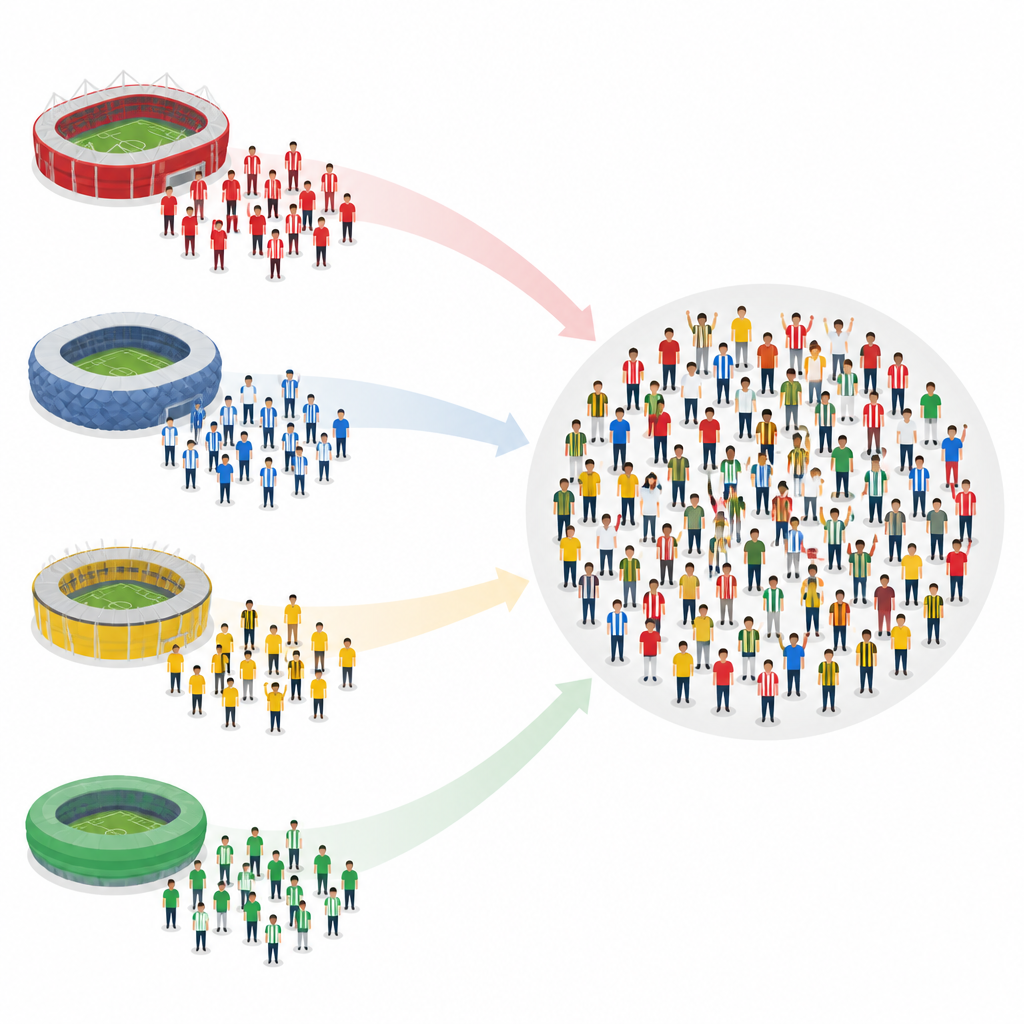
Football fandom has long been tied to strong local and national loyalties. Supporters usually see themselves as part of a club community or as backing a national team at tournaments. Yet modern football exposes fans to much more than their home ground. European club competitions, televised leagues from abroad, and easier travel mean that supporters now watch and meet fans from many countries. The study explores whether these experiences add a new layer of identity, in which people start to see themselves as part of a broader community of European fans on top of their older loyalties.
Testing the idea of a European fan community
To find out, the researcher used an online survey of more than 7000 adults in Germany, Spain, Poland, and Norway, focusing on nearly 3700 who were classed as football fans. Participants rated how strongly they felt part of three groups: fans of their favourite club, fans in their own country, and fans across Europe. They also answered questions about age, gender, education, income, political attitudes, feelings toward Europe, levels of trust in others, and detailed patterns of football consumption, such as watching European competitions or foreign national leagues.
How strong is European fan identity and who feels it most?
The answers show that club identity is still strongest, followed by national identity, but many supporters also feel they belong to a European fan community. About half of the fans gave this European feeling a score of six or higher on a scale from zero to ten, and one in five put it at eight or above. Statistical tests indicate that this is not just an echo of club or national ties but a distinct layer of identity. Younger fans, those with higher levels of education, and those who feel more emotionally attached to Europe are more likely to report a strong European fan identity. General trust in other people and specific trust in unknown European fans are also linked to feeling part of this wider group.
Football habits that bridge borders
Patterns of watching and engaging with football matter as well. Fans who are very interested in football overall, who watch European competitions even when their own club is not playing, and who regularly follow foreign leagues are much more inclined to see themselves as part of a European community of supporters. Those who think that fans across Europe share common interests, should speak with a common voice, and benefit from cross-border fan networks are likewise more likely to feel this bond. Positive views of fans as helpful, trustworthy, and supportive go hand in hand with stronger European identification, whereas critical views of football governance or worries about commercialisation do not seem to weaken this sense of belonging.

What a shared fan identity means for Europe
Overall, the article concludes that a meaningful European fan identity has taken shape alongside club and national loyalties. It grows out of everyday practices like watching international matches, travelling to away games, and following fan debates that cross borders. This identity does not erase older attachments but adds another circle of belonging, helping many supporters see fellow fans from other countries as part of a shared “we.” While the study cannot prove cause and effect, it suggests that football fandom offers one concrete way in which ordinary people may develop a thin but real sense of being part of Europe together, which could support social cohesion during unsettled times.
Citation: Biel, J. Belonging to a community of European fans? European common in-group identity formation through football fandom. Humanit Soc Sci Commun 13, 764 (2026). https://doi.org/10.1057/s41599-026-07782-z
Keywords: football fandom, European identity, social cohesion, sports community, fan culture