Clear Sky Science · en
Visual effect analysis of gates at modern industrial heritage sites in China based on eye-tracking technology and the semantic difference method
Why old factory gates still catch our eye
Across China, many once-bustling factories have fallen silent, but their grand entrance gates still stand as witnesses to a century of change. These gateways do more than mark a boundary; they shape our first impression of a historic site and hint at the stories hidden inside. This study asks a simple question with modern tools: when people look at these old industrial gates, what exactly draws their gaze, and how does that shape what they feel about the place?
Bringing faded gate photos back to life
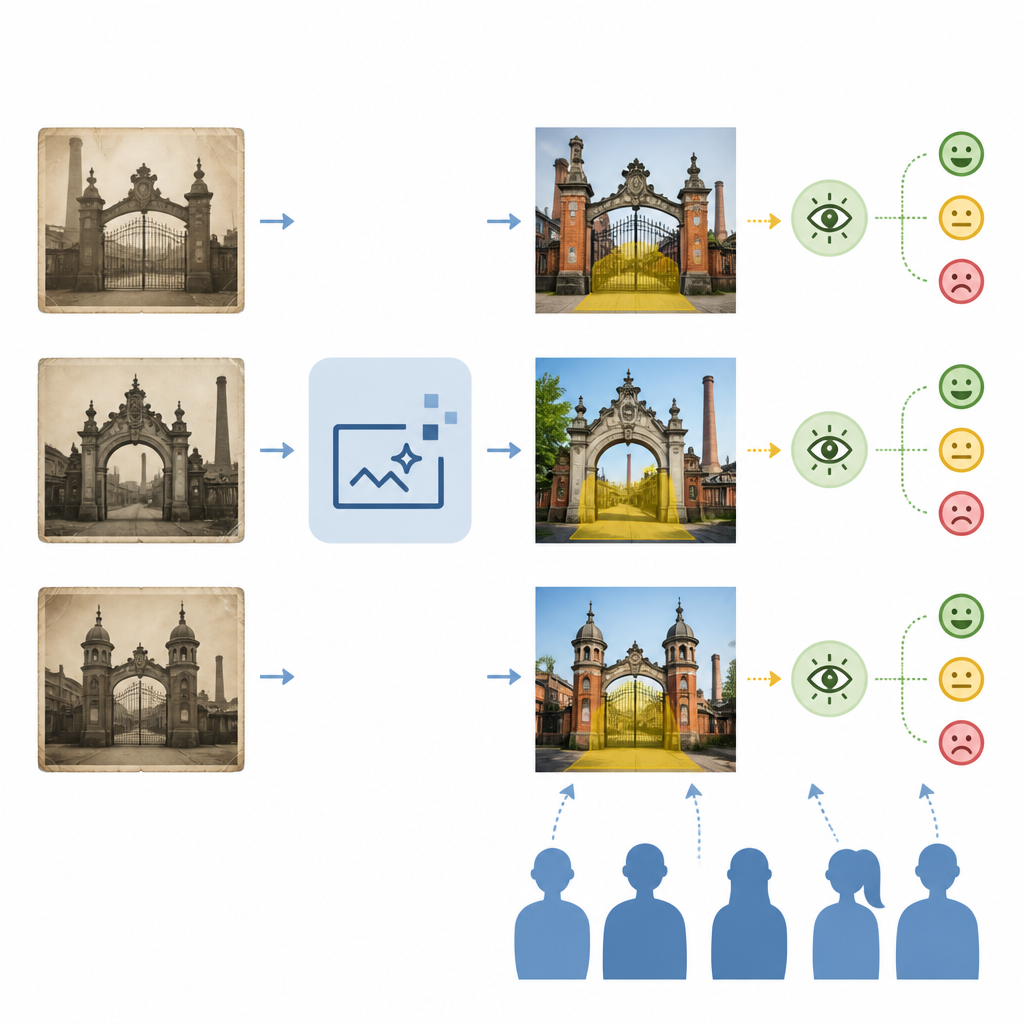
The researchers focused on three famous industrial sites: the Nanjing Jinling Arsenal, the Nantong Zisheng Ironworks, and the Shenyang Arsenal. Surviving photographs of their gates were black-and-white, blurry, and missing detail, which made them hard to use in careful visual tests. To fix this, the team turned to a type of artificial intelligence that can clean and colorize old images. Using a tool called Stable Diffusion, they restored the photos so that carvings, brick textures, and structural lines appeared sharper and more vivid. These refreshed images offered a closer glimpse of how the gates might have looked when they were new, giving a solid base for studying how people react to them today.
Watching where people look and how they feel
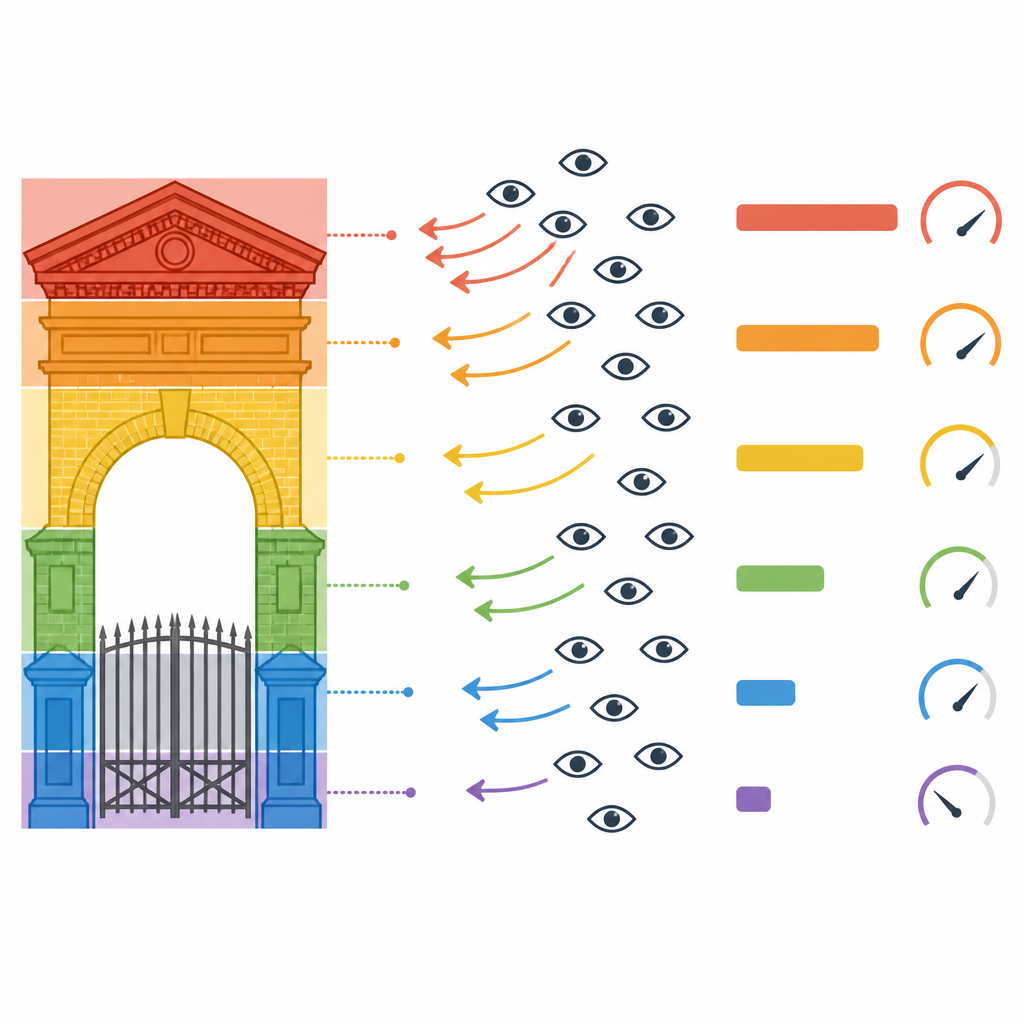
With the images ready, 45 young adults viewed the three gates while wearing an eye-tracking device that recorded exactly where and how long they looked at different parts of each gate. The researchers divided every gate into six areas, including the top triangle, the horizontal beam above the door, the posts, the walls, the arch, and the opening itself. They measured when viewers first looked at each area, how long their eyes stayed, and how often their gaze returned. Afterward, the same people filled out a questionnaire that asked them to rate the gates on simple qualities such as beauty, harmony, simplicity, sense of history, cultural meaning, and how much they stirred personal memories.
What the gates’ details reveal about attention
The results showed a clear pattern: people did not look at every part of the gate equally. Their eyes were drawn first and most strongly to the upper parts, especially the beam above the doorway and the decorative top. These zones often contain rich detail, color contrasts, and signs, so they carry more visual information in a small space. Even after the researchers adjusted the data to account for how large each area was in the picture, the upper elements still held attention longer and more often than plain walls or posts. In contrast, the big doorway opening, though it covers a large area, attracted relatively shallow and brief glances, mostly for quick recognition of the passage rather than careful study.
Linking eye movements to taste and meaning
When the eye-tracking data were compared with the questionnaire scores, the two lined up in revealing ways. The Jinling Arsenal gate, which balances Chinese and Western styles with a central arch, side wings, and a tower-like feature at the top, earned the highest marks for beauty, harmony, and cultural depth. Its heatmap showed a symmetrical band of attention running up the middle, matching people’s sense that the design feels orderly and well-proportioned. The Shenyang Arsenal gate, with its unusual twin towers and layered shapes, pulled viewers into more exploratory looking and was rated richer in elements and “strangeness,” but weaker in local cultural identity. The Nantong gate, plainer and more restrained, was praised for simplicity and a sober historic feel, yet scored lower for fine detail, symbolic power, and memory-evoking impact.
Guiding future care of historic gateways
The study concludes that both the physical size of a gate’s parts and the meaning carried by their details shape visual appeal. Areas that pack more symbols, carvings, or traces of time into a small space are especially powerful in catching and holding attention. By carefully preserving lintels, plaques, decorative tops, and honest signs of weathering, while gently refining background walls and posts, designers and conservators can keep industrial heritage gates visually engaging without erasing their authenticity. In short, how we look at these gateways today can help guide how we protect and present them for tomorrow.
Citation: Li, H., Qi, M., Tao, H. et al. Visual effect analysis of gates at modern industrial heritage sites in China based on eye-tracking technology and the semantic difference method. Humanit Soc Sci Commun 13, 664 (2026). https://doi.org/10.1057/s41599-026-06990-x
Keywords: industrial heritage, eye tracking, historic gates, AI image restoration, visual perception